
Introduction
Few foods represent modern fast-food culture as strongly as the burger.
It is sold in roadside stalls, gourmet restaurants, sports stadiums, airports, and delivery apps across the world. From classic cheeseburgers to plant-based versions, the burger has become one of the most recognizable and commercially successful foods ever created.
But the burger did not begin as a global symbol of convenience food.
Its story includes migration, industrialization, urban growth, mass marketing, and changing lifestyles. The modern burger evolved from older minced-meat traditions, gained identity in the United States, and expanded worldwide through restaurants and popular culture.
This is the history behind the burger craze.
Before the Burger: Minced Meat Traditions
Long before the hamburger sandwich existed, many cultures prepared chopped or minced meat dishes.
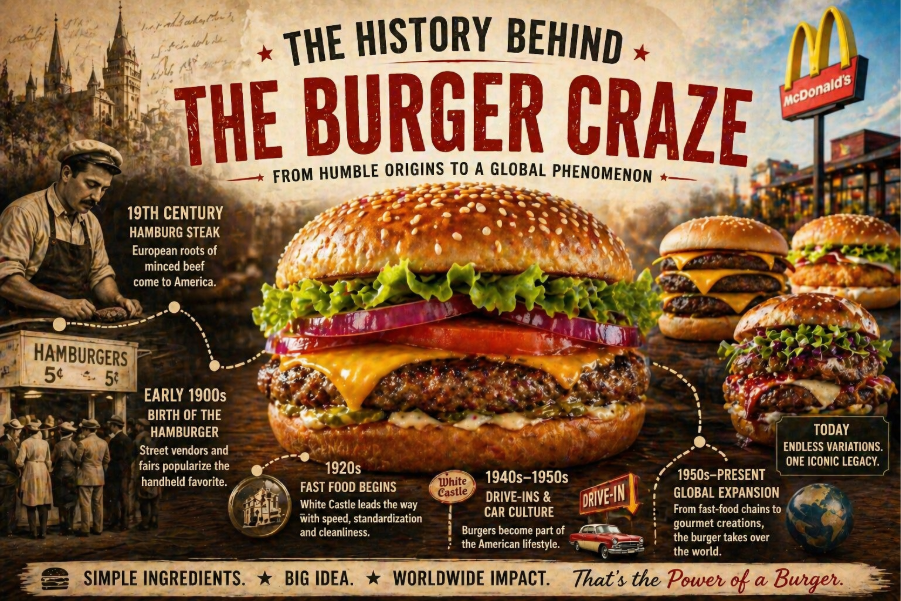
One important influence often cited is the Hamburg steak, associated with the German city of Hamburg. During the 19th century, seasoned minced beef patties were known in Europe and later among immigrants traveling to America.
These dishes were usually served on a plate, not inside bread.
The connection between Hamburg-style minced beef and the later hamburger gave the burger both its name and early identity.
Why the Name “Hamburger”?
Despite common assumptions, the word “hamburger” originally referred to something from Hamburg, not necessarily made with ham.
Just as “Frankfurter” refers to Frankfurt and “Vienna sausage” to Vienna, “Hamburger steak” referred to the Hamburg style.
When the meat patty later began being served inside bread, the term evolved into “hamburger.”
Over time, many people shortened it simply to “burger.”
The American Transformation
The exact inventor of the hamburger sandwich is debated.
Several individuals and regions in the United States have claimed to be first to place a beef patty between bread in the late 19th or early 20th century.
Commonly cited names include:
- Louis Lassen (New Haven, Connecticut)
- Charlie Nagreen (Wisconsin)
- The Menches brothers (Ohio/New York fair circuits)
- Fletcher Davis (Texas)
Because documentation is limited and competing stories exist, historians cannot assign a universally accepted single inventor.
What is clear is that the burger emerged in America during a period when quick, portable meals were becoming increasingly valuable.
Why Burgers Became Popular So Quickly
The burger solved several everyday problems at once.
It was:
- Portable
- Filling
- Relatively affordable
- Fast to cook
- Easy to standardize
- Convenient to eat without full table service
In growing industrial cities, workers needed quick meals that fit busy schedules.
The burger matched modern urban life perfectly.
The Role of the 1904 St. Louis World’s Fair
Although some claims are debated, the 1904 St. Louis World’s Fair is often associated with helping popularize the hamburger nationally.
Large fairs exposed visitors to regional foods and emerging trends.
Whether or not it “invented” the burger, this era helped spread public familiarity with it.
White Castle and Standardization
A major turning point came in 1921 with the founding of White Castle in Wichita, Kansas.
White Castle helped professionalize burger sales through:
- Clean, visible kitchens
- Standardized portions
- Consistent pricing
- Rapid service
- Strong branding
This mattered because ground beef once faced public skepticism around sanitation and quality.
White Castle helped make burgers appear reliable and modern.
Many historians consider it one of the first major fast-food burger chains.
The Rise of Drive-In and Car Culture
As automobile ownership expanded in the mid-20th century, burgers became linked with American mobility.
Drive-ins and roadside diners made burgers ideal for:
- Travelers
- Families
- Teen social culture
- Quick suburban meals
The burger was no longer just city worker food—it became part of leisure culture.
McDonald’s and Global Scale
Few events changed burger history more than the expansion of McDonald’s in the mid-20th century.
The company refined systems around:
- Speed
- Efficiency
- Franchising
- Consistent menus
- Global branding
This helped transform the burger into an international symbol of modern convenience food.
Other chains followed globally, expanding burger culture even further.
From Fast Food to Gourmet Food
By the late 20th and early 21st centuries, burgers evolved again.
Restaurants began offering:
- Premium beef blends
- Artisan buns
- Regional cheeses
- Specialty sauces
- Vegetarian and vegan patties
- Health-focused alternatives
The burger proved adaptable across price levels and dietary preferences.
It could be inexpensive street food or upscale dining.
Few foods have that range.
Why the Burger Craze Endures
The burger remains popular because it combines several rare strengths:
- Familiar flavor profile
- Quick preparation
- Customizable ingredients
- Shareable brand appeal
- Strong comfort-food identity
- Works for dine-in, takeaway, and delivery
It also fits modern lifestyles shaped by speed and convenience.
Criticism and Reinvention
The burger craze has also faced criticism around:
- Nutrition concerns
- Ultra-processed food culture
- Environmental impact of meat production
- Portion inflation
These concerns have driven innovation such as:
- Plant-based burgers
- Leaner proteins
- Smaller portions
- Sustainable sourcing
The burger continues to evolve with public values.
Final Thoughts
The burger craze did not happen by accident.
It grew from older meat traditions, found perfect timing in industrial America, scaled through branding and fast-food systems, and adapted to global tastes.
What began as a practical handheld meal became one of the most influential foods in modern culture.
From lunch counters to luxury menus, the burger remains more than food.
It is a symbol of convenience, reinvention, and mass appeal.