
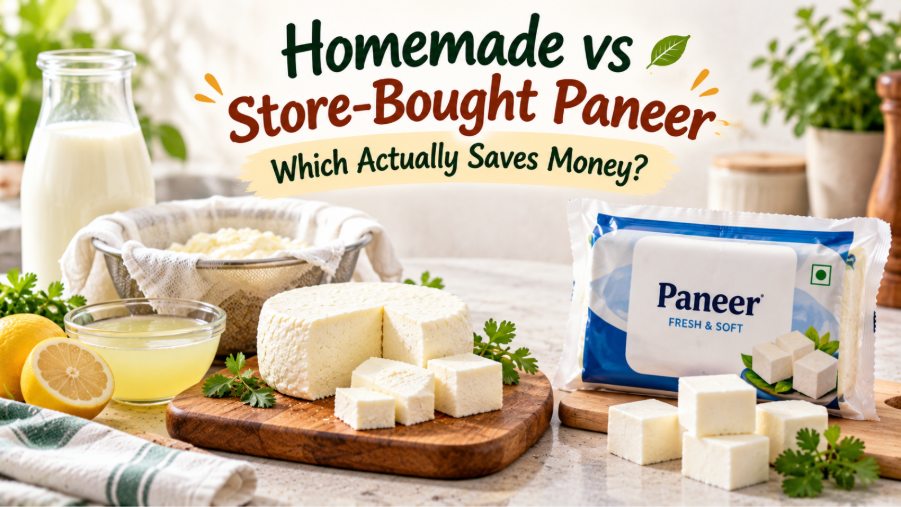
The homemade vs store-bought paneer debate is about more than just price. You need to consider how much paneer one litre of milk produces, the cost of ingredients, protein content, preparation time, and what you can do with the leftover whey.
Paneer is a staple in many Indian kitchens, appearing in everything from paneer bhurji and palak paneer to protein-rich salads and post-workout meals. But have you ever wondered whether making paneer at home is actually cheaper than buying a ready-made packet?
Making paneer at home sounds economical, but the savings depend on the milk you choose and the quantity you obtain. Let’s compare both options using a simple kitchen experiment and realistic cost calculations.
Homemade vs Store-Bought Paneer: The Cost Comparison
To compare prices fairly, we need to calculate the cost of producing a similar quantity of paneer at home and buying it from a store.
For this example, assume that one litre of full-fat milk costs ₹62 and that lemon juice or another food-grade acid costs approximately ₹3 per batch. These are illustrative figures, not guaranteed prices for every Indian city or shop.
Recent online grocery listings provide a useful reference point: several regular paneer products are listed at approximately ₹95–₹100 for 200 grams, although prices vary by brand, location, and offer.
| Cost factor | Homemade paneer | Store-bought paneer |
| Main ingredient | 1 litre of milk | Ready-made paneer |
| Illustrative milk cost | ₹62 | Included in purchase price |
| Acid or lemon juice | ₹3 | Included |
| Total direct cost | ₹65 | ₹95–₹100 for 200 g |
| Final paneer quantity | Depends on milk and preparation | 200 g as labelled |
| Preparation time | Around 30–45 minutes, including heating and draining | Minimal |
| Leftover whey | Available | Usually not available separately |
The homemade cost does not include electricity or gas, equipment, and your time. More importantly, one litre of milk will not always produce 200 grams of paneer.
How much paneer can one litre of milk produce?
Milk composition has a major effect on paneer yield. Dairy technology references report typical yields of around 16–18% for cow’s milk and 20–22% for buffalo milk under relevant processing conditions. Actual results vary with fat content, heating, acidity, draining, and pressing.
For a practical home experiment, you could use these approximate planning ranges:
- Cow’s milk: around 160–180 g of paneer per litre.
- Buffalo’s milk: around 200–220 g per litre.
These are estimates, not guaranteed yields. Your actual result may differ.
Using the illustrative ₹65 batch cost, the cost of 200 grams of paneer would be approximately:
- At a yield of 170 g: ₹76.47 per 200 g.
- At a yield of 200 g: ₹65 per 200 g.
- At a yield of 220 g: ₹59.09 per 200 g.
By comparison, store-bought paneer priced at ₹95–₹100 per 200 grams costs more in this example.
The initial verdict: Homemade paneer can be cheaper, but the amount you obtain from your milk determines how much you actually save.
A Simple Kitchen Experiment to Test the Savings
Instead of relying only on estimates, conduct a small experiment at home. It will help you calculate the cost of your own paneer using the milk available in your area.
What you need
- 1 litre of full-fat cow’s milk
- Lemon juice or another suitable food-grade acid
- A saucepan
- A clean muslin cloth or fine strainer
- A kitchen weighing scale
- A bowl for collecting whey
Step 1: Record the ingredient cost
Write down the actual price of one litre of milk and the approximate amount of lemon juice used.
For example:
| Ingredient | Cost |
| 1 litre of milk | ₹62 |
| Lemon juice | ₹3 |
| Total direct cost | ₹65 |
Replace these figures with your local prices.
Step 2: Prepare the paneer
- Heat the milk until it is just below or at a gentle boil.
- Reduce or switch off the heat.
- Add lemon juice gradually, stirring gently, until the milk separates into curds and greenish-yellow whey.
- Allow the separation to finish.
- Strain the curds through a clean muslin cloth.
- Drain and press the curds until the paneer reaches your preferred texture.
- Weigh the finished paneer.
Add the acid gradually rather than pouring in a large amount at once. Excess acid can affect the taste and texture. The Indian government’s consumer guidance also describes gradual acid addition and straining as key steps in paneer preparation.
Step 3: Calculate your cost per 200 grams
Use this formula:
Cost per 200 g = Total batch cost ÷ Paneer yield in grams × 200
Suppose your ingredients cost ₹65 and you obtain 175 grams of paneer.
₹65 ÷ 175 × 200 = ₹74.29 per 200 grams
If the store-bought alternative costs ₹95 for 200 grams, your estimated saving is:
₹95 − ₹74.29 = ₹20.71 per 200 grams
Remember that this calculation excludes fuel or electricity, equipment, and labour. It also assumes that the paneer you make is comparable to the product you buy.
Step 4: Compare texture and taste
Cost is only one part of the experiment. Try both types in the same recipe, such as paneer bhurji or a simple paneer stir-fry.
Compare:
- Softness and moisture
- Crumbliness
- Taste and acidity
- How well the paneer holds its shape
- Cooking performance
Use the same recipe and cooking time for both samples. That makes the comparison fairer.
Is Homemade Paneer Better for Protein?
Paneer is a useful source of protein, but its nutritional composition varies according to the milk and preparation method.
For example, the fat and protein content of paneer depend on the original milk composition, the amount of moisture retained, and how much milk protein is recovered during processing.
This means you should not assume that every homemade paneer has the same protein content as every packaged product.
Read the nutrition label
For packaged paneer, check the nutrition information per 100 grams. Compare:
- Protein
- Calories
- Total fat
- Saturated fat
- Serving size
Some products are specifically formulated to contain more protein or less fat than conventional paneer. A regular homemade version may not match those products nutritionally.
If you make paneer at home, its exact nutritional value will be difficult to establish without a laboratory analysis. You can estimate it from the milk used, but the amount of water retained and the nutrients lost in the whey make precise calculations difficult.
What about protein per rupee?
If your main goal is to get more protein for your money, compare the protein content and price together.
Use this formula:
Cost per 10 g of protein = Price per 100 g ÷ Protein per 100 g × 10
For instance, if a product costs ₹50 per 100 grams and contains 18 grams of protein per 100 grams, the calculation is:
₹50 ÷ 18 × 10 = ₹27.78 per 10 g of protein
This example is hypothetical. Use the actual price and nutrition label of the product you are considering.
The cheapest paneer by weight is not necessarily the cheapest source of protein. Comparing protein per rupee gives you a more useful result.
The Hidden Bonus: Don’t Waste the Whey
One advantage of making paneer at home is that you can collect the liquid left after separating the curds. This liquid is called whey.
It may look like waste, but it can contain water-soluble milk components, including some proteins and lactose. Its composition depends on the milk and the paneer-making process.
You can use suitable leftover whey in several ways:
- Add it to roti or chapati dough.
- Use it as part of the liquid in dal.
- Add it to soups.
- Use it in suitable bread or baking recipes.
These are established uses for paneer whey.
However, do not treat whey as a protein supplement with a guaranteed protein content. The amount of protein remaining in it varies, and it is not nutritionally equivalent to a concentrated whey protein powder.
Store leftover whey safely in a clean, covered container in the refrigerator and use it promptly. Discard it if it develops an unusual smell, appearance, or other signs of spoilage.
When Is Store-Bought Paneer Worth the Extra Cost?
Homemade paneer may save money, but it also requires preparation, cleaning, and planning. Store-bought paneer can be a sensible choice when convenience matters more than the potential savings.
Choose homemade paneer when:
- You regularly use paneer in your meals.
- Milk is reasonably priced in your area.
- You can obtain a good yield from your milk.
- You enjoy preparing food at home.
- You can use the leftover whey instead of discarding it.
Choose store-bought paneer when:
- You need paneer immediately.
- You have limited time for cooking.
- You use paneer only occasionally.
- You want a specific nutritional profile, such as a labelled high-protein product.
- You prefer the consistency and convenience of a packaged product.
When buying packaged paneer, check the ingredient list, nutrition label, storage instructions, and expiry or use-by date. Purchase from a reliable retailer and keep the product refrigerated according to its instructions.
Homemade paneer also needs prompt refrigeration and careful handling. Freshly prepared food is not automatically safe to leave at room temperature for extended periods.
How Much Could You Save in a Month?
Let’s use the earlier example to estimate potential monthly savings.
Assume:
- Homemade paneer costs ₹74.29 per 200 g, based on a ₹65 batch yielding 175 g.
- Store-bought paneer costs ₹95 per 200 g.
- You use 200 g of paneer twice a week.
Your estimated saving per 200 g is ₹20.71.
At two servings per week, the estimated monthly saving over four weeks would be:
₹20.71 × 2 × 4 = ₹165.68 per month
Over 12 months, using the same simplified four-weeks-per-month assumption, that would be approximately ₹1,988.
These figures are illustrations, not guaranteed savings. They exclude energy, equipment, and labour costs and assume the same prices and yield throughout the year. Your actual savings could be lower or higher.
For a more accurate estimate, repeat the kitchen experiment two or three times, record the average yield, and compare it with the current price of the store-bought product you normally purchase.
Final Verdict: Homemade or Store-Bought?
The homemade vs store-bought paneer comparison has no single answer for every household.
Homemade paneer can be more economical when milk is affordable, the yield is good, and you use the paneer and leftover whey efficiently. Store-bought paneer offers convenience and makes it easier to compare products with declared nutritional information.
If you regularly cook paneer dishes, try the one-litre experiment before deciding. Record your milk cost, finished paneer weight, and preparation expenses. Then compare your actual cost per 200 grams with the price of your preferred packaged brand.
The best choice is the one that fits your budget, schedule, cooking habits, and nutritional needs—not simply the one with the lowest price tag.