
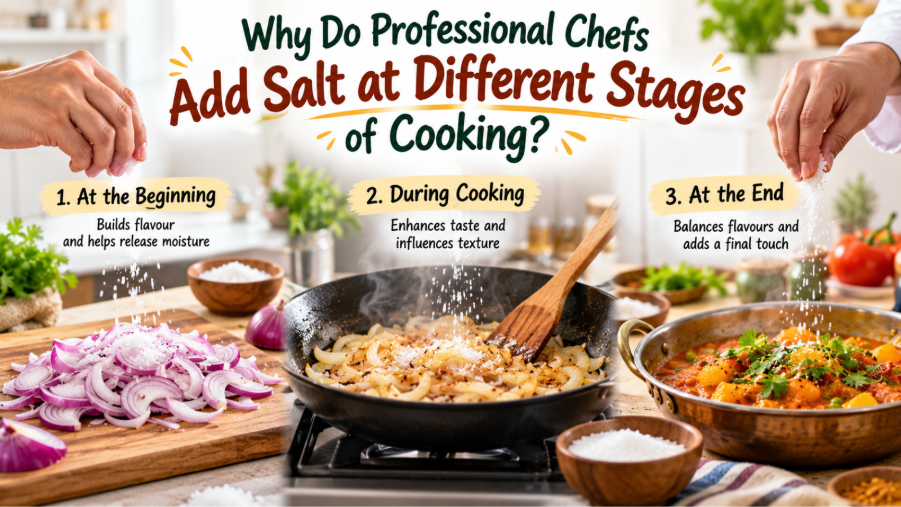
Why chefs add salt at different stages of cooking is all about flavour, moisture, and texture. Salt does more than create a salty taste. It enhances other flavours, draws moisture from certain ingredients, and helps distribute seasoning throughout a dish.
Have you noticed how professional chefs add salt at different times? They might season onions at the beginning, add salt to vegetables halfway through cooking, and adjust the seasoning just before serving.
Understanding this simple technique can improve everyday meals, from Indian dal and vegetable curry to biryani, soup, and omelettes. Let’s explore the science behind salt timing and try a simple onion experiment at home.
Why Chefs Add Salt at Different Stages of Cooking
Salt is primarily sodium chloride. When dissolved in food, it influences how we perceive sweetness, bitterness, acidity, and other flavours. In suitable amounts, it can make ingredients taste more balanced and bring their natural flavours into focus.
However, salt does not behave identically in every dish. Its effect depends on the ingredient, the amount of moisture present, the cooking method, and how long the food cooks.
Professional chefs generally add salt at different stages for four reasons:
- To build flavour: Early seasoning gives salt time to dissolve and distribute through the ingredients.
- To influence moisture: Salt draws water from many ingredients, including sliced vegetables.
- To control the final taste: Seasoning throughout cooking helps prevent bland patches and excessive saltiness.
- To finish a dish: A final adjustment can balance the flavours after cooking and evaporation are complete.
This is why experienced cooks often season gradually, taste their food, and adjust the amount as they go.
1. Adding Salt at the Beginning: Building the Flavour Foundation
Think about making an Indian curry.
You heat oil, add whole spices, and cook onions until they soften and turn golden. You then add ginger, garlic, tomatoes, ground spices, and eventually water or another cooking liquid.
If you add a small amount of salt while the onions are cooking, it can encourage moisture to move out of the onion pieces. This may help them soften, although the exact effect depends on the quantity of salt, the heat, and the cooking method.
Early seasoning also allows salt to dissolve into the ingredients and liquid as the curry develops.
What happens if you wait until the end?
The curry can still taste good, but you may need to stir more thoroughly and allow time for the salt to distribute. A final sprinkle is not necessarily a substitute for seasoning throughout a long cooking process.
Consider a simple vegetable curry. The onions, tomatoes, vegetables, and cooking liquid each contribute different flavours. Adding a little salt at suitable stages helps you assess the combined flavour as the dish develops.
Try this: The next time you prepare a curry, add a small amount of salt while cooking the onions. Add the remaining salt gradually as the other ingredients cook, tasting before each addition.
Remember that this is about distributing the total amount more effectively—not automatically using more salt.
2. Adding Salt During Cooking: Managing Moisture and Texture
Salt can change the way ingredients release moisture. This is particularly noticeable when cooking vegetables.
For example, when you salt sliced onions, they may release water. This can help them soften, but excessive surface moisture can temporarily slow browning because energy is being used to evaporate that water.
That does not mean salting onions early is always wrong. If your goal is to soften onions for a curry, early salting may be useful. If you want deeply browned onions, manage the heat, pan crowding, and moisture carefully.
What about mushrooms?
Mushrooms contain a large amount of water. When salt is added, moisture can move to their surfaces. Depending on the pan temperature and cooking technique, this may affect how quickly they brown.
For well-browned mushrooms, use a sufficiently hot pan, avoid overcrowding, and allow excess moisture to evaporate. You can experiment with salting at the beginning versus later in the cooking process.
The important lesson is that salt timing should match the texture you want. The best approach for soft onions may not be the best approach for crisp vegetables or browned mushrooms.
3. Why Chefs Salt Meat Before Cooking
Professional cooks often season meat before it reaches the pan or grill. This gives salt time to interact with the surface and, when allowed sufficient time, distribute more deeply into the meat.
Salt initially draws some moisture toward the surface. Over time, that moisture can dissolve the salt, and some of the resulting salty liquid can move back into the meat.
This is one reason advance seasoning can be useful for steaks, roasts, and other larger cuts. Salt also affects the behaviour of meat proteins, particularly in brining and certain processed meat preparations.
Does salting meat immediately before cooking work?
Yes. Salting immediately before cooking can still season the surface effectively.
The more problematic situation is not simply salting meat before cooking. It is assuming that every timing choice produces the same result.
For instance, meat salted well in advance has more time for the salt and moisture to redistribute. Meat salted at the last moment has less time for those changes to occur.
Practical tip: For a steak or similar cut, either season shortly before cooking or season sufficiently in advance and refrigerate it safely. Avoid leaving meat at room temperature for extended periods just to give the salt more time.
4. Why Pasta Water Is Salted Before the Pasta Goes In
Pasta provides one of the clearest examples of timing salt for a specific purpose.
When dry pasta cooks in salted water, it absorbs some of that water and the salt dissolved in it. This helps season the pasta itself rather than relying entirely on the sauce to provide flavour.
If you cook pasta in unsalted water and add salt only to the sauce, the result can still be delicious. However, the pasta itself will have received less seasoning during cooking.
The purpose of salting pasta water is primarily flavour—not significantly speeding up cooking. The small amount of salt typically used raises water’s boiling point by too little to make a meaningful difference to cooking time.
Does the same principle apply to Indian rice?
The general principle applies to rice cooked in water: salt can season the grains as they absorb liquid.
For pulao or biryani, cooks may season the cooking liquid before or during the addition of rice, depending on the recipe. The final amount should account for other salty ingredients, such as stock, spice mixtures, or previously seasoned meat.
For absorption-style cooking, remember that the salt added to the liquid will generally remain in the finished dish. Start with a measured amount, particularly if the recipe includes other sources of sodium.
5. Why Chefs Season Soups, Curries, and Dal in Stages
Long-cooking dishes change as they cook.
Water evaporates, ingredients soften, spices release flavour, and the balance between acidity, sweetness, and savouriness develops. Because of these changes, the amount of salt that tastes appropriate at the beginning may not be right at the end.
Imagine preparing a tomato-based curry.
At the start, you add salt to the onions and tomatoes. Later, you add water and simmer the curry. As the liquid reduces, the concentration of salt increases. If you add a large amount at the beginning and then cook the dish down considerably, the final result may become too salty.
This is why chefs often season in stages:
- Add a modest amount while building the base.
- Taste after adding the main ingredients and liquid.
- Reassess the seasoning as the dish cooks.
- Make the final adjustment after the consistency is right.
The same principle applies to dal, soups, gravies, and slow-cooked dishes. Professional cooks build flavour gradually while accounting for changes in volume and the salt already present in their ingredients.
A useful tip for Indian cooking
When preparing dal, remember that the water may reduce during simmering. If you plan to finish the dal with salted butter, stock, or another salty ingredient, leave room for that contribution.
Taste the dal after it reaches the consistency you intend to serve. Adjust the seasoning then rather than trying to predict the final concentration at the beginning.
6. Why Some Chefs Add Salt at the Very End
Finishing salt serves a different purpose from salt dissolved into a cooking liquid.
A small sprinkle of salt on freshly cooked vegetables, roasted potatoes, or a finished dish can create noticeable salty points on the surface. The crystals may also provide a slight textural contrast, depending on the type of salt used.
This can make the first bite taste different from a dish in which the same amount of salt has dissolved completely throughout.
However, finishing salt is not necessary for every recipe. A dal, stew, or curry generally benefits more from balanced seasoning throughout than from a salty layer sprinkled on top.
When finishing salt works well
Consider using a small finishing sprinkle for:
- Roasted vegetables
- Grilled corn
- Fresh tomato salads
- Roasted potatoes
- Certain breads and savoury pastries
Choose a salt appropriate for the dish and use it sparingly. Large crystals and fine table salt have different volumes by weight, so a teaspoon of one type may not contain the same amount of salt as a teaspoon of another.
The aim is to enhance the dish, not make it taste overwhelmingly salty.
7. A Simple Kitchen Experiment: Does Salt Timing Change the Result?
You do not need a professional kitchen to explore the science of salt. A small experiment with onions is enough to demonstrate why timing can matter.
What you need
- Two small onions of similar size
- Two similar pans
- Cooking oil
- Salt
- A kitchen timer
- A plate for each sample
Experiment A: Salt at the beginning
- Slice one onion into pieces of similar thickness.
- Heat a measured amount of oil in the first pan.
- Add the onion and a small, measured quantity of salt.
- Cook at medium heat, stirring at regular intervals.
- Record the time needed for the onion to soften and begin browning.
Experiment B: Salt later
- Slice the second onion to a similar thickness.
- Heat the same amount of oil in the second pan.
- Add the onion without salt.
- Cook at the same heat, stirring at the same intervals.
- Add the same quantity of salt at a predetermined time.
- Record the cooking time and observe the changes.
What should you observe?
Look for differences in:
- How quickly the onions soften
- The amount of visible liquid in the pans
- How easily the onions brown
- The final colour and texture
- The taste of each sample
Keep the onion quantity, pan size, heat, oil, and stirring pattern as consistent as possible.
Repeat the experiment if you can. One trial may be influenced by differences in onion moisture or pan temperature.
Do not assume that one method will always win. Early salt may encourage moisture release and softening, while the resulting moisture may temporarily slow browning. The outcome depends on the cooking conditions and the result you want.
This experiment demonstrates an important point: cooking advice works best when you understand the purpose behind it.
8. The Most Important Rule: Taste Before Adding More Salt
Although salt timing matters, there is no universal rule that says every dish must be salted at exactly three different stages.
Some recipes need early seasoning and a final adjustment. Others require more precise measurements, particularly baking. Dishes containing soy sauce, cheese, stock, pickles, or other salty ingredients need special care.
Salt also contributes sodium to your diet. The World Health Organization recommends that adults consume less than 2,000 mg of sodium per day, equivalent to less than 5 g of salt from all sources. This includes salt already present in foods, not just the salt added during cooking.
A practical approach is to add modest amounts, taste as the food develops, and account for ingredients that already contain salt. You do not need to make food excessively salty to bring out its flavour.
Final Verdict: Why Do Professional Chefs Add Salt at Different Stages?
The reason professional chefs add salt at different stages of cooking is simple: salt performs different jobs depending on when and how it is used.
Early seasoning helps establish the flavour foundation. Salt during cooking can influence moisture and texture. Seasoning meat in advance gives salt time to redistribute. Salted cooking water seasons pasta and grains, while a final adjustment helps balance the completed dish.
The best timing depends on the ingredient and the result you want. Instead of following a rigid rule, observe how your food changes, taste it throughout cooking, and adjust carefully.
Try the onion experiment in your own kitchen. Once you see how timing influences moisture and browning, you will have a better understanding of why professional chefs treat salt as a cooking tool rather than merely a finishing touch.