
Foods That Built Empires and Changed the World are far more than ingredients found in kitchens and marketplaces. Throughout history, food has shaped civilizations, determined the fate of kingdoms, inspired explorers to cross dangerous oceans, and transformed global economies. Long before oil became the world’s most valuable commodity, salt was worth its weight in gold. Before modern banking systems existed, spices served as symbols of wealth, and tea became powerful enough to spark revolutions.
Every civilization has a story, and behind almost every great empire lies a food that made its growth possible. Whether it was wheat feeding the first cities, rice sustaining vast Asian populations, or potatoes preventing famine across Europe, food has quietly influenced the direction of human history for thousands of years.
Today, these foods are everyday staples found in supermarkets and kitchens across the globe. Yet behind each ingredient lies an extraordinary journey of innovation, trade, conquest, survival, and cultural exchange. In this article, we’ll explore the remarkable foods that helped build empires, shaped civilizations, and continue to influence the world we live in today.
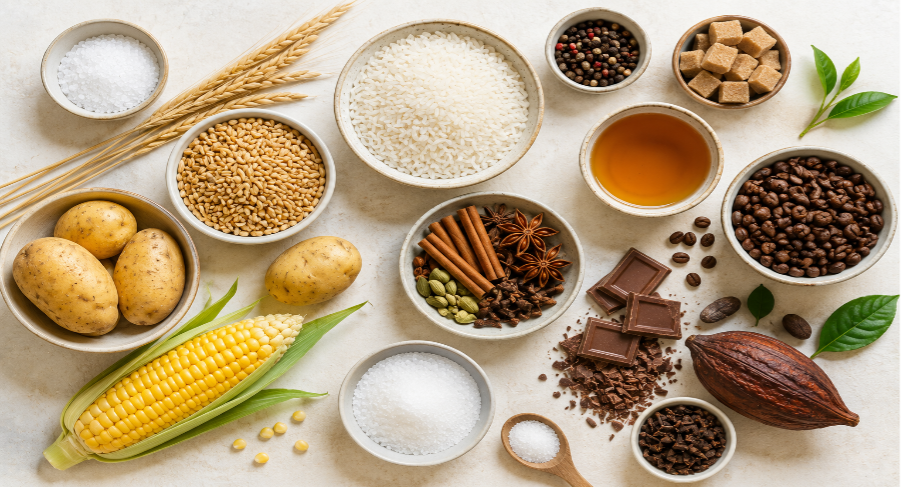
How Food Became the Foundation of Civilizations
Long before governments established borders and currencies, food determined where people settled and how societies developed. Early humans followed seasonal food sources, but agriculture changed everything. Once communities learned to cultivate crops and domesticate animals, they could settle permanently, build villages, and eventually create thriving cities.
Reliable food supplies allowed populations to grow, leading to advances in architecture, science, writing, trade, and governance. Food surpluses also encouraged specialization, enabling people to become artisans, merchants, scholars, and soldiers instead of spending every day searching for meals.
As civilizations expanded, food became a valuable trading commodity. Entire economies were built around transporting grains, spices, tea, coffee, and sugar across continents. Merchant routes connected distant cultures, exchanging not only ingredients but also languages, religions, technologies, and traditions.
1. Salt – The White Gold That Built Empires
Today, salt sits quietly on dining tables, but for thousands of years it was among the world’s most valuable resources.
Before refrigeration, salt preserved meat, fish, vegetables, and dairy products, making long-distance travel and military campaigns possible. Without salt, armies could not march for extended periods, and traders could not transport food over vast distances.
Ancient Egypt used salt during the mummification process, while the Roman Empire constructed extensive trade routes dedicated to transporting this precious mineral. One of these roads, the Via Salaria, literally means “Salt Road.”
Salt became so valuable that workers and soldiers were sometimes paid with it. This historical practice is believed to have contributed to the English word “salary.”
Salt also created enormous wealth through taxation. Governments imposed heavy taxes on salt production and distribution, generating significant revenue but also causing widespread public dissatisfaction. In France, the unpopular salt tax, known as the Gabelle, became one of the many grievances leading to the French Revolution.
2. Wheat – The Grain That Built Cities
Wheat transformed human civilization more profoundly than almost any other crop.
Originating in the Fertile Crescent around 10,000 years ago, wheat enabled early humans to transition from nomadic lifestyles to permanent settlements. Reliable harvests meant stable food supplies, encouraging population growth and the rise of organized societies.
Ancient civilizations such as Mesopotamia, Egypt, Greece, and Rome relied heavily on wheat as a dietary staple. Bread became not only an essential food but also a symbol of prosperity and political stability.
Governments recognized wheat’s importance and established granaries to store surplus harvests. During poor growing seasons, these reserves prevented famine and maintained social order.
Roman leaders understood that feeding citizens was essential for maintaining political support, giving rise to the famous phrase “bread and circuses.”
Suggested Outbound Link: Food and Agriculture Organization (FAO) – History of Agriculture
3. Rice – Feeding Ancient Kingdoms and Modern Nations
Rice has nourished civilizations for more than 8,000 years and continues to feed over half of the world’s population today.
Unlike many grains, rice thrives in flooded fields, allowing farmers to cultivate it intensively across large regions of Asia. Sophisticated irrigation systems developed in China, India, Japan, Thailand, and Southeast Asia demonstrated remarkable engineering skills centuries before modern technology.
Rice cultivation supported enormous populations, enabling powerful kingdoms to flourish. Its consistent yields contributed to economic stability, military strength, and urban development throughout Asia.
Today, rice remains deeply connected to cultural traditions, religious ceremonies, and national cuisines across dozens of countries.
4. Spices – The Treasure That Changed Global Trade
Few commodities have influenced history as dramatically as spices.
Black pepper, cinnamon, cloves, nutmeg, cardamom, and saffron were once worth fortunes. European nobles viewed these ingredients as symbols of luxury and status, while merchants risked dangerous journeys to obtain them.
The spice trade connected Asia, Africa, the Middle East, and Europe for centuries. Arab merchants controlled many early trade routes, making spices both scarce and expensive in Europe.
The enormous profits encouraged explorers to search for direct sea routes to Asia. Vasco da Gama reached India by sea in 1498, dramatically altering international commerce. Christopher Columbus also hoped to find a western route to Asia’s spice markets but instead encountered the Americas.
The competition for spices contributed to colonization, naval expansion, and the creation of powerful trading companies such as the Dutch East India Company and the British East India Company.
Encyclopaedia Britannica – Spice Trade
5. Sugar – The Sweet Commodity That Reshaped Nations
Sugar was once an expensive luxury reserved for royalty.
Its growing popularity in Europe led to the rapid expansion of sugar plantations across the Caribbean and the Americas. Unfortunately, this demand also fueled the transatlantic slave trade, making sugar one of history’s most controversial commodities.
Sugar transformed global diets, encouraged industrial food production, and generated enormous wealth for colonial empires.
Today, it remains one of the world’s most widely consumed ingredients, appearing in everything from desserts to processed foods.
6. Potatoes – The Crop That Saved Europe
Originally cultivated in the Andes Mountains of South America, potatoes were introduced to Europe during the sixteenth century.
Initially viewed with suspicion, potatoes eventually became one of Europe’s most important crops due to their exceptional nutritional value and ability to grow in difficult conditions.
Countries such as Ireland relied heavily on potatoes to sustain rapidly growing populations. However, dependence on a single crop also revealed its dangers when potato blight caused the devastating Irish Potato Famine during the 1840s.
Despite this tragedy, potatoes continue to play a crucial role in global food security.
7. Tea – The Drink That Sparked Revolutions
Tea began as a medicinal beverage in ancient China before becoming one of the world’s most popular drinks.
As tea spread across Asia and Europe, it developed into a thriving international industry. Britain became particularly passionate about tea, importing enormous quantities from China and later cultivating plantations in India and Sri Lanka.
Heavy taxation eventually turned tea into a political symbol. In 1773, American colonists protested British taxation during the Boston Tea Party, an event that helped ignite the American Revolution.
Tea remains deeply embedded in cultures around the world, symbolizing hospitality, relaxation, and tradition.
8. Coffee – Fuel for Innovation and Ideas
Coffee originated in Ethiopia before spreading throughout the Middle East and Europe.
Coffeehouses quickly became centres of discussion where philosophers, scientists, writers, merchants, and politicians exchanged ideas.
Many historians refer to these establishments as the “universities of the penny” because, for the price of a cup of coffee, anyone could participate in conversations that shaped science, commerce, and politics.
The Enlightenment, Industrial Revolution, and modern business culture all benefited from coffee’s stimulating effects and the collaborative spaces it created.
Smithsonian Magazine – History of Coffee
9. Corn (Maize) – Feeding Continents
Corn, also known as maize, was first domesticated in present-day Mexico over 9,000 years ago.
It became the foundation of civilizations such as the Maya and Aztecs before spreading worldwide through the Columbian Exchange.
Corn’s remarkable adaptability allowed farmers to cultivate it across diverse climates, making it one of the world’s most productive crops.
Today, corn supports food production, livestock farming, biofuels, pharmaceuticals, and countless industrial products.
10. Chocolate – From Sacred Drink to Global Delight
Chocolate began its journey as cacao, a sacred crop among the Maya and Aztecs.
Rather than eating chocolate bars, these civilizations prepared bitter ceremonial drinks using cacao beans, spices, and water.
Cacao beans also served as currency in some regions, demonstrating their immense value.
Following European exploration, chocolate evolved into the sweet confection enjoyed worldwide today, becoming one of the most beloved foods on Earth.
The Lasting Legacy of History’s Most Influential Foods
These remarkable foods demonstrate that history is shaped not only by kings, battles, and inventions but also by everyday ingredients.
Salt preserved civilizations.
Wheat enabled cities to flourish.
Rice nourished billions.
Spices inspired exploration.
Sugar transformed economies.
Potatoes prevented famine.
Tea sparked revolution.
Coffee fueled intellectual movements.
Corn sustained continents.
Chocolate evolved from sacred ritual to universal indulgence.
Even today, these foods influence global trade, international relations, agriculture, and cultural identity. Every meal carries echoes of centuries of exploration, innovation, and human resilience.
For food lovers, understanding this history adds a new appreciation to every bite. Behind every grain of rice, loaf of bread, cup of coffee, or pinch of spice lies a story that helped shape the modern world.
Frequently Asked Questions
Which food changed history the most?
Many historians consider wheat, rice, and salt among the most influential because they supported population growth and enabled civilizations to flourish.
Why were spices so valuable?
Spices were rare, difficult to transport, and highly prized for preserving food, enhancing flavour, and medicinal uses.
Did food really cause wars?
Yes. Competition for valuable foods such as spices, salt, sugar, and tea contributed to conflicts, colonization, and global exploration.
Which food inspired European exploration?
The search for spices was one of the primary motivations behind the Age of Exploration.
Why is salt called white gold?
Salt was once incredibly valuable because it preserved food, supported trade, and generated significant tax revenue, making it comparable to precious metals.
Final Thoughts
The story of human civilization is, in many ways, the story of food. The ingredients we now consider ordinary once determined the success of kingdoms, inspired explorers to venture into unknown seas, and connected cultures across continents. Understanding the history behind these everyday staples reminds us that food is far more than nourishment—it is a powerful force that has shaped economies, cultures, and civilizations for thousands of years.
The next time you season a meal with salt, enjoy a cup of coffee, savour chocolate, or cook with spices, remember that these humble ingredients have extraordinary stories. They didn’t just feed the world—they helped build it.