
Introduction
Food does far more than feed people.
Across history, certain foods have shaped civilizations, driven trade routes, influenced wars, transformed economies, and changed the way societies functioned.
Some foods helped build empires. Others fueled migration, colonization, industrial growth, or population expansion. Entire cultures, political systems, and global markets evolved around access to specific crops and ingredients.
When we look closely at history, it becomes clear:
Human civilization was often shaped by what people could grow, trade, preserve, or afford to eat.
Here are some of the foods that changed human history forever.
🌾 Wheat — The Foundation of Early Civilization
Wheat was one of the earliest domesticated crops and played a major role in the rise of settled societies.
Before agriculture, many human groups lived as hunter-gatherers. The cultivation of wheat helped communities establish:
- Permanent settlements
- Food storage systems
- Organized farming
- Larger populations
Ancient civilizations in regions such as Mesopotamia depended heavily on wheat production.
Control over grain supplies often meant control over political and economic power.
🍚 Rice — Feeding Billions Across Asia
Rice became central to many Asian civilizations because it could support extremely large populations.
Wet rice farming allowed:
- High crop yields
- Dense settlements
- Stable food systems
Over centuries, rice shaped:
- Agricultural economies
- Labor systems
- Cultural traditions
- Regional cuisines
Even today, rice remains one of the world’s most important staple foods.
🥔 Potato — The Crop That Reshaped Europe
The potato originated in the Andes region of South America and later spread to Europe after colonial exchange.
Initially viewed with suspicion in some regions, potatoes eventually became essential because they were:
- Nutritious
- High yielding
- Adaptable to difficult climates
The potato helped support rapid population growth in Europe.
However, dependence on a single crop also revealed risks. The Irish Potato Famine in the 19th century caused mass starvation, migration, and major social change.
Few foods have influenced demographic history so dramatically.
☕ Coffee — Fuel for Modern Work Culture
Coffee changed more than drinking habits.
As coffeehouses spread through the Middle East and Europe, they became centers for:
- Business discussions
- Political debate
- Intellectual exchange
- Journalism and finance
Some historians even describe coffeehouses as spaces that helped shape modern urban culture.
Later, coffee became deeply connected to:
- Industrial work schedules
- Office culture
- Global trade systems
Today, coffee remains one of the world’s most traded commodities.
🍵 Tea — A Beverage That Influenced Empires
Tea played a massive role in global trade and colonial history.
Demand for tea influenced:
- British trade expansion
- Colonial economics
- Maritime commerce
- Tax conflicts
One famous example is the Boston Tea Party, which became a symbolic event leading toward the American Revolution.
Tea was not just a beverage—it became a political and economic force.
Spices — The Reason Explorers Crossed Oceans
For centuries, spices such as:
- Black pepper
- Cinnamon
- Cloves
- Nutmeg
were incredibly valuable.
European demand for spices helped drive:
- Exploration
- Maritime trade routes
- Colonial expansion
Explorers searched for faster access to spice-producing regions, changing global geography and commerce in the process.
The spice trade connected continents long before modern globalization.
🍫 Chocolate — From Sacred Drink to Global Industry
Chocolate began as a sacred beverage among ancient Mesoamerican civilizations such as the Maya and Aztecs.
After reaching Europe, chocolate evolved into:
- Luxury consumption
- Industrial production
- Global confectionery markets
Today chocolate is one of the world’s largest food industries.
Its history reflects trade, colonization, agriculture, and changing consumer culture.
🌽 Corn (Maize) — A Global Agricultural Power
Corn originated in the Americas but spread worldwide through trade and colonial expansion.
Its versatility allowed it to become:
- Human food
- Animal feed
- Industrial ingredient
Modern agriculture and food manufacturing rely heavily on corn production.
Few crops influence both food systems and industrial economies so extensively.
🍞 Bread — More Than Basic Food
Bread has symbolized survival, labor, and social stability for centuries.
In many societies:
- Bread shortages triggered unrest
- Grain prices affected politics
- Access to bread reflected economic conditions
The phrase “breadwinner” itself reflects how central bread once was to household survival.
Food Shapes More Than Diets
History shows that food influences:
- Migration
- Population growth
- Economic systems
- Political power
- Cultural identity
- Technological innovation
Civilizations rise around food security—and struggle when it collapses.
Final Thoughts
The foods we eat every day are connected to stories far bigger than the plate itself.
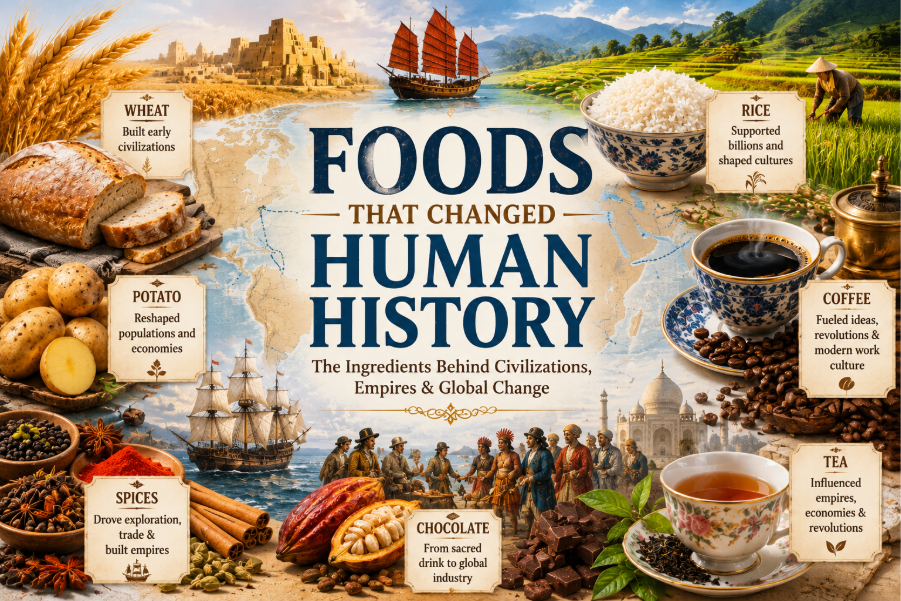
Wheat helped build civilizations. Potatoes reshaped populations. Tea influenced revolutions. Spices drove exploration. Coffee transformed work culture.
Food has always been more than nourishment.
In many ways, it helped shape the modern world itself.