
Introduction
Few foods have achieved what pizza has.
It is sold on busy street corners, served in Michelin-starred restaurants, delivered to homes at midnight, and customized in nearly every country. From New York slices to Neapolitan classics, pizza has become one of the most recognizable foods in the world.
But pizza did not begin as a luxury product or a global brand.
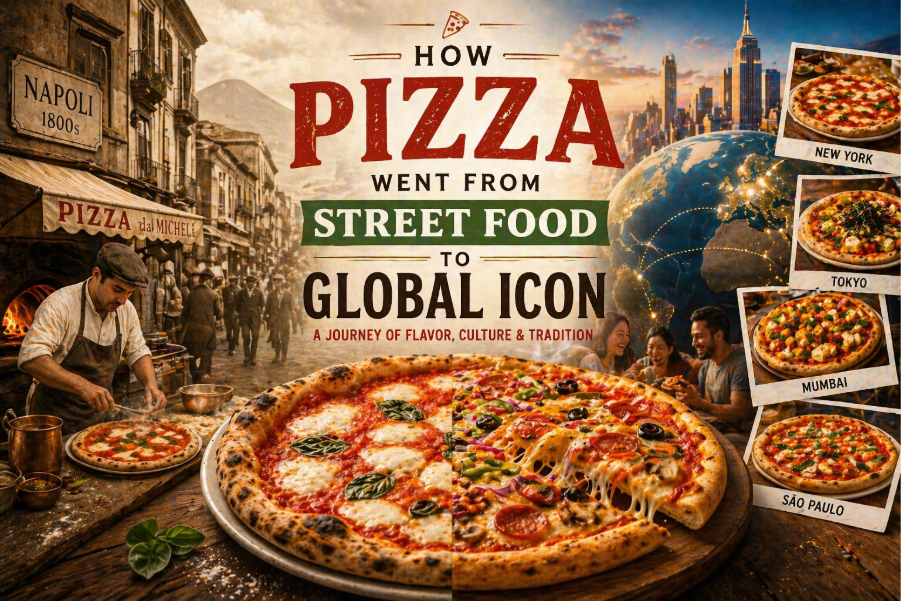
Its modern story began as an affordable street food in Naples, Italy, created for ordinary people who needed something inexpensive, filling, and easy to eat. Over time, migration, industrialization, and cultural adaptation transformed it into an international icon.
This is the story of how pizza moved from local necessity to global obsession.

Before Modern Pizza: The Flatbread Tradition
Pizza’s deeper roots go back much further than Italy.
Many ancient civilizations ate flatbreads topped with herbs, oils, or other ingredients. Variations existed in the Mediterranean world, including ancient Greece and Rome. These foods were practical, portable, and inexpensive—qualities pizza still carries today.
However, while topped flatbreads existed long before, modern pizza is widely associated with Naples.
Why Naples Became Pizza’s Birthplace
By the 18th and early 19th centuries, Naples was one of Europe’s largest cities. It had a large working-class population, including laborers who needed cheap, satisfying food that could be eaten quickly.
Street vendors and bakers sold flatbreads topped with ingredients such as garlic, lard, cheese, and later tomato. Pizza became especially popular because it was:
- Affordable
- Filling
- Fast to prepare
- Easy to eat on the move
In many ways, pizza was an early version of modern fast food.
The Tomato Changed Everything
One of the most important moments in pizza history was the arrival of the tomato in Europe after the Columbian Exchange.
Initially, tomatoes were viewed with suspicion in parts of Europe. Over time, southern Italians embraced them in cooking. Once tomatoes began appearing on Neapolitan flatbreads, pizza moved closer to the version recognized today.
Tomato brought acidity, moisture, color, and flavor—turning a simple bread into something more distinctive.
The First Pizzerias
As demand grew, pizza moved from street stalls into dedicated shops.
One of the earliest widely cited pizzerias is Antica Pizzeria Port’Alba, established in Naples in 1830. Instead of only buying from street vendors, customers could now sit and eat pizza in a more formal setting.
This was a major step in pizza’s evolution—from quick street meal to restaurant experience.
The Margherita Legend
No pizza story is complete without Pizza Margherita.
A popular legend says that in 1889, pizzaiolo Raffaele Esposito prepared pizzas for Queen Margherita of Savoy during a royal visit to Naples. One version topped with tomato, mozzarella, and basil resembled the colors of the Italian flag and became associated with the queen.
Historians debate parts of the story, but its symbolic power is undeniable.
Margherita helped position pizza not just as food for workers, but as something embraced across social classes.
Immigration Took Pizza Global
Pizza’s greatest leap happened through migration.
In the late 19th and early 20th centuries, Italian immigrants carried food traditions abroad, especially to the United States. One early landmark was Lombardi’s in New York, commonly cited as America’s first licensed pizzeria in 1905.
At first, pizza was mainly eaten within Italian communities. But gradually, wider audiences discovered it.
After World War II, returning soldiers who had eaten pizza in Italy helped accelerate its popularity in America. From there, mass adoption began.
Reinvention in America
Once pizza took hold in the United States, it evolved rapidly.
Regional styles emerged:
- New York style – large foldable slices
- Chicago deep dish – thick crust, layered filling
- Detroit style – rectangular with crisp edges
- California style – creative gourmet toppings
This period helped transform pizza from ethnic cuisine into mainstream popular culture.
Chains later industrialized pizza delivery and convenience, making it even more universal.
Pizza Conquers the World
Today, nearly every country has adapted pizza to local tastes.
Examples include:
- Paneer toppings in India
- Seafood variations in Japan
- Corn toppings in parts of Asia
- Regional meats across Europe and Latin America
This flexibility is one reason pizza became global.
It can be traditional or modern, simple or premium, vegetarian or meat-based, street food or fine dining.
Few foods adapt as easily across cultures.
UNESCO Recognition
In 2017, UNESCO added the art of the Neapolitan pizzaiuolo (pizza maker tradition) to the Intangible Cultural Heritage list.
This recognition honored not just the dish itself, but the craftsmanship, techniques, and cultural traditions behind authentic Neapolitan pizza-making.
It was a reminder that pizza is both food and living heritage.
Why Pizza Became a Global Icon
Pizza succeeded worldwide because it combines several rare strengths:
- Familiar ingredients
- Shareable format
- Affordable options
- Endless customization
- Comfort-food appeal
- Cross-cultural adaptability
It can fit almost any market, occasion, or budget.
That is powerful.
Final Thoughts
Pizza’s rise was not accidental.
It began as practical street food for working people in Naples. It gained identity through tradition, spread through migration, evolved through innovation, and scaled through convenience.
What started as a humble meal sold in crowded streets is now one of the world’s most beloved foods.
Few dishes tell a story of culture, movement, and reinvention as clearly as pizza.
From Naples to nearly everywhere—pizza became more than food.
It became global language.