
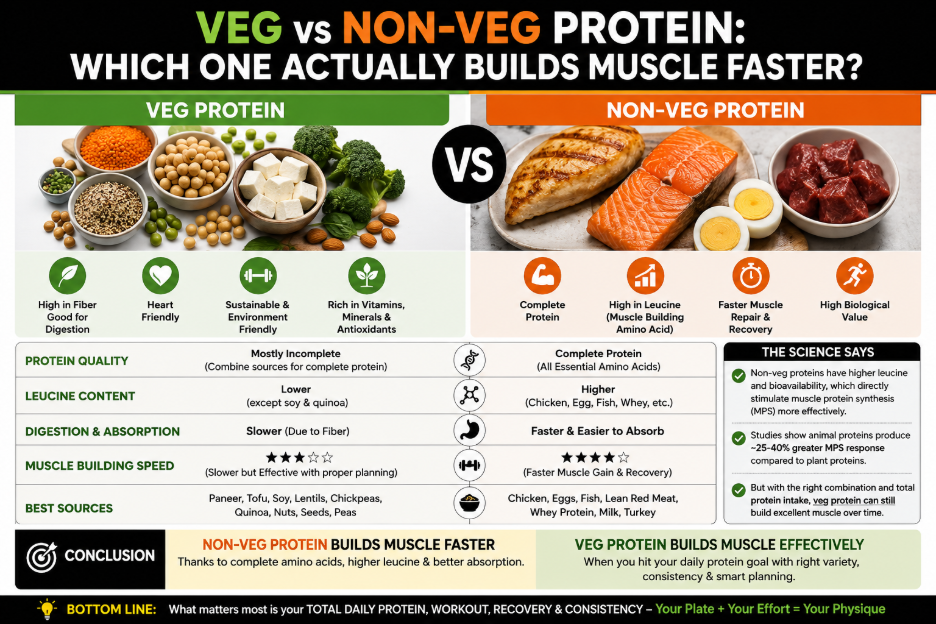
Veg vs Non-Veg Protein Ask ten people in a gym whether vegetarian protein is “as good as” non-vegetarian protein, and you will get ten confident, contradictory answers. One camp swears that dal and paneer can match chicken and eggs gram for gram. The other insists that no plant food comes close to meat, fish, or whey. However, both sides quote only half the truth — and neither side is running the numbers through an actual protein calculator.
The real answer sits in a field of nutrition science called protein quality, and once you understand how it works, the veg-versus-non-veg debate stops being an argument and becomes a calculation. This article walks through what protein quality means, how vegetarian and non-vegetarian foods compare on that scale, and how to use a simple protein calculator to work out exactly how much protein you need for muscle growth, whichever diet you follow.
What “Protein Quality” Actually Means
Not all protein is created equal, and this has nothing to do with taste or tradition. Instead, two things determine protein quality:
Amino acid profile – Protein is made of 20 amino acids, nine of which the body cannot produce on its own. Nutritionists call these essential amino acids, and food must supply them. Specifically, a food that contains all nine in sufficient amounts is a complete protein, while a food missing or low in one or more is an incomplete protein.
Digestibility – How much of that protein your gut actually absorbs, rather than passing through unused.
To measure this, scientists use two scoring systems:
- PDCAAS (Protein Digestibility-Corrected Amino Acid Score) – the older method, based on how well the intestines digest the entire protein.
- DIAAS (Digestible Indispensable Amino Acid Score) – a newer and more precise method, which researchers developed to correct the shortcomings of PDCAAS. Rather than measuring the whole protein, DIAAS tracks each essential amino acid separately at the point the small intestine absorbs it. As a result, most nutrition researchers now consider DIAAS the more accurate measure of true protein quality.
Generally, researchers consider a DIAAS or PDCAAS score above 100 excellent, a score of 75–99 good, and anything below 75 a lower-quality protein source on its own.
How Vegetarian and Non-Vegetarian Foods Compare
Here is where the numbers matter more than opinion.
| Food Type | Category | Approx. DIAAS / PDCAAS Score |
|---|---|---|
| Whey protein | Non-veg | 100+ |
| Eggs | Non-veg | ~100–113 |
| Milk / Paneer / Casein | Non-veg (dairy) | ~100–114 |
| Chicken / Fish / Meat | Non-veg | ~100–108 |
| Soy protein isolate | Veg | ~90–98 |
| Tofu | Veg | ~80–90 |
| Quinoa | Veg | ~70–90 |
| Chickpeas / Rajma | Veg | ~65–75 |
| Lentils (dal) | Veg | ~60–70 |
| Wheat / Rice | Veg | ~40–60 |
| Peanuts / Almonds | Veg | ~40–55 |
A few patterns stand out immediately. For instance, animal-based proteins — eggs, dairy, chicken, fish, and whey — almost always score at or near the top of the scale, because their amino acid composition closely matches what the human body needs, and they digest efficiently. Plant proteins, on the other hand, generally sit lower, with soy as the main exception. This happens mainly because most grains run low in the amino acid lysine, while most legumes run low in methionine and cysteine. Consequently, a food like dal alone is a good protein source, but not technically a complete one.
Notably, research comparing free-living vegetarians and omnivores has found real-world differences too. One DIAAS-based study of endurance athletes found that omnivorous diets delivered roughly 11% higher protein quality scores and 43% more usable protein per day than vegetarian diets on average, and that the vegetarian group also had lower lean body mass. Importantly, this gap was not because vegetarians ate less protein overall — rather, it was because their bodies absorbed and used that protein less completely, on average.
Why Non-Veg Protein Tends to Score Higher
Three main reasons explain the gap:
- Amino acid completeness. Meat, fish, eggs, and dairy naturally contain all nine essential amino acids in ratios close to human muscle tissue.
- Higher leucine content. Leucine is the specific amino acid that triggers muscle protein synthesis — the biological process behind muscle growth. Animal proteins are typically richer in leucine per gram than most plant proteins.
- Digestibility and anti-nutrients. Many plant foods contain fibre, phytates, and tannins that can slightly reduce how much protein the body absorbs, especially in unprocessed or unrefined forms. Fortunately, cooking, soaking, sprouting, and fermenting reduce this effect considerably.
Can Vegetarians Build Muscle Just as Well?
Yes — but it takes a slightly more deliberate approach, not a different biology. In fact, three strategies close the gap almost entirely:
- Protein combining. Pairing a grain with a legume — rice and dal, roti and chana, hummus and pita — creates a combined amino acid profile close to a complete protein, because each food fills in the amino acid the other lacks.
- Leaning on high-quality plant sources. Soy (tofu, edamame, soy chunks), quinoa, and dairy-based vegetarian foods (paneer, Greek yogurt, milk) sit far closer to animal-protein quality than legumes or grains eaten alone.
- Eating a slightly higher total volume. Because the body absorbs plant proteins less completely on average, vegetarians often need to eat somewhat more total protein than non-vegetarians to end up with the same usable amount reaching the muscle. Research suggests this difference often falls in the range of an extra 10–20 grams of protein per day for active individuals, not a dramatic overhaul of the diet.
In short, vegetarians are not at a disadvantage that can’t be planned around. They simply need to be a little more intentional about food combinations and total quantity.
Using a Protein Calculator: How to Calculate Protein for Muscle Growth
This is the part most people get wrong, because researchers designed the RDA (Recommended Dietary Allowance) of 0.8 grams of protein per kilogram of body weight to prevent deficiency in a sedentary adult — not to build muscle. Therefore, anyone training with resistance exercise needs considerably more, and a protein calculator makes that number easy to find.
Step 1: Set your target range
For muscle growth, most sports nutrition research supports a range of 1.6 to 2.2 grams of protein per kilogram of body weight per day. Vegetarians training seriously may want to sit toward the higher end of this range, or slightly above it, to account for lower average protein quality. This is exactly the formula a good protein calculator uses behind the scenes.
Protein calculator formula: Daily protein target (g) = Body weight (kg) × 1.6 to 2.2
Example: A 70 kg individual training for muscle growth would aim for:
- 70 × 1.6 = 112 g (lower end)
- 70 × 2.2 = 154 g (upper end)
Step 2: Distribute it across the day
Muscle protein synthesis responds best when you spread protein across 3–5 meals rather than consuming it in one or two large servings. Ideally, each meal supplies enough protein to cross what researchers call the leucine threshold — roughly 2–3 grams of leucine, which usually corresponds to about 20–40 grams of quality protein per sitting, depending on the source’s leucine density.
Step 3: Adjust for source quality
- If you eat mostly non-vegetarian protein, you can generally hit your gram target directly from the formula above.
- If you eat mostly vegetarian protein, add a buffer of roughly 10–15% to your target, and prioritise combining grains with legumes, and including soy, dairy, or quinoa where possible.
Step 4: Track, don’t guess
A rough mental estimate is a starting point, not a finishing one. Logging meals for a week or two against your calculated target — using a food diary or a calorie and macro tracking tool — is the only reliable way to know whether you are actually hitting your number, since most people underestimate their intake by a wide margin.
A Worked Protein Calculator Example
Take a 65 kg vegetarian aiming for muscle growth. Plugging these numbers into a protein calculator looks like this:
- Base target: 65 × 1.8 = 117 g/day
- Vegetarian buffer (+12%): 117 + 14 ≈ 131 g/day
- Spread across 4 meals: roughly 33 g of protein per meal
A practical day might look like this: paneer and rice at breakfast, a dal-and-roti lunch with a side of curd, a soy-chunk or tofu-based snack, and a dinner combining lentils with quinoa or a vegetarian protein supplement if needed.
The Bottom Line
Non-vegetarian protein sources generally score higher on protein quality scales like PDCAAS and DIAAS, thanks to more complete amino acid profiles, higher leucine content, and easier digestibility. That said, this is a fact worth knowing, not a reason for vegetarians to worry. With the right food combinations, a slightly higher total protein intake, and consistent tracking, a well-planned vegetarian diet can support muscle growth just as effectively as a non-vegetarian one.
Ultimately, the number that actually matters for muscle growth is not “veg or non-veg” — it’s whether you are hitting your personal daily protein target, spread evenly across your meals, week after week. Run your own numbers through the protein calculator above, and pair it with a muscle-building plan to put the target into practice. Everything else is just fine-tuning.