
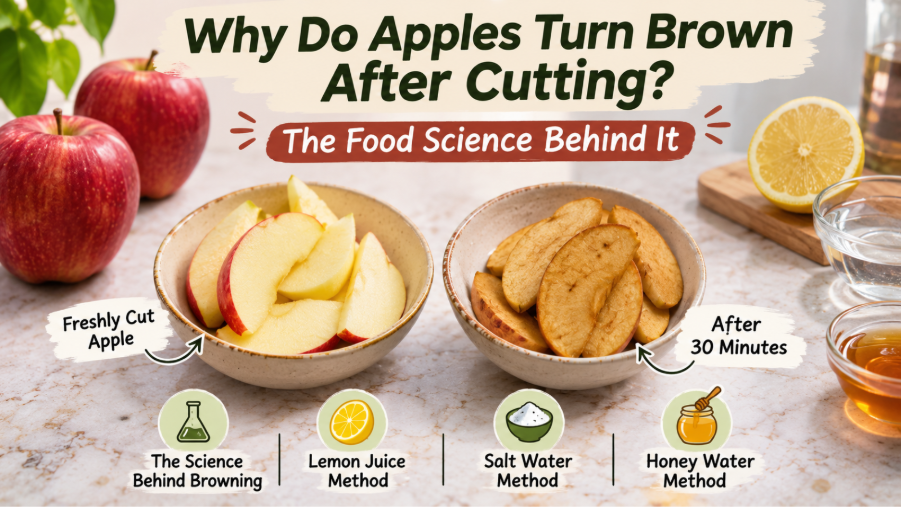
why apples turn brown – Have you ever cut an apple, left it on the kitchen counter for a few minutes, and returned to find its beautiful white flesh turning brown?
It’s a common kitchen observation, but have you ever wondered why it happens?
But here’s something interesting: lemon juice, salt water and even cold temperatures can slow down this process.
In this article, we’ll explore why apples turn brown, understand the science behind the colour change, discover whether brown apples are safe to eat, and conduct a simple kitchen experiment to find the best way to keep cut apples looking fresh.
Focus keyphrase: why apples turn brown
1. Why Do Apples Turn Brown After Cutting?
The browning of apples is primarily caused by a process known as enzymatic browning.
Inside an undamaged apple, different chemical components remain separated within its cells. When you cut, peel or bite an apple, you damage these cells and allow their contents to mix with oxygen.
This triggers a reaction involving three important components:
- Polyphenols: Naturally occurring compounds present in apples.
- Polyphenol oxidase (PPO): An enzyme responsible for initiating the browning reaction.
- Oxygen: From the surrounding air, which participates in the reaction.
The enzyme helps convert certain polyphenols into compounds called quinones. These compounds subsequently undergo further reactions and form brown-coloured pigments.
That’s why the freshly cut surface gradually changes from white or cream to brown.
Interestingly, this process isn’t unique to apples. Similar browning can occur in potatoes, bananas, avocados and other fruits and vegetables.
2. What Happens Inside an Apple When You Cut It?
Let’s understand the process step by step.
Step 1: The apple is cut
A knife damages the apple’s cells and exposes the inner flesh.
Step 2: Oxygen enters the exposed surface
The damaged cells allow oxygen from the air to interact with previously separated compounds.
Step 3: The enzyme becomes active
Polyphenol oxidase facilitates the oxidation of suitable phenolic compounds.
Step 4: Brown pigments develop
This entire process is an example of enzymatic oxidation.
The speed of browning depends on several factors, including the apple variety, temperature, oxygen exposure, acidity and enzyme activity.
3. Why Do Some Apples Turn Brown Faster Than Others?
Have you noticed that some apples remain fresh-looking for longer while others turn brown almost immediately?
This happens because not all apple varieties have the same chemical composition or enzyme activity.
Several factors influence how quickly an apple changes colour:
- Enzyme activity: Apples with higher polyphenol oxidase activity may brown faster.
- Polyphenol content: The amount and type of phenolic compounds influence the reaction.
- Apple variety: Different varieties have different natural browning tendencies.
- Temperature: Warmer conditions generally allow faster enzymatic reactions, while refrigeration slows them down.
- Physical damage: Bruised or heavily cut apples expose more damaged tissue to oxygen.
This explains why two apples sitting side by side in your kitchen may develop completely different levels of browning. Scientific American
4. Are Brown Apples Safe to Eat?
Here’s some good news: An apple turning brown after cutting doesn’t automatically mean it has spoiled.
The brown colour is usually the result of enzymatic browning, not bacterial spoilage.
A freshly cut apple that has turned slightly brown is generally safe to eat if it was handled and stored properly.
However, pay attention to other signs of spoilage:
- Unpleasant or fermented smell.
- Unusually mushy or slimy texture.
- Visible mould.
- Signs of decay.
Colour alone isn’t a reliable way to determine whether an apple is safe.
Remember: Cut apples should be refrigerated promptly. Don’t leave cut fruit at room temperature for more than two hours in total, or one hour when the surrounding temperature exceeds 32°C. UNL Food
5. Four Simple Ways to Stop Apples from Turning Brown
You don’t need expensive preservatives to keep apple slices looking fresh. A few everyday kitchen ingredients can slow down enzymatic browning.
Method 1: Lemon Juice
Lemon juice is one of the most effective household options.
It contains citric acid and vitamin C (ascorbic acid), which help slow browning through different mechanisms.
The acidity reduces the activity of polyphenol oxidase, while vitamin C acts as an antioxidant.
How to use it:
- Add one tablespoon of lemon juice to a cup of water.
- Dip freshly cut apple slices into the mixture.
- Leave them for approximately 2–3 minutes.
- Drain and refrigerate.
The apple may have a slightly tangy taste, but its appearance should remain fresher for longer.
Method 2: Salt Water
Salt water is another simple option.
A dilute salt solution can help slow the browning reaction.
How to use it:
- Add approximately half a teaspoon of salt to two cups of water.
- Dip apple slices for 5–10 minutes.
- Drain and rinse briefly if needed.
- Store in an airtight container in the refrigerator.
Use a mild solution to avoid making the apples taste salty.
Method 3: Honey Water
Honey water is a useful alternative if you don’t want the sharp taste of lemon.
How to use it:
- Mix two tablespoons of honey into one cup of water.
- Dip the apple slices into the solution.
- Remove and drain.
- Refrigerate in a covered container.
The coating helps reduce oxygen exposure and slows browning. UNL Food
Method 4: Cold Water and Refrigeration
Sometimes, the simplest method is enough.
How to use it:
- Place freshly cut apple slices in a clean container.
- Cover them completely with cold water.
- Close the container.
- Refrigerate until ready to eat.
Water reduces direct exposure to oxygen, while refrigeration slows enzyme activity.
For convenience, drain the slices before serving.
6. Kitchen Experiment: Which Method Keeps Apples Fresh the Longest?
Let’s turn this food science explanation into a simple experiment.
Instead of guessing which preservation method works best, compare four treatments under similar conditions.
Materials Required
- One fresh apple.
- Lemon juice.
- Salt.
- Honey.
- Four small bowls.
- Water.
- Four labelled plates or containers.
- A knife and timer.
Experiment Setup
Cut the apple into approximately equal-sized slices.
Prepare each solution using the same proportions described in the previous section.
Treat the apple slices for the same amount of time, drain them and place them in separate labelled containers.
Keep all four groups under identical conditions.
Observation Schedule
Observe the slices at the following intervals:
- Immediately after preparation.
- After 15 minutes.
- After 30 minutes.
- After 60 minutes.
- After 2 hours.
Take photographs from the same angle and under similar lighting conditions.
Rate browning using a simple scale:
- 0 – No visible browning.
- 1 – Very slight browning.
- 2 – Mild browning.
- 3 – Moderate browning.
- 4 – Heavy browning.
Expected result: Untreated apple slices will generally brown faster. Lemon juice is expected to perform particularly well because of its acidity and antioxidant content. Salt water and honey water can also slow discoloration.
The actual results may vary depending on apple variety, solution concentration and storage conditions.
For a fair comparison, use identical apple slices, equal treatment times and the same refrigeration conditions. Don’t leave the samples unrefrigerated for extended periods just to observe browning. Cooperative Extension
7. Does Browning Change the Nutritional Value of Apples?
Apples are nutritious fruits containing dietary fibre, vitamin C and various plant compounds, including polyphenols.
But what happens when they turn brown?
Vitamin C can also be affected by oxidation during storage and exposure to air.
However, this doesn’t mean that a slightly brown apple becomes nutritionally worthless.
The fruit still provides dietary fibre and other nutrients.
If you want to preserve the quality of cut apples:
- Cut them shortly before eating.
- Avoid unnecessary exposure to air.
- Use lemon juice when convenient.
- Store cut pieces in a covered container.
- Refrigerate promptly.
8. Why Does Lemon Juice Work Better Than Plain Water?
Both methods can slow browning, but they work differently.
Plain water mainly creates a barrier that reduces direct contact between the apple surface and oxygen.
Lemon juice provides additional protection because it contains acidic compounds and vitamin C.
9. Interesting Food Science: Browning Isn’t Always Bad
Although brown apple slices may not look appealing, enzymatic browning isn’t always an undesirable process.
In some foods, browning contributes to the development of flavour, colour and aroma.
For example:
- Tea processing involves enzymatic oxidation reactions.
- Cocoa processing includes oxidation-related changes that contribute to flavour development.
- Some fruits and vegetables develop characteristic colours during processing.
The important difference is that the same type of chemical process can be useful in one food application and undesirable in another.
In the case of freshly cut apples, consumers generally prefer the original light colour.
10. Final Thoughts: Should You Worry About Brown Apples?
Now you know why apples turn brown after cutting.
The good news is that you can slow this process using simple household ingredients.
Lemon juice is an especially useful option, while salt water, honey water and refrigeration offer practical alternatives.
The next time you prepare an apple for breakfast, a lunchbox or an evening snack, try one of these methods.
You might discover that a small kitchen experiment can teach you quite a lot about food chemistry.
Sometimes, the most interesting science experiments don’t happen in laboratories. They happen right in your kitchen.