
Introduction
Few foods are as universal, practical, and familiar as the sandwich.
It appears in lunchboxes, cafés, airports, office desks, and gourmet restaurants around the world. From simple vegetable fillings to elaborate club sandwiches, it has become one of the most adaptable foods ever created.
But unlike many dishes whose names come from ingredients or cooking methods, the sandwich has a far more unusual story.
It was named after a person.
The word “sandwich” is linked to an 18th-century English aristocrat whose title became permanently attached to one of the world’s most popular meals. Over time, what began as a convenient way to eat became a global food category.
This is the story behind why sandwiches are called sandwiches.
The Man Behind the Name
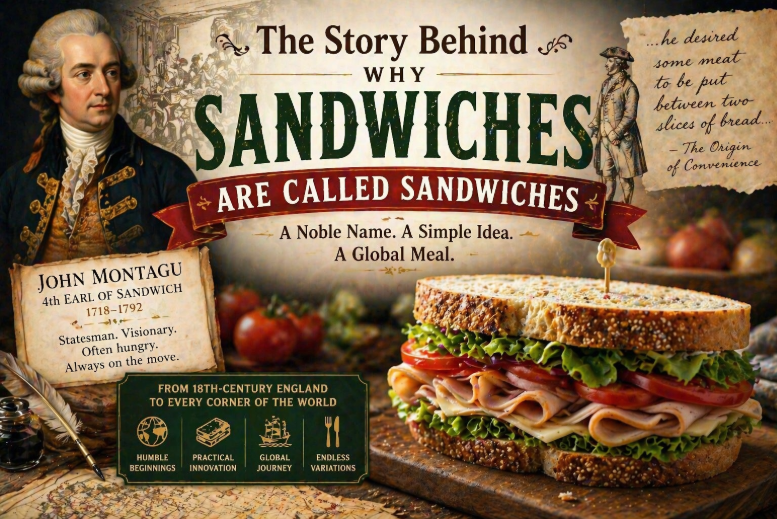
The sandwich is most commonly connected to John Montagu, the 4th Earl of Sandwich (1718–1792), a British statesman and nobleman.
“Sandwich” was not his surname—it was his aristocratic title, derived from the town of Sandwich in Kent, England.
Montagu held important political positions during his lifetime, but today he is remembered less for government and more for food history.
According to popular accounts, he requested meat placed between slices of bread so he could eat conveniently without interrupting his activities.
That simple act is said to have inspired others to order “the same as Sandwich,” eventually giving rise to the name.
The Famous Gambling Legend
The best-known version of the story claims the Earl requested meat between bread while engaged in long gambling sessions, allowing him to eat with one hand and continue playing cards.
This tale became widely repeated because it is memorable and fits the practical nature of the food.
However, some historians suggest a more realistic explanation: Montagu was also known as a busy statesman who often worked long hours at his desk, and a handheld meal would have been useful during administrative work as well.
Whether cards or paperwork, the common theme is convenience.
Was the Sandwich Invented Then?
Not exactly.
People had been placing fillings inside bread or eating bread with toppings for centuries before the Earl of Sandwich lived.
Across many cultures, flatbreads and loaves were used to hold meats, cheeses, vegetables, and spreads. Bread was often practical as both plate and utensil.
What the Earl likely influenced was not the invention of the food itself—but the popularization of the name.
That distinction is important.
The sandwich as an idea existed long before the sandwich as a word.
How the Name Spread
The term gained recognition in 18th-century England.
One of the earliest recorded written uses appeared in historian Edward Gibbon’s journal in 1762, where he mentioned seeing men eating “bits of cold meat” or a “Sandwich” in a coffee house.
Once the name entered fashionable social spaces such as clubs and coffee houses, it spread quickly.
The food itself was practical:
- Easy to prepare
- Portable
- Convenient for travel
- Suitable hot or cold
- Adaptable to different ingredients
That practicality helped the word survive and expand.
Why the Sandwich Became So Popular
The sandwich succeeded because it solved everyday problems.
It was ideal for:
- Busy workers needing quick meals
- Travelers needing portable food
- Households using leftovers efficiently
- Cafés seeking easy menu items
- People wanting minimal utensils
Long before modern fast food, the sandwich offered speed and flexibility.
It could be humble or premium, simple or elaborate.
Few foods are as scalable.
Industrialization and Modern Lunch Culture
During the 19th and 20th centuries, urbanization and industrial work schedules increased demand for convenient meals.
The sandwich fit perfectly into factory breaks, office lunches, railway travel, and later school lunchboxes.
As bread production became more standardized and packaged sliced bread became common in the 20th century, sandwiches became even more accessible.
They were no longer occasional café food—they became everyday food.
Why the Name Stayed
Many named foods fade with time, but “sandwich” endured because it became generic enough to describe an entire category.
Today the word applies to:
- Cold sandwiches
- Hot sandwiches
- Subs and hoagies
- Toasted sandwiches
- Open-faced variants (in some contexts)
- Gourmet chef creations
Few people think of an English aristocrat while ordering one.
Yet his title remains in daily global use.
A Curious Side Note: Earl of Sandwich Brand
The historical association remains commercially visible today through the restaurant chain Earl of Sandwich, founded by descendants connected to the Montagu family title.
It shows how strongly the story still resonates.
Final Thoughts
The sandwich was not truly invented by one man.
People had eaten bread with fillings for centuries.
But John Montagu, the 4th Earl of Sandwich, is widely credited with giving the food its lasting name through a habit rooted in convenience.
That name spread because the food itself was useful, adaptable, and easy to love.
From aristocratic title to lunch staple, few words in food history have traveled so far.
The next time you order a sandwich, you are using an 18th-century noble title without even thinking about it.