
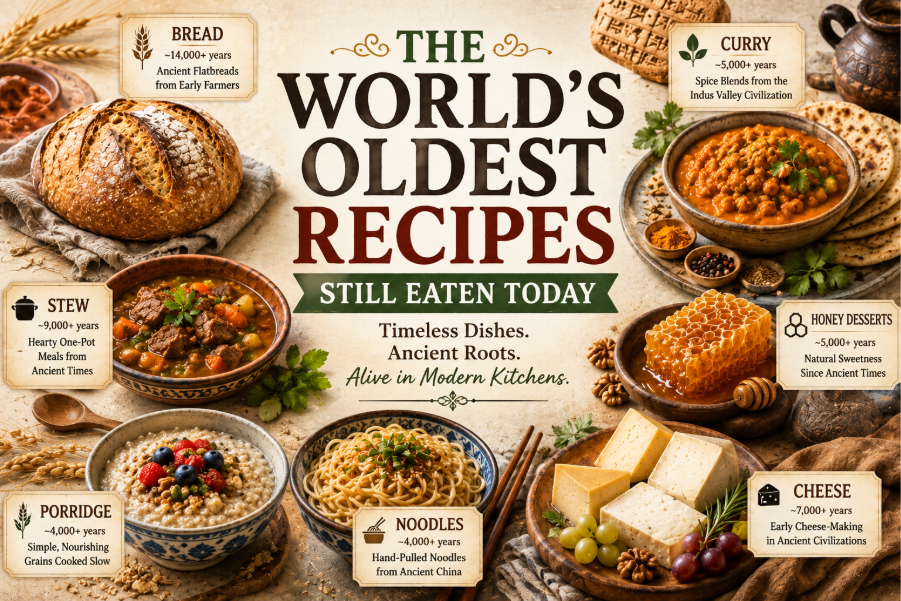
Introduction
Food trends change constantly.
Yet some recipes have survived for centuries—and in some cases, even thousands of years.
Long before restaurants, cookbooks, or social media, ancient civilizations were already preparing breads, soups, noodles, porridges, and desserts using techniques that still feel familiar today. While ingredients and cooking tools evolved over time, many traditional recipes survived because they were practical, flavorful, and deeply connected to culture.
What makes these dishes fascinating is not just their age.
It is the fact that people still eat them today.
Across continents, ancient foods continue to appear on modern tables, carrying pieces of history into everyday life.
Bread — One of Humanity’s Oldest Recipes
Bread is among the oldest prepared foods in human history.
Archaeological evidence suggests early forms of bread existed thousands of years before modern civilization fully developed. Ancient communities ground grains, mixed them with water, and cooked flatbreads over heated surfaces or stones.
Different civilizations later developed their own versions:
- Egyptian bread
- Roman bread
- Middle Eastern flatbreads
- Indian rotis
- Mediterranean loaves
Despite modern baking technology, the basic recipe remains remarkably similar:
- Grain
- Water
- Heat
Bread continues to be one of the most universally consumed foods on Earth.
Stew — Ancient Comfort Food
Stews have existed for thousands of years because they solved practical problems.
They allowed people to:
- Use available ingredients efficiently
- Cook tougher meats slowly
- Feed larger groups
- Preserve nutrition in one-pot meals
Ancient civilizations across Mesopotamia, Greece, Rome, and Asia all prepared stew-like dishes.
Modern soups and curries still follow many of the same principles.
The ingredients may differ, but the concept remains ancient and timeless.
Noodles — A Recipe That Crossed Centuries
China holds some of the oldest archaeological evidence of noodle-like foods.
One famous discovery revealed preserved noodles believed to be around 4,000 years old.
Over time, noodle traditions spread and evolved across regions:
- Chinese hand-pulled noodles
- Japanese ramen and udon
- Italian pasta traditions
- Central Asian noodle dishes
Though styles changed dramatically, the core recipe idea survived:
Simple dough transformed into versatile meals.
Porridge — A Survival Food That Never Disappeared
Porridge has existed since ancient agricultural societies first began boiling grains in water.
It became common because it was:
- Affordable
- Easy to digest
- Filling
- Adaptable
Ancient people used:
- Oats
- Barley
- Millet
- Rice
Even today, porridge-like foods remain part of breakfast traditions across many cultures.
Cheese — Preserved Milk from Ancient Times
Cheese-making dates back thousands of years.
Early societies discovered that milk could be preserved and transformed into more durable food through curdling and fermentation.
Cheese became important because it:
- Extended shelf life
- Improved portability
- Preserved nutrients
Ancient civilizations in the Middle East and Mediterranean regions consumed forms of cheese long before modern refrigeration existed.
Today the industry has evolved enormously, but the basic process remains ancient.
Honey Desserts — Sweetness Before Sugar
Before refined sugar became widely available, honey was one of humanity’s primary sweeteners.
Ancient civilizations used honey in:
- Cakes
- Pastries
- Drinks
- Preserved foods
Many traditional desserts still rely on ancient sweetening principles using honey, nuts, grains, and fruits.
Curry-Like Dishes — Ancient Spice Traditions
Archaeological evidence suggests spice-based cooking existed in the Indian subcontinent thousands of years ago.
While modern curries vary widely, ancient cooking methods already included:
- Spice blending
- Slow cooking
- Herb-based flavoring
- Grain and lentil combinations
The exact recipes changed over time, but the culinary foundation remained surprisingly consistent.
Why Ancient Recipes Survive
Not every old recipe lasts for centuries.
The dishes that survive usually share certain qualities:
- Simple ingredients
- Adaptability
- Strong cultural connection
- Practical cooking methods
- Reliable nutrition
Foods tied closely to daily life tend to survive longest.
Food as Living History
Ancient recipes are more than culinary traditions.
They are forms of cultural continuity.
Every time people prepare traditional bread, stew, noodles, or porridges, they continue practices shaped by generations before them.
Unlike artifacts locked in museums, food remains active history—something people can still experience directly.
Final Thoughts
Some of the oldest recipes in the world are not forgotten relics.
They are still eaten every day.
Across thousands of years, human societies changed dramatically—but many foods endured because they remained practical, comforting, and meaningful.
The next time you eat bread, noodles, stew, or porridge, remember:
You may be tasting a recipe connected to ancient civilization itself.