
Introduction
Food travels across countries faster than language does.
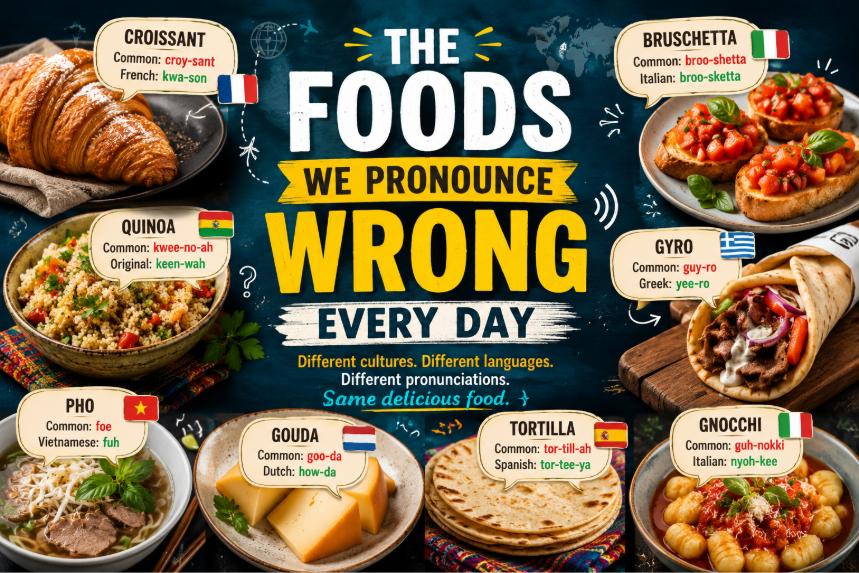
As dishes move from one culture to another, their names often change in pronunciation. Sometimes people simplify them. Sometimes accents reshape them. And sometimes entire countries end up saying a food name differently from its original version.
The result?
Many of the foods we order confidently every day are commonly mispronounced.
But these pronunciation differences are not really mistakes in a negative sense—they are part of how language adapts when food becomes global.
Still, knowing the original pronunciation makes food history even more interesting.
Here are some famous foods many people pronounce differently from their traditional forms.
🥐 Croissant
Common Pronunciation:
“Croy-sant”
Closer French Pronunciation:
“Kwa-son”
The croissant comes from France, and French pronunciation tends to soften or drop several ending sounds.
Outside French-speaking regions, people often pronounce the word more literally based on spelling.
🍅 Bruschetta
Common Pronunciation:
“Broo-shetta”
Correct Italian Pronunciation:
“Broo-sketta”
In Italian, “ch” often creates a hard “k” sound.
This makes “bruschetta” one of the most frequently mispronounced Italian foods worldwide.
🌾 Quinoa
Common Pronunciation:
“Kwee-no-ah”
Closer Pronunciation:
“Keen-wah”
Quinoa originated in the Andean regions of South America and has roots connected to Indigenous languages.
As it became globally popular as a health food, many people encountered the spelling long before hearing the pronunciation.
🥙 Gyro
Common Pronunciation:
“Guy-ro”
Closer Greek Pronunciation:
“Yee-ro” or “Zhee-ro” (depending on regional accent)
The Greek word refers to “turning” or “rotation,” describing the rotating meat cooking method.
English pronunciation often changes the sound dramatically because of unfamiliar spelling patterns.
🍜 Pho
Common Pronunciation:
“Foe”
Vietnamese Pronunciation:
Closer to “Fuh”
Pho is one of Vietnam’s most internationally recognized dishes, but tonal languages make pronunciation difficult to replicate perfectly in English.
Many global versions simplify the pronunciation.
🧀 Gouda
Common Pronunciation:
“Goo-da”
Dutch Pronunciation:
Closer to “Khow-da” or “How-da”
The Dutch “g” sound is difficult for many non-native speakers, so softer pronunciations became common internationally.
🌮 Tortilla
Common Pronunciation:
“Tor-till-ah”
Spanish Pronunciation:
“Tor-tee-ya”
In Spanish, double “ll” often produces a “y” sound.
The pronunciation varies slightly across Spanish-speaking countries, but “tortiya” is generally much closer than “tortilla” with a hard “l.”
🍝 Tagliatelle
Common Pronunciation:
“Tag-lee-a-telly”
Italian Pronunciation:
Closer to “Tal-ya-tel-leh”
Italian pronunciation places strong emphasis on smoother vowel flow and softer combinations of letters.
Many Italian pasta names are simplified outside Italy.
☕ Espresso
Common Mistake:
“Expresso”
Correct Form:
“Espresso”
This is one of the most widespread food-word mistakes in English.
The word comes from Italian and refers to coffee prepared by forcing water through finely ground coffee under pressure—not “express” speed, even though many people associate it with quick preparation.
🥔 Gnocchi
Common Pronunciation:
“Guh-nokki”
Italian Pronunciation:
“Nyoh-kee”
The “gn” combination in Italian creates a soft sound unfamiliar in English.
Because of spelling complexity, gnocchi is often pronounced very differently outside Italy.
🌍 Why Food Pronunciations Change
Food names change pronunciation for several reasons:
Language Adaptation
People naturally adjust unfamiliar sounds to fit their native language patterns.
Globalization
Foods spread faster than formal pronunciation education.
Spelling Confusion
Many food names come from languages with different pronunciation rules.
Regional Accents
Even within the same language, pronunciation changes by region.
Final Thoughts
Food names carry pieces of culture, language, and history.
When dishes travel globally, pronunciation evolves along with them. What starts in one language often transforms as millions of new speakers adopt the word into everyday conversation.
So the next time you order a croissant, bruschetta, pho, or gyro, remember:
You are not just saying a food name.
You are speaking a word shaped by cultural journeys across the world.