
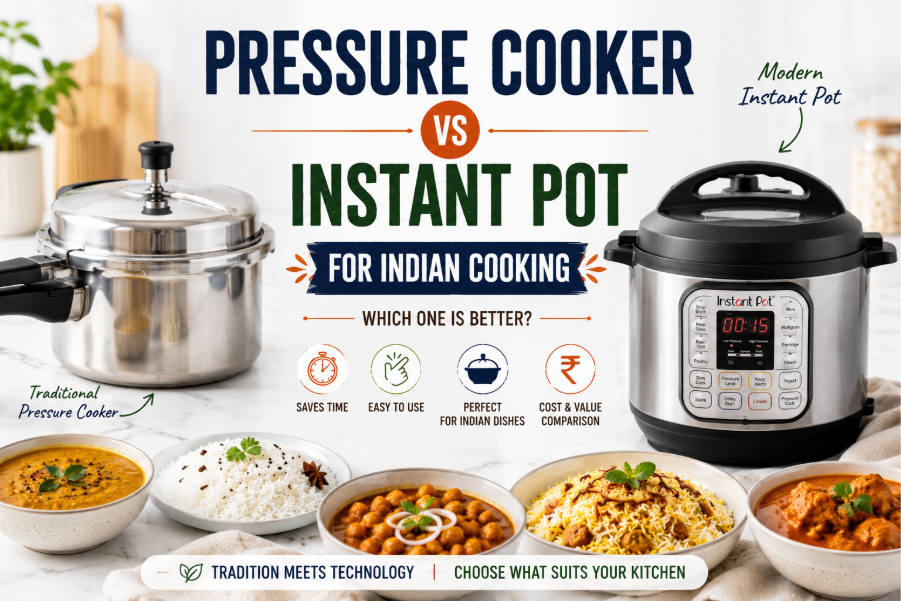
If you cook Indian food regularly, you probably already know how useful a pressure cooker can be. Dal softens quickly, chickpeas become tender, meat cooks faster, and even a simple rice dish can come together with very little effort. But with electric multi-cookers such as the Instant Pot becoming more common, one question comes up often: Pressure Cooker vs Instant Pot for Indian Cooking— which one is actually better?
The answer depends on how you cook.
A traditional stovetop pressure cooker is simple, fast, inexpensive, and familiar to most Indian kitchens. An Instant Pot, on the other hand, gives you automatic temperature and pressure control, programmable cooking, and several other functions in one appliance.
Neither one wins every situation. For some Indian dishes, the traditional cooker is still hard to beat. For busy cooks who want convenience and repeatable results, an Instant Pot can be extremely useful.
Let’s compare them based on the foods you actually cook.
Pressure Cooker vs Instant Pot for Indian Cooking: What’s the Difference?
The biggest difference is how they generate and control pressure.
A traditional pressure cooker sits directly on the stovetop. Heat from the burner raises the pressure inside the pot, and you control the cooking primarily by adjusting the flame.
An Instant Pot is an electric pressure cooker. You select a cooking program, and the appliance controls the heating and pressure automatically.
Both use pressure to raise the boiling temperature of water. This allows food to cook faster than it would in an ordinary pot.
The important distinction is that you’re much more involved with a stovetop cooker, while the Instant Pot handles most of the process for you.
Traditional Pressure Cooker
The stovetop pressure cooker has been a staple in Indian kitchens for decades, and there’s a good reason for that.
It’s straightforward.
Add your ingredients, close the lid, place it on the burner, and cook until the required pressure or number of whistles is reached.
For many Indian recipes, cooks don’t even need a written recipe anymore. They know roughly how many whistles a particular dal or vegetable needs and can adjust the heat based on experience.
Advantages of a Traditional Pressure Cooker
Fast cooking
A stovetop cooker heats directly from the burner, so it can come to pressure quickly, especially on a strong gas stove.
Simple operation
There are no menus, buttons, cooking programs, or electrical components to deal with.
Affordable
Traditional pressure cookers are generally much less expensive than electric multi-cookers.
Easy to clean
The basic design is simple, with fewer parts compared with an electric multi-cooker.
Excellent for Indian cooking
Dal, rice, potatoes, beans, meat, sambar, and many other everyday Indian foods work beautifully in a stovetop pressure cooker.
Disadvantages
The main disadvantage is that you need to pay attention.
You have to control the heat, monitor the cooker, and decide when to turn off the burner.
The traditional “whistle” method can also be inconsistent. The number of whistles can change depending on the heat level, amount of food, liquid, and even the cooker itself.
That’s why experienced cooks often rely on more than just counting whistles.
Instant Pot
The Instant Pot takes the pressure-cooking concept and automates much of it.
Instead of listening for whistles and adjusting the flame, you select a cooking time and let the appliance regulate the pressure and temperature.
It can also perform functions such as slow cooking, sautéing, steaming, and warming, depending on the model.
Advantages of an Instant Pot
Less supervision
Once you’ve selected the appropriate settings, you don’t need to stand beside the cooker adjusting the flame.
Programmable cooking
You can set a cooking time and let the appliance handle the pressure cycle.
Consistent results
Once you’ve worked out the right time and liquid ratio for a particular recipe, it’s easier to repeat the same process.
Useful for meal preparation
You can cook dal, beans, rice, and other ingredients while working on something else.
Multiple cooking functions
The sauté function is particularly useful for Indian cooking because you can brown onions and spices in the same pot before pressure cooking.
Disadvantages
Higher cost
An Instant Pot costs considerably more than a basic stovetop pressure cooker.
Longer overall process than the cooking time suggests
An Instant Pot needs time to heat up and build pressure before the programmed cooking time begins. The food may therefore take longer from start to finish than the number shown on the display suggests.
More parts to clean
The lid, sealing ring, inner pot, steam-release components, and other parts require regular cleaning.
Learning curve
If you’re used to whistles, you have to learn a different way of thinking about pressure cooking.
Which Is Better for Dal?
For everyday Indian dal, both work very well.
A traditional pressure cooker is excellent when you want dal quickly and already know your preferred cooking method.
Add dal, water, turmeric, and other ingredients, bring the cooker to pressure, and cook until the lentils are soft.
The Instant Pot is useful when you’re busy. You can add the ingredients, select the appropriate pressure-cooking setting, and leave it to work.
Winner: Traditional Pressure Cooker for Speed and Simplicity
Winner: Instant Pot for Convenience
If dal is something you make almost every day, the traditional cooker remains an excellent choice.
Which Is Better for Rice?
Rice is slightly more dependent on the type of rice and the amount of water.
A stovetop pressure cooker can produce excellent rice, but it takes some practice to get the timing and water ratio right.
An Instant Pot can be convenient because the cooking environment is more controlled.
However, don’t assume that one water ratio works for every rice. Basmati, sona masuri, brown rice, and other varieties behave differently.
Winner: Instant Pot for Repeatability
Winner: Traditional Cooker for Experienced Cooks
If you’ve been cooking rice in a pressure cooker for years, there’s little reason to change simply because an Instant Pot exists.
Which Is Better for Chickpeas and Rajma?
This is where pressure cooking really earns its place in Indian cooking.
Chickpeas and kidney beans need enough pressure-cooking time to become properly tender.
Both appliances can handle them well.
The bigger issue is preparation.
Soaking dried beans beforehand can significantly reduce cooking time and help them cook more evenly.
With an Instant Pot, you can set a longer pressure-cooking cycle and let the appliance do the work.
With a stovetop cooker, you’ll need to monitor the pressure and cooking time more closely.
Winner: Instant Pot for Convenience
For people who cook beans regularly but don’t want to watch the cooker, the Instant Pot has a clear advantage.
Which Is Better for Chicken and Mutton?
Both are useful for Indian meat dishes, but the cooking process is slightly different.
A traditional pressure cooker gets very hot quickly and works well for dishes such as chicken curry, mutton curry, keema, and other braised preparations.
The Instant Pot has one major advantage: you can use the sauté function first.
You can brown the meat, cook onions, toast whole spices, and build the masala before switching to pressure cooking.
That means fewer dishes and less transferring between pots.
For tougher cuts of mutton, pressure cooking can dramatically shorten the time required to make the meat tender.
Winner: Traditional Cooker for Familiar Indian Cooking
Winner: Instant Pot for One-Pot Convenience
Which Is Better for Biryani?
This one is more complicated.
Pressure cooking isn’t ideal for every style of biryani.
Traditional dum biryani depends on carefully layered rice and meat cooking together with controlled steam. A pressure cooker can produce a tasty rice dish, but it doesn’t necessarily reproduce the texture and cooking process of traditional dum biryani.
For quick chicken or vegetable rice dishes, either appliance can be useful.
For authentic layered biryani, however, neither appliance should automatically replace the traditional cooking method.
Winner: Neither for Traditional Dum Biryani
For authentic biryani, the cooking technique matters more than the appliance.
Which Is Better for Sambar?
Both work well.
A traditional pressure cooker can soften dal and vegetables quickly.
An Instant Pot is convenient when you’re preparing the base and want to sauté onions, tomatoes, spices, or other ingredients before pressure cooking.
However, vegetables don’t all require the same cooking time. If you put delicate vegetables under pressure for too long, they can become overly soft.
Winner: Tie
Choose based on how much supervision and convenience you prefer.
Which Is Easier for Beginners?
The Instant Pot may appear easier because you don’t need to learn how to manage stovetop pressure manually.
But there’s another side to this.
You still need to understand:
- How much liquid to use
- Which pressure setting to choose
- How long different ingredients need
- When natural release is useful
- When quick release is appropriate
- How much food can safely go into the pot
So an Instant Pot doesn’t remove the need to understand cooking.
It simply automates more of the process.
Traditional Pressure Cooker vs Instant Pot: Quick Comparison
| Feature | Traditional Pressure Cooker | Instant Pot |
| Price | Lower | Higher |
| Heating | Stovetop | Electric |
| Pressure control | Manual | Automatic |
| Supervision | More | Less |
| Cooking speed | Very fast once heated | Convenient but includes preheating |
| Cleaning | Simple | More components |
| Dal | Excellent | Excellent |
| Rice | Excellent | Excellent |
| Beans | Excellent | Excellent |
| Meat | Excellent | Excellent |
| Sautéing | Requires separate pan or cooking step | Built in |
| Portability | Easy | Heavier |
| Electricity required | No | Yes |
| Beginner-friendly | Requires practice | Easier automation |
| Multiple functions | Limited | Many |
| Indian kitchen familiarity | Very high | Growing |
Common Mistakes With Both Cookers
Using Too Little Liquid
Pressure cooking requires sufficient liquid to generate steam.
Don’t simply copy the amount of water you would use in an open pot.
Overfilling the Cooker
Pressure cookers shouldn’t be filled beyond their recommended maximum level.
Foods that expand or foam, such as lentils and beans, need particular attention.
Opening Immediately
Don’t force the lid open.
Wait until the pressure has been safely released according to the cooker’s instructions.
Relying Only on Cooking Time
Cooking time isn’t the only factor.
The amount of food, starting temperature, liquid, ingredient size, and pressure-release method all affect the final result.
So, Which One Should You Buy?
If you mostly cook traditional Indian food and want something inexpensive, fast, and familiar, a good stovetop pressure cooker is difficult to beat.
It is especially practical for:
- Dal
- Rice
- Sambar
- Potatoes
- Chickpeas
- Rajma
- Chicken curry
- Mutton curry
- Vegetable preparations
If you want automation, convenience, and multiple cooking functions, an Instant Pot makes more sense.
It’s particularly useful if you:
- Cook several times a week
- Meal prep regularly
- Want less supervision
- Cook beans frequently
- Like one-pot meals
- Want sautéing and pressure cooking in the same appliance
- Prefer programmable cooking
Can You Have Both?
Absolutely.
If you cook a lot of Indian food, the two appliances can actually complement each other.
Use the stovetop pressure cooker when you want speed and simplicity.
Use the Instant Pot when you’re busy, meal prepping, or want to cook something without constantly monitoring the stove.
You don’t necessarily have to treat them as competing appliances.
Chef’s Tips for Indian Pressure Cooking
Think beyond whistles. The number of whistles is only one way of describing pressure cooking. Heat level, ingredient quantity, and cooker size also matter.
Learn your ingredients. Dal, rice, chickpeas, rajma, chicken, and mutton all behave differently under pressure.
Use sautéing strategically. If you’re using an Instant Pot, take advantage of the sauté function to build flavor before pressure cooking.
Don’t overcook vegetables. Pressure can turn delicate vegetables mushy very quickly.
Keep recipes consistent. Once you find a water ratio and cooking time that works for your particular rice or dal, write it down. Your own kitchen experience is often more useful than a generic cooking chart.
Final Verdict
So, Pressure Cooker vs Instant Pot for Indian Cooking—which one is better?
For speed, simplicity, affordability, and traditional Indian cooking, the stovetop pressure cooker still has the edge.
For automation, convenience, meal preparation, and multi-function cooking, the Instant Pot is the better choice.
If you grew up using a traditional pressure cooker, there’s no reason to replace it simply because electric cookers are popular. And if you’re someone who wants to put dinner together, press a button, and get on with the rest of your evening, an Instant Pot can be a worthwhile upgrade.
In the end, the better cooker isn’t the one with more buttons. It’s the one that fits the way you actually cook.