
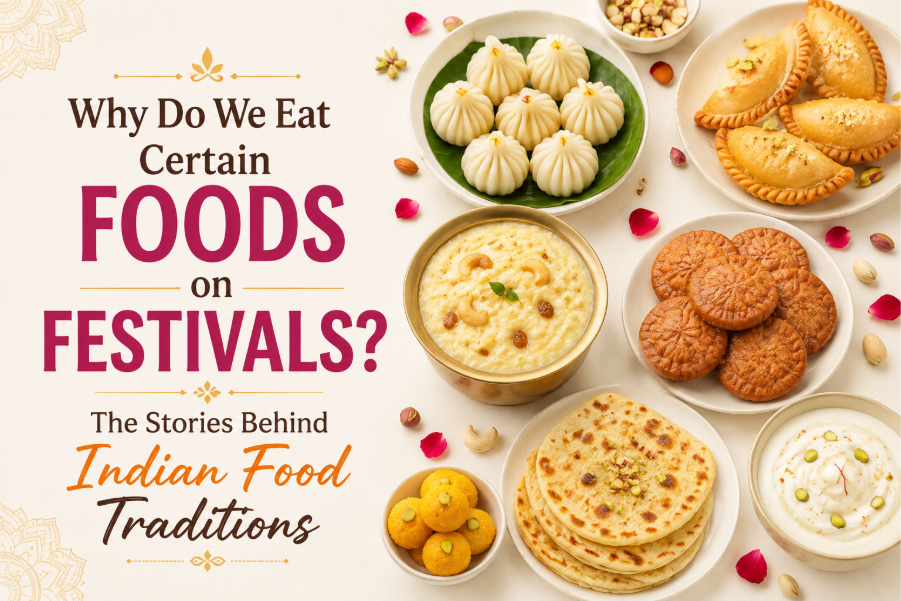
Food in India is rarely just food. A festival meal can mark a harvest, welcome a new season, honor a deity, bring relatives together, or simply give a family a reason to make something they don’t prepare every day.
That is why certain dishes appear on the table year after year. Modak during Ganesh Chaturthi, gujiya during Holi, Pongal during the harvest festival, thekua during Chhath, and festive sweets across different regions are more than recipes. They carry memories, local ingredients, rituals, and stories from one generation to the next.
The interesting part is that there isn’t one universal Indian festival menu. Food traditions change dramatically from one state, community, and family to another. A dish considered essential in Maharashtra may have little connection with a celebration in Kerala or Bihar.
So why do we eat certain foods on festivals? The answer usually comes down to tradition, seasonality, symbolism, availability of ingredients, and the simple joy of sharing food.
Food as Part of the Celebration
Festival cooking often begins before the celebration itself.
Families buy ingredients, prepare sweets, roast nuts, grind spices, soak grains, and make doughs. Some dishes are prepared as offerings, while others are made specifically for guests and family members.
This makes food part of the ritual rather than something served after the important part of the celebration.
In Tamil Nadu, for example, traditional temple foods include dishes such as Venn Pongal, Sakkara Pongal, Sundal, Puliyodhare, and curd rice. The exact dishes vary by temple, but food prepared for the deity and subsequently shared with devotees remains an important part of the tradition. (Incredible India)
The same idea appears across India in different forms: prepare something special, offer it, share it, and associate that flavor with the occasion.
1. Modak and Ganesh Chaturthi
Few festival foods are as closely associated with a celebration as modak and Ganesh Chaturthi.
Traditional ukadiche modak is made with a rice-flour outer layer and a filling of coconut and jaggery. The dumplings are steamed and often prepared as an offering during Ganesh Chaturthi. (Incredible India)
There is also a practical beauty to the ingredients. Rice flour, coconut, and jaggery are simple staples, yet steaming turns them into something that feels distinctly festive.
Today you’ll find many modern versions, including fried, chocolate, and flavored modaks. However, the steamed coconut-and-jaggery version remains strongly connected with the traditional celebration.
The food therefore becomes part of the identity of the festival itself.
2. Gujiya and Holi
When Holi arrives, gujiya is one of the first sweets many people associate with the celebration.
A traditional gujiya has a crisp pastry shell with a sweet filling, often made with ingredients such as khoya, nuts, coconut, and cardamom.
It isn’t just a dessert placed on a table. Gujiya is closely associated with the social side of Holi, when families and friends visit one another and exchange food and sweets.
The Ministry of Tourism’s Incredible India describes gujiya, along with thandai, dahi vada, and pakora, among the traditional foods prepared during Holi celebrations. (Incredible India)
There’s also a practical reason festive sweets like gujiya became so useful. They can be prepared in batches and shared easily with visiting family and neighbors.
That makes them ideal for a festival built around hospitality.
3. Pongal and the Harvest
The connection between food and season is particularly clear with Pongal.
The festival is associated with the harvest in Tamil Nadu, and rice plays a central role. Traditional celebrations include cooking rice in a pot and allowing it to boil over while people celebrate the occasion.
Sweet Pongal, or Sakkara Pongal, combines rice with ingredients such as jaggery, milk, ghee, and nuts.
The ingredients aren’t random. Rice is a fundamental crop and food in the region, so using the newly harvested grain in a celebratory preparation connects the meal directly to agriculture.
This is one of the clearest examples of how festival food can reflect the landscape and livelihood of a region.
4. Thekua and Chhath
In Bihar and neighboring regions, thekua has a strong connection with Chhath traditions.
Thekua is made primarily with wheat flour and jaggery, shaped and cooked until firm and crisp. Regional food sources describe it as a popular traditional preparation associated with festivals and home cooking. (Incredible India)
What makes thekua interesting is its texture.
Unlike a soft milk-based sweet that needs careful refrigeration, thekua is relatively firm and portable. It can be prepared ahead and carried easily, which suits a festival involving rituals and time spent outdoors.
The recipe therefore reflects both tradition and practicality.
5. Puran Poli and Maharashtrian Celebrations
Puran Poli is another excellent example of food becoming part of regional festival culture.
It is a sweet flatbread filled with a mixture based on cooked chana dal and jaggery, with cardamom and ghee adding richness.
During Ganesh Chaturthi celebrations in Maharashtra, Puran Poli is among the traditional foods prepared alongside modak. (Incredible India)
The dish requires more work than simply opening a packet of sweets. The filling has to be cooked, sweetened, cooled, and enclosed in dough before being rolled and cooked.
That effort is part of what makes festive food special.
A dish prepared only occasionally can become associated with the people who taught you how to make it.
6. Shrikhand and the Celebration Table
Shrikhand, made from strained yogurt, sugar, cardamom, and often saffron or nuts, is another traditional sweet found in western Indian cuisine.
It is also served as prasad during Ganesh Chaturthi in Maharashtra. (Incredible India)
The recipe demonstrates something important about Indian festive cooking: special food doesn’t always require expensive ingredients.
Yogurt becomes thick and creamy simply by removing excess whey. A few aromatic ingredients then transform it into a dessert suitable for a celebration.
The technique is simple, but the result feels distinctly festive.
7. Festival Foods Often Follow the Season
One of the biggest reasons traditional festival foods make sense is seasonality.
Before modern refrigeration, supermarkets, and year-round access to every ingredient, cooking was much more closely tied to what was available at a particular time of year.
That influence can still be seen today.
Some festival foods use:
- Freshly harvested grains
- Seasonal fruits
- Jaggery
- Sesame
- Coconut
- Dairy
- Nuts and seeds
- Local vegetables
- Regional grains and flours
The ingredients may have changed in some modern kitchens, but the original connection between the calendar and the kitchen often remains.
8. Why Are So Many Festival Foods Sweet?
Walk into an Indian celebration and you’ll often find sweets somewhere on the menu.
There is a practical explanation, but there is also a cultural one.
Sweet foods are commonly associated with auspicious occasions, happiness, celebration, hospitality, and sharing.
Ingredients such as jaggery, sugar, dates, coconut, milk, ghee, and nuts can also turn ordinary staples into foods that feel special.
Consider the variety:
Modak uses coconut and jaggery.
Gujiya combines pastry with a rich sweet filling.
Puran Poli turns dal and jaggery into a sweet flatbread.
Thekua uses wheat flour and jaggery.
The recipes are completely different, yet all demonstrate how everyday ingredients can become celebration foods.
9. Food Is Often Prepared as an Offering
In many Indian traditions, food is prepared as an offering before being shared with people.
This is why certain dishes become inseparable from particular festivals.
The recipe isn’t simply chosen because it tastes good. It can have a place in the ritual itself.
During Ganesh Chaturthi, for example, modak is traditionally offered to Lord Ganesha. During Pongal, the preparation and cooking of Pongal itself are tied to the harvest celebration. Temple food traditions in Tamil Nadu likewise include dishes prepared as offerings and later shared with devotees. (Incredible India)
This gives the food a meaning that goes beyond the plate.
10. Recipes Carry Family Memories
Perhaps the most important reason we continue making festival foods is simpler than history or symbolism.
We remember people through food.
The measurements might not even be written down.
Someone knows how much jaggery to add without weighing it. Another person knows exactly when the dough is ready. Someone else insists that the filling needs another few minutes on the stove.
These small habits become family traditions.
Over time, a recipe can change slightly. One family adds more cardamom. Another uses extra nuts. Someone prefers ghee while another uses less sugar.
Yet the dish remains recognizable.
That is how food traditions survive—not because every household follows exactly the same recipe, but because people continue making and sharing the dish.
11. Regional India Means Regional Festival Foods
It’s tempting to talk about “Indian festival food” as though there is one standard menu.
There isn’t.
India’s festival foods change with geography.
In Maharashtra, you might find modak, Puran Poli, Shrikhand, and Varan Bhat during Ganesh celebrations. (Incredible India)
In northern India, gujiya is strongly associated with Holi. (Incredible India)
In Tamil Nadu, Sakkara Pongal and Venn Pongal have important connections with temple and festival food traditions. (Incredible India)
In Bihar, foods such as thekua, tilkut, and anarsa form part of the region’s traditional food culture. (Incredible India)
And in Rajasthan, dishes such as ghewar have a connection with Teej celebrations. (Incredible India)
The diversity is the point.
Festival food tells you something about where a dish comes from.
12. Why Festival Food Tastes Different
There’s another reason festive food often feels more memorable: we prepare it differently.
Everyday cooking tends to prioritize speed.
Festival cooking allows more time.
You might:
- Toast spices instead of adding them directly
- Cook dal slowly
- Make sweets from scratch
- Fry or steam dough carefully
- Roast nuts
- Clarify or use ghee
- Prepare several dishes together
- Garnish food just before serving
These extra steps aren’t always necessary for basic cooking, but they create a sense of occasion.
Food tastes different when people have made it specifically to share.
How Festival Foods Keep Changing
Traditional food doesn’t have to remain frozen in time.
Modern kitchens have introduced air fryers, pressure cookers, electric appliances, new ingredients, and shortcuts. Families also adapt recipes for dietary preferences and changing lifestyles.
You can see this clearly with modak. Alongside traditional steamed versions, modern variations include chocolate and other flavored fillings. (Incredible India)
The important thing is that adaptation doesn’t necessarily erase tradition.
A family can make a traditional recipe one year, experiment with a new version the next, and still preserve the original recipe for the next generation.
The Bigger Story Behind Indian Festival Food
The next time you eat a festival dish, it’s worth looking beyond the recipe.
Ask where the ingredients came from.
why that particular dish is prepared.
who taught the family to make it.
Often, the answers reveal a much bigger story.
Indian festival foods bring together agriculture, geography, family traditions, religious practices, hospitality, and memory. A bowl of Pongal can reflect a harvest. A modak can represent an offering. A plate of gujiya can be part of a Holi gathering. Thekua can connect a recipe with regional tradition.
That’s why we keep making these foods.
Conclusion
The reason we eat certain foods on festivals isn’t simply because they’re traditional or because they taste good. Indian festival food carries stories.
Some dishes are connected to harvests and seasons. Others are prepared as offerings. Many are designed to be shared with family, friends, neighbors, and guests. And over generations, recipes become part of family memories.
That’s what makes festival food special. The recipe may be written in a cookbook, but its real history lives in the kitchens where people continue to make it.
So the next time you bite into a piece of gujiya, break open a modak, or sit down to a plate of Pongal, remember that you’re not just eating a festive dish. You’re tasting a small piece of India’s culinary history.