
The effect of altitude on cooking is a fascinating example of how the environment can influence everyday food. At higher elevations, atmospheric pressure decreases, which changes the temperature at which water boils. This can affect cooking time, moisture retention, and the texture of certain foods.
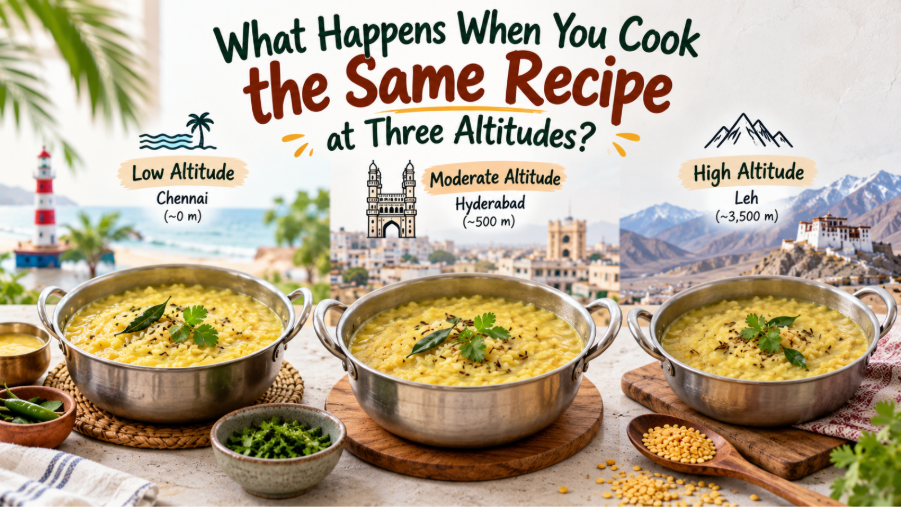
Imagine cooking the same pot of dal in coastal Chennai, Hyderabad, and the mountains of Leh. You use the same lentils, the same amount of water, and the same ingredients. Will the dal taste identical, or will the cooking process change with elevation?
For Indian cooking, where rice, dal, potatoes, and other ingredients often need to soften in boiling water, these differences can be particularly interesting.
Let’s explore a kitchen experiment that compares the same Indian recipe at three different altitudes and discover what physics can tell us about the food on our plates.
The Experiment: One Recipe, Three Altitudes
To make the comparison meaningful, we need a recipe that is familiar, affordable, and sensitive to changes in cooking conditions.
Our choice is simple moong dal khichdi.
Khichdi combines rice and lentils in one dish, making it useful for observing how grains soften, how much water they absorb, and how the final texture develops.
The three cooking locations
We will compare three hypothetical cooking environments:
| Environment | Example location | Approximate elevation category |
| Low altitude | Chennai | Near sea level |
| Moderate altitude | Hyderabad | Several hundred metres above sea level |
| High altitude | Leh | Several thousand metres above sea level |
These locations provide a useful Indian context, although the exact elevation varies within each city.
Important: This is a proposed experiment based on established cooking science, not a report of an experiment already performed. The results below describe what we would expect to happen. Actual cooking times and textures must be measured to establish the differences for a particular recipe and cooking setup.
Ingredients for the experiment
Use the same ingredients and quantities for every batch:
- ½ cup rice
- ¼ cup split yellow moong dal
- 3 cups water
- ¼ teaspoon turmeric
- Salt to taste
- 1 teaspoon ghee, added after cooking
For a controlled test, avoid adding extra vegetables, tomatoes, or other ingredients that could introduce additional variables.
Use the same rice and dal brands, the same pot design, and the same heat source where possible. Record the water temperature before heating, the time it takes to reach a boil, the total cooking time, and the final texture.
The Science: Why Altitude Changes Cooking
At higher elevations, the atmospheric pressure is lower. As a result, water boils at a lower temperature.
At sea level, pure water boils at approximately 100°C under standard atmospheric conditions. As elevation increases, the boiling point falls. For example, at an elevation of around 1,500 metres, water boils at roughly 95°C rather than 100°C, although the precise value depends on atmospheric pressure.
That difference may appear small, but it matters when food needs sustained heat to soften.
Consider what happens when you cook rice or lentils in boiling water. The ingredients absorb water and undergo physical and chemical changes that soften their structure. When the boiling water is cooler, these processes generally take longer.
Higher elevations can also have lower humidity, which may contribute to faster moisture loss during uncovered cooking. The effect depends on the local conditions and cooking method.
The key point is that boiling water does not become hotter simply because you turn up the stove. Under ordinary open-pot conditions, once the water is boiling, additional heat mainly increases the rate of boiling and evaporation.
Test 1: Does Khichdi Take Longer to Cook at Higher Altitudes?
This is the first thing we would investigate.
At low altitude, the boiling water reaches a higher temperature than it would at a high-altitude location. Under otherwise similar conditions, this generally allows the rice and lentils to cook more quickly.
At higher elevations, the lower boiling temperature can slow the softening process.
What we would expect
Low altitude: The khichdi may reach the desired softness sooner because the boiling water is hotter.
Moderate altitude: The difference may be relatively small, depending on the elevation, recipe, and cooking equipment.
High altitude: The khichdi may need more time to reach the same tenderness because the boiling temperature is lower.
However, there is no single cooking-time adjustment that works for every recipe. The type of lentil, rice variety, water quantity, pot shape, and heating method all affect the result.
A pressure cooker also changes the comparison because it raises the pressure inside the vessel, allowing water to reach temperatures above its normal open-pot boiling point. The exact behaviour depends on the cooker and its operating conditions.
How to record the result
For each location, record:
| Measurement | Low altitude | Moderate altitude | High altitude |
| Time for water to boil | Record | Record | Record |
| Total cooking time | Record | Record | Record |
| Rice texture | Record | Record | Record |
| Dal texture | Record | Record | Record |
| Final consistency | Record | Record | Record |
Do not fill in the cooking times before performing the experiment. The table is designed to capture actual measurements rather than invented results.
Test 2: Will the Rice and Dal Have Different Textures?
Cooking time is only part of the story. Texture is another useful observation.
Rice needs sufficient heat and water to soften. Lentils also need enough time and moisture to become tender. If the recipe is stopped at the same time in all three locations, the higher-altitude batch may be less cooked.
For example, the low-altitude khichdi might be soft and creamy while the high-altitude batch remains firmer.
But this is not guaranteed. If each batch is cooked until it reaches the same level of tenderness, the final textures may be quite similar.
That distinction matters: a longer cooking time does not necessarily mean a worse result.
The purpose of the experiment is to discover how much the cooking process needs to change to achieve a comparable result.
For a fair comparison, judge the khichdi using the same criteria each time:
- Are the rice grains soft?
- Has the moong dal broken down?
- Is the mixture creamy or grainy?
- Is there excess water?
- Does the dish hold its shape after resting for five minutes?
These observations will make the experiment more informative than simply comparing the time shown on a clock.
Test 3: Does the Water Disappear Faster?
Water loss is another variable worth measuring.
At higher elevations, lower atmospheric pressure can encourage liquids to evaporate more readily. Dry conditions may also contribute to moisture loss. However, evaporation depends on several factors, including the pot’s surface area, whether it is covered, the strength of the heat, and the surrounding humidity.
To investigate this, weigh the empty cooking pot first, then weigh it again after adding the ingredients and water. After cooking, weigh the pot and its contents once more, using the same procedure for every batch.
The difference can provide an estimate of how much mass has been lost during cooking, although spills and differences in food sticking to the pot can affect the measurement.
If the high-altitude batch needs a longer cooking time, it may lose more moisture unless the pot is covered or additional water is used.
This is why covering a pot can be useful when cooking grains and lentils at higher elevations.
What About Chapatis, Cakes, and Other Indian Foods?
Khichdi is just one example. The effects of altitude vary considerably across different cooking methods.
Chapatis and rotis
Chapatis are cooked on a hot tawa, so the boiling-point effect does not apply to them in exactly the same way it applies to food simmering in water.
Dough moisture, resting time, flour type, and tawa temperature remain important. At higher elevations, drier air can contribute to moisture loss, so keeping dough covered may be useful.
Cakes and baked foods
Altitude can affect baked goods because lower atmospheric pressure allows gases in the batter to expand more readily. This can change the structure of cakes and other leavened foods.
At sufficiently high elevations, recipes may need adjustments to leavening, liquids, sugar, or baking time. The appropriate adjustment depends on the recipe and the elevation.
Boiled potatoes
Potatoes cooked in an open pot may take longer to become tender at higher elevations because the boiling water is cooler.
If you are preparing potato curry or aloo paratha filling, this can influence how long you need to boil the potatoes before using them.
Pressure-cooked dal
Pressure cooking can reduce the impact of lower atmospheric pressure by allowing the food to cook at a higher temperature than it would in an ordinary open pot.
Nevertheless, elevation, cooker design, operating pressure, and the type of pulse can still affect cooking time. Follow the manufacturer’s instructions and check that the dal is fully cooked rather than relying entirely on a fixed number of minutes.
How to Make the Experiment Fair
If you want to turn this article into a real kitchen experiment, the most important step is to control the variables.
Use the same quantities of rice, dal, and water. Keep the pot dimensions consistent, use the same cooking method, and avoid changing the recipe between locations.
Also record the elevation and approximate local conditions.
For the strongest comparison, repeat each test at least three times. A single attempt can be affected by differences in heating, water temperature, ingredient age, or the moment when you decide the food is ready.
One important limitation is that cooking at three different locations introduces variables beyond altitude. A gas stove, an electric cooktop, and an induction stove can heat pots differently. Water hardness and humidity may also vary.
If you cannot cook at all three elevations, you can still conduct a useful experiment by comparing foods cooked in different locations with carefully documented methods. Just avoid claiming that altitude alone caused every difference unless other variables have been controlled.
The Final Verdict: Does Altitude Really Change Food?
Yes. The effect of altitude on cooking is real, particularly for foods that depend on boiling or simmering.
At higher elevations, lower atmospheric pressure reduces the boiling point of water. This generally means that rice, lentils, potatoes, and other foods cooked in boiling water may need more time to become tender.
The effect can be less noticeable at moderate elevations and more significant in mountainous regions. Pressure cookers and other cooking methods can also change the outcome.
But altitude does not automatically make food taste worse. With suitable adjustments to cooking time, moisture, and method, you can still prepare delicious khichdi, soft lentils, fluffy rice, and many other familiar dishes.
The most interesting lesson is that a recipe is not just a list of ingredients. It is also a relationship between food, heat, water, pressure, and time.
And the next time someone says their dal takes longer to cook in the mountains, you will know that there is real science behind that kitchen observation.
Sources