
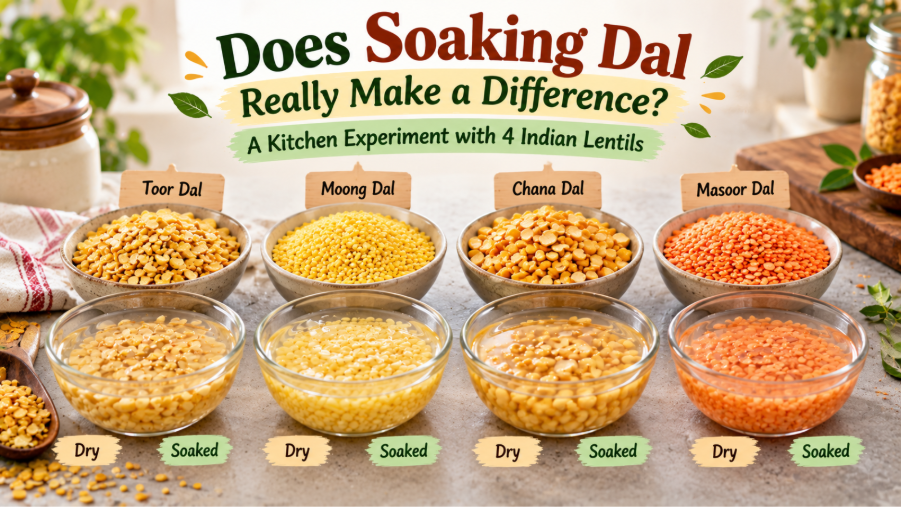
The benefits of soaking dal go beyond traditional cooking habits. Soaking can help certain pulses cook faster, soften more evenly, and reduce some compounds that may interfere with digestion or nutrient absorption. However, the effect depends on the type of dal, how long it is soaked, and how it is cooked.
Every Indian kitchen has its own dal routine. Some people soak lentils before cooking, while others rinse them, add water, and put the pressure cooker straight on the stove. But does soaking actually make a difference, or is it simply an extra step passed down through generations?
Let’s put four Indian kitchen staples- toor dal, moong dal, chana dal, and masoor dal-to the test with a simple kitchen experiment.
Benefits of Soaking Dal: What Does Science Say?
Soaking dry pulses allows water to enter the seeds, increasing their moisture content and softening their structure. This can reduce the amount of time required to cook them until tender.
Research also suggests that soaking can reduce certain antinutritional compounds, including some phytates, tannins, and oligosaccharides. The effect varies by pulse and soaking conditions, and cooking itself can further change these compounds. Soaking does not eliminate every antinutrient or guarantee that everyone will experience less digestive discomfort.
Here are the main potential benefits:
- Shorter cooking time: Hydrated pulses generally need less time to soften.
- Softer texture: Soaking can help water penetrate the pulse before cooking begins.
- Changes in digestibility: Soaking and cooking can reduce some compounds associated with digestive discomfort.
- Changes in nutrient availability: Some processing methods can reduce compounds that bind minerals, although soaking can also cause losses of certain water-soluble nutrients.
One important point: soaking is not essential for every type of dal. Split lentils often cook relatively quickly without it, while larger or denser pulses can benefit more from pre-soaking.
The Experiment: Four Dals, Two Cooking Methods
Let’s compare four common Indian lentils using two methods:
Method A: Unsoaked dal
Rinse the dal, add water, and cook without soaking.
Method B: Soaked dal
Rinse the dal, soak it in water, drain, and cook using the same method as the unsoaked sample.
For a fair comparison, use the same quantity of dry dal, the same cooking equipment, and the same final tenderness standard.
The experiment below is a proposed kitchen test, not a report of measurements already collected. Actual cooking times will vary with the pulse variety, age, water hardness, equipment, and pressure-cooker settings.
1. Toor Dal (Arhar Dal)
Common uses: Dal tadka, pappu, sambar, and everyday dal.
Toor dal is a staple in many Indian households. It is usually sold as split, dehulled pigeon peas, and it can take longer to soften than some smaller split lentils.
Test it:
- Sample A: Rinse and cook without soaking.
- Sample B: Rinse, soak for about 30-60 minutes, drain, and cook.
What to observe: Compare the time required for both samples to become completely tender. Check whether the grains mash easily and whether the finished dal has a smooth consistency.
Likely outcome: Soaking may shorten cooking time, although the difference can be modest for split toor dal in a pressure cooker.
Kitchen verdict: Soaking is useful when you have time to prepare ahead, but it may not be necessary for everyday pressure-cooked dal.
2. Moong Dal
Common uses: Moong dal, khichdi, dal soup, and light meals.
Split yellow moong dal is often among the quickest dals to cook. It can become soft and creamy without a long soaking period.
Test it:
- Sample A: Rinse and cook directly.
- Sample B: Rinse, soak for about 20-30 minutes, drain, and cook.
What to observe: Compare cooking time, texture, and how easily each sample breaks down when stirred.
Likely outcome: The soaked sample may cook somewhat faster, but the difference may be small because split yellow moong dal already cooks relatively quickly.
Kitchen verdict: If you’re making a quick weekday meal, soaking split yellow moong dal may not save enough time to justify the extra step.
Whole green moong is a different case. Its intact seed coat means it generally benefits more from soaking than split yellow moong dal.
3. Chana Dal
Common uses: Chana dal curry, dal fry, puran poli filling, and some South Indian preparations.
Chana dal consists of split chickpeas and is generally firmer than many smaller split lentils. It can take considerably longer to become soft, especially when cooked without soaking.
Test it:
- Sample A: Rinse and cook without soaking.
- Sample B: Rinse, soak for 2-4 hours, drain, and cook.
What to observe: Record the cooking time and check whether the centre of each piece is fully tender. Compare the texture after cooking and whether the dal holds its shape.
Likely outcome: Chana dal may show a more noticeable time difference than split yellow moong dal. However, the exact result depends on the dal’s age and the cooking method.
Kitchen verdict: Chana dal is a strong candidate for soaking, particularly when you want to reduce cooking time or prepare a dish that requires tender but intact grains.
4. Masoor Dal
Common uses: Masoor dal curry, lentil soup, and quick everyday meals.
Split red masoor dal is popular because it cooks relatively quickly and often breaks down into a soft consistency.
Test it:
- Sample A: Rinse and cook directly.
- Sample B: Rinse, soak for about 15-30 minutes, drain, and cook.
What to observe: Compare how quickly the dal softens, how much it breaks down, and whether the final consistency differs.
Likely outcome: A short soak may reduce cooking time, but the difference may be limited because split red masoor dal is already quick-cooking.
Kitchen verdict: For ordinary red masoor dal, soaking is often optional. If you are short on time, rinsing and cooking directly is usually practical.
The Results Table: What Should You Record?
Once you’ve tested the four dals, use a table like this to record your actual results.
| Dal | Soaking plan | Cooking time | Texture after cooking | Is soaking worthwhile? |
| Toor dal | 30-60 minutes | Record result | Record result | Depends on time saved |
| Split yellow moong dal | 20-30 minutes | Record result | Record result | Often optional |
| Chana dal | 2-4 hours | Record result | Record result | Often useful |
| Split red masoor dal | 15-30 minutes | Record result | Record result | Often optional |
Important: These are suggested soaking periods, not measured results. Fill in the cooking-time and texture columns only after completing the experiment.
For the most reliable comparison, cook each sample until it reaches the same level of tenderness rather than stopping both samples after the same number of minutes.
If you use a pressure cooker, follow its instructions and use adequate water. Cooking time measured on the stove should be distinguished from the time needed for pressure to build and release.
Does Soaking Dal Make It More Nutritious?
This is where the answer becomes more complicated.
Soaking can reduce some antinutritional compounds, such as phytates, that can bind minerals and reduce their absorption. However, the amount reduced varies depending on the type of pulse and the processing conditions. Studies have also found that soaking and cooking can change levels of certain vitamins and other compounds, so it is inaccurate to say that soaking automatically increases every nutrient.
Another reason people soak pulses is to reduce some oligosaccharides associated with intestinal gas. Research on lentils has found that soaking can reduce certain fermentable carbohydrates, although individual digestive responses differ.
For everyday cooking, the practical message is simple: soaking can be helpful, but it is not a magic nutritional upgrade. Eating a varied diet and cooking pulses properly remain important.
Should You Throw Away the Soaking Water?
For many everyday dal preparations, draining the soaking water and rinsing the pulses before cooking is a reasonable approach. Some water-soluble compounds may leach into the soaking water, including compounds that can contribute to digestive discomfort.
However, draining can also discard some water-soluble nutrients. The balance depends on the pulse and soaking conditions. There is no single method that maximises every nutrient in every situation.
A practical approach is to use clean water for soaking, avoid leaving pulses at warm room temperatures for excessively long periods, and refrigerate them if soaking overnight in a warm climate.
Always cook dal thoroughly. Soaking is a preparation step, not a substitute for cooking.
The Smart Indian Kitchen Strategy
Instead of soaking every dal automatically, match the method to the dish you’re preparing.
- Making quick moong dal? Rinse and cook directly if you’re short on time.
- Preparing chana dal? Soak ahead when possible to help reduce cooking time.
- Cooking toor dal for pappu or dal tadka? Try both methods and see whether soaking makes a meaningful difference with your pressure cooker.
- Making red masoor dal? Direct cooking is often convenient because split red lentils soften quickly.
- Cooking whole pulses? Consider soaking them for longer, as whole seeds generally need more time to hydrate.
You can also prepare ahead by soaking pulses in the refrigerator and cooking them when needed. Just remember that cooking times vary, so use tenderness-not the clock alone-as your final guide.
Final Verdict: Is Soaking Dal Worth It?
So, does soaking dal really make a difference? Yes, but the size of that difference depends on the dal.
Chana dal is often worth soaking because it can take longer to soften. Toor dal may benefit depending on your cooking method, while split yellow moong dal and split red masoor dal are often quick enough to cook without soaking.
The benefits of soaking dal include potentially shorter cooking times and changes to certain antinutritional compounds. But soaking also takes planning and may lead to small losses of water-soluble nutrients.
The best strategy is not to follow one rule for every pulse. Experiment with your usual brands, cooking equipment, and recipes, and record the results.
Your kitchen test may reveal that one dal benefits from soaking while another hardly changes at all. And that is the real lesson: traditional cooking habits are worth exploring, but a little practical science can help you decide which ones genuinely make your everyday cooking easier.
Sources