
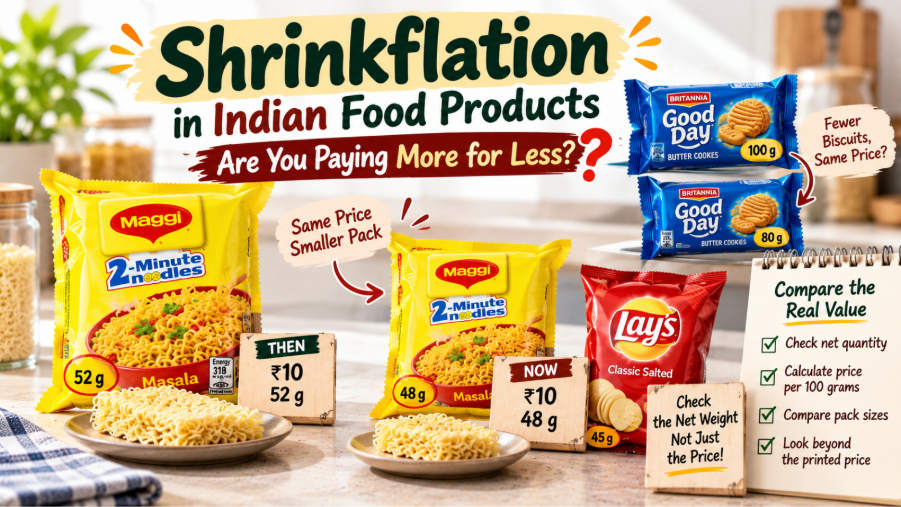
Have you ever opened your favourite biscuit packet and wondered why it seems to contain fewer biscuits than before? Or noticed that a familiar snack costs the same ₹10 but no longer lasts as long? You might be experiencing shrinkflation in Indian food products—a pricing strategy in which the quantity of a product decreases while its price remains unchanged.
From biscuits and instant noodles to chips and chocolates, package sizes can change over time. For shoppers who remember buying the same products for years, these changes can be difficult to notice. The printed price looks familiar, but the amount of food inside may be different.
So, are Indian consumers paying more for less? Let’s explore how shrinkflation works, examine reported examples, and learn how to calculate the real cost of everyday packaged foods.
What Is Shrinkflation in Indian Food Products?
Shrinkflation happens when a manufacturer reduces the quantity, weight, or size of a product without making a corresponding reduction in its price.
Imagine buying a packet of biscuits for ₹10. Previously, it contained 100 grams, but the manufacturer later reduces the quantity to 80 grams while keeping the price unchanged.
You still pay ₹10, but you receive 20% less product.
The price per gram rises from ₹0.10 to ₹0.125—a 25% increase.
This is why shrinkflation can be easy to overlook. Many shoppers remember the price of a familiar product more readily than its exact weight.
In India, small packs priced at ₹5, ₹10, and ₹20 are particularly relevant because they provide affordable entry points for consumers. Industry reporting has described manufacturers using smaller pack sizes to manage rising production costs while maintaining familiar price points.
However, not every small packet is an example of shrinkflation. To establish that shrinkflation has occurred, you need evidence that the quantity has decreased while the price has stayed the same.
Why Are Food Companies Reducing Pack Sizes?
Manufacturing food involves much more than purchasing ingredients. Companies must also pay for packaging, transport, energy, storage, labour, distribution, and retail operations.
When these expenses rise, manufacturers have several options: increase prices, reduce pack sizes, adjust their product ranges, or absorb some of the additional costs.
1. Rising ingredient costs
Ingredients such as wheat, sugar, edible oils, cocoa, and milk can experience price fluctuations.
For products made in large quantities, even a small increase in ingredient costs can affect production expenses significantly.
2. Packaging and transportation expenses
Packaging materials, fuel, and distribution costs also affect the final price of packaged foods.
A manufacturer may respond by changing the quantity inside a packet rather than immediately increasing the printed price.
3. Familiar price points
In India, a ₹5 or ₹10 snack is an established part of everyday shopping.
Increasing a product’s price from ₹10 to ₹12 is immediately noticeable. Reducing its weight while retaining the ₹10 price may be less obvious to shoppers who do not check the label.
For manufacturers, maintaining a familiar price point may help preserve affordability at the checkout. For consumers, however, the price per gram can increase even when the printed price does not.
Neither a price increase nor a pack-size reduction automatically means a company is acting improperly. The important question for shoppers is whether they understand how the product’s value has changed.
Real Examples: How Pack Sizes Can Change
Shrinkflation has been reported in several Indian packaged-food categories. Two examples illustrate why checking quantity matters.
Example 1: Instant noodles
In June 2026, NDTV Profit reported that certain Maggi instant noodle packs had undergone quantity reductions while their MRPs remained unchanged. Its report described a ₹10 pack changing from 52 grams to 48 grams.
Using those reported figures:
| Measurement | Earlier pack | Later pack |
| Price | ₹10 | ₹10 |
| Net quantity | 52 g | 48 g |
| Price per 100 g | ₹19.23 | ₹20.83 |
The new pack contains approximately 7.7% less product. The cost per 100 grams rises by approximately 8.3%.
The example demonstrates how a small change in quantity can increase the effective price without changing the amount paid at the checkout.
This is a reported example from June 2026, not a guarantee that every Maggi product or pack size has the same quantity today. Check the current label before buying.
Example 2: Biscuits and small snack packs
Indian consumer-goods reporting has also documented manufacturers using smaller quantities to maintain familiar prices for low-cost biscuits and other everyday products. A 2022 GlobalData report, for example, described a hypothetical 100-gram biscuit pack being reduced to 80 grams while remaining at ₹10.
The mathematics is straightforward:
| Measurement | Original pack | Smaller pack |
| Price | ₹10 | ₹10 |
| Quantity | 100 g | 80 g |
| Price per 100 g | ₹10 | ₹12.50 |
The smaller pack represents a 20% reduction in quantity and a 25% increase in price per 100 grams.
These figures illustrate the effect of a hypothetical reduction; they should not be interpreted as proof that a particular biscuit brand currently sells these exact pack sizes.
How to Calculate Whether You Are Paying More
You do not need an economics degree to identify a change in value. A calculator and the information printed on the package are enough.
Use this formula:
Price per 100 grams = (Pack price ÷ Net weight in grams) × 100
Let’s compare three hypothetical snack packets.
| Product | Price | Net weight | Price per 100 g |
| Snack A | ₹10 | 100 g | ₹10.00 |
| Snack B | ₹10 | 80 g | ₹12.50 |
| Snack C | ₹15 | 150 g | ₹10.00 |
Although Snack B costs the same as Snack A at checkout, it is 25% more expensive per 100 grams.
Snack C costs more in total but offers the same price per 100 grams as Snack A.
This is why comparing the printed price alone can be misleading.
For liquids, calculate the price per 100 millilitres instead. For products sold by count, compare the price per piece where the items are reasonably comparable.
Also remember that price per gram does not measure every aspect of value. Ingredients, nutritional composition, freshness, convenience, and personal preferences may matter too.
A Simple Supermarket Experiment: Investigate Five Products
Want to find out whether shrinkflation is affecting the products you buy? Try this practical experiment during your next grocery trip.
Step 1: Choose five familiar products
Select five packaged foods you purchase regularly, such as:
- Biscuits
- Potato chips
- Instant noodles
- Chocolate
- Packaged namkeen
Choose products with clearly printed net quantities and prices.
Step 2: Record the current details
Create a simple table with the product name, MRP, net weight, and price per 100 grams.
For example:
| Product | MRP | Net weight | Price per 100 g |
| Biscuit packet | ₹10 | 80 g | ₹12.50 |
| Chips packet | ₹20 | 45 g | ₹44.44 |
| Noodles packet | ₹10 | 48 g | ₹20.83 |
These are illustrative values for demonstrating the calculation, not a survey of current retail prices.
Step 3: Find an older package
If you have an older packet, a dated photograph, or a reliable retailer listing, compare its net quantity and MRP with the current product.
Be careful when using online listings. An old listing may be outdated, and different package variants may have different quantities.
Step 4: Calculate the difference
If the price remains unchanged, calculate the percentage reduction in quantity:
Percentage reduction = ((Old quantity − New quantity) ÷ Old quantity) × 100
For example, a reduction from 100 grams to 80 grams equals:
((100 − 80) ÷ 100) × 100 = 20%
If the price has also changed, calculate the price per 100 grams for both versions. That will reveal the combined effect of the price and quantity changes.
Step 5: Separate evidence from assumptions
A smaller packet does not prove shrinkflation by itself. It could be a different product variant or a new package size.
To make a credible comparison, record the dates, quantities, prices, and sources. If you cannot find reliable evidence of an older package, describe your findings as a comparison of current products rather than claiming that a manufacturer reduced its quantity.
This approach turns an everyday shopping observation into a small consumer investigation.
Is Shrinkflation Illegal in India?
A reduction in pack size is not, by itself, proof of an illegal practice. The relevant question is whether the product complies with applicable packaging and consumer-protection requirements.
India’s Department of Consumer Affairs explains that the Legal Metrology (Packaged Commodities) Rules require declarations on packaged products, including the manufacturer’s or packer’s details, net quantity, maximum retail price, and other applicable information. The department also lists unit sale price among the required declarations under the rules.
For consumers, the practical lesson is to check the declared quantity and price rather than judging a product by the size of its wrapper.
If you suspect that a package contains less than its declared net quantity, or that mandatory declarations are missing or misleading, you can consult the Department of Consumer Affairs’ official information on Legal Metrology to understand the applicable requirements.
A smaller product is not necessarily a violation. The circumstances and the applicable rules matter.
Five Ways to Protect Your Grocery Budget
You cannot control how manufacturers set their prices, but you can make more informed purchasing decisions.
1. Check net quantity every time. Do not assume that your usual product still weighs the same as it did last year.
2. Compare unit prices. Calculate the price per 100 grams or 100 millilitres to compare different pack sizes fairly.
3. Compare similar products. A premium product and a budget product may have different ingredients or quality, so price per gram is only one part of the comparison.
4. Check the full price, not just the discount. A promotional label does not necessarily mean a product is cheaper per unit than an alternative.
5. Track frequently purchased foods. Keep a simple note of the usual price and quantity of products you buy every week. It becomes easier to spot changes when you have a reliable reference.
Buying a larger pack is not always the best choice, either. It may offer a lower unit price but could lead to waste if the food expires before you finish it.
Final Verdict: Are You Paying More for Less?
Shrinkflation shows why the price printed on a packet does not always tell the whole story. When the quantity falls but the price remains unchanged, the cost per gram or millilitre rises.
Indian consumer reporting has documented pack-size reductions in everyday packaged-food categories, including instant noodles and biscuits. But individual products must be checked carefully before making claims about specific brands.
The next time you pick up your favourite snack, look beyond the familiar price. Check its net weight, compare the unit price, and look for reliable evidence if you suspect the quantity has changed.
The smartest grocery shopper is not necessarily the person who spends the least at checkout. It is the person who understands exactly what they are paying for.