
You buy a fresh bunch of coriander (dhaniya) for your curry, chutney, or dal. The leaves look bright green at the market, but a day or two later, they become limp, yellow, or unpleasantly slimy in the refrigerator. Before you know it, half the bunch ends up in the bin.
But why does coriander wilt so quickly, and can a simple storage trick help it last longer?
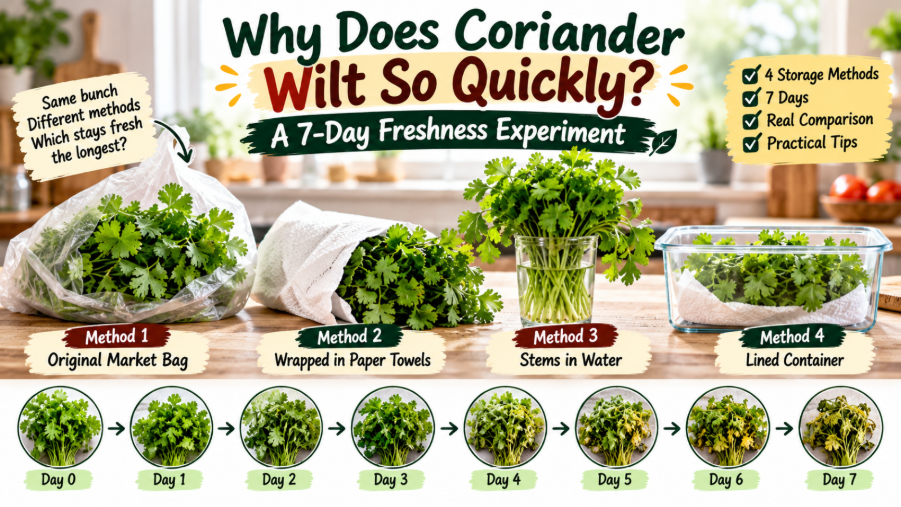
The answer lies in moisture loss, temperature, and how the leaves are stored. In this article, we’ll explore how to keep coriander fresh for longer by comparing four storage methods in a seven-day kitchen experiment. Rather than assuming one method works best, we’ll track the changes in appearance, moisture, smell, and usability to discover which method performs best in your kitchen.
Why Does Coriander Wilt So Quickly?
Coriander leaves are delicate and lose quality relatively quickly after harvesting. Once separated from the plant, they can no longer replace the water they lose to their surroundings.
Three main factors contribute to wilting and spoilage.
1. Moisture loss
Coriander leaves contain a high proportion of water. When they lose too much moisture, their cells lose firmness, causing the leaves and stems to droop.
Warm conditions and exposure to moving air can accelerate moisture loss. This is why a bunch left on a sunny kitchen counter may wilt much faster than one stored in a cool environment.
Research on fresh culinary herbs identifies water loss as an important cause of quality deterioration, particularly in leafy herbs such as coriander. University of California, Davis
2. Excess moisture and poor airflow
Although coriander needs to retain moisture, wet leaves trapped in a crowded container can deteriorate quickly.
Water droplets that remain between tightly packed leaves can create conditions that favour spoilage. Damaged leaves may also develop soft, discoloured areas.
The goal is not to make coriander completely dry or keep it soaking wet. Instead, aim for a cool environment that limits moisture loss without leaving the leaves persistently wet.
3. Temperature fluctuations
Leaving coriander at room temperature exposes it to warmer conditions than refrigeration.
Refrigeration generally slows deterioration in fresh coriander. However, storing it in a refrigerator does not guarantee a week of freshness: the starting quality, temperature, packaging, and handling all matter.
For this reason, the best storage method is one that manages moisture while keeping the bunch cool.
How to Keep Coriander Fresh for Longer: Four Methods to Test
Let’s compare four common storage methods using coriander purchased on the same day.
The experiment is designed for a typical home kitchen. You can use ordinary containers, paper towels, and a glass of water rather than purchasing specialised equipment.
Method 1: Store coriander in its original market bag
This is the simplest method and one many households use.
Place the bunch in its original bag and store it in the refrigerator.
What to observe:
- Whether the leaves remain firm.
- Whether condensation collects inside the bag.
- Whether the stems become limp.
- Whether yellow or discoloured leaves appear.
This method gives you a useful baseline for comparison. Its performance will depend on the bag’s material, the amount of trapped moisture, and the condition of the coriander when purchased.
Method 2: Wrap coriander in paper towels
Paper towels can absorb some excess moisture while providing a protective layer around the leaves.
For this test:
- Remove damaged or yellow leaves.
- If washing the coriander, dry it thoroughly.
- Wrap the bunch loosely in a clean, dry paper towel.
- Place it inside a suitable food-storage bag or container.
- Refrigerate it.
Check the towel daily. If it becomes noticeably damp, replace it with a clean one.
The aim is to prevent excess moisture from accumulating around the leaves without allowing them to dry out excessively.
Method 3: Store coriander stems in a glass of water
This method resembles placing fresh flowers in a vase.
Utah State University Extension recommends placing coriander stems in a container of water, loosely covering the leaves with a bag, and refrigerating the bunch. It advises changing the water every two days, with storage for up to approximately one week under suitable conditions. Utah State University Extension
To test the method:
- Trim a small amount from the bottom of the stems.
- Place the stems in a clean glass containing a little fresh water.
- Keep the leaves above the waterline.
- Loosely cover the leaves with a clean bag.
- Place the glass in the refrigerator.
- Replace the water every two days.
Check that the leaves do not become wet from condensation inside the covering.
This method is worth testing because the stems have access to water while the leaves are protected from excessive drying.
Method 4: Use a clean, lined food-storage container
For the fourth method, place coriander in a clean container lined with a paper towel.
First, remove damaged leaves and ensure the coriander is dry on the surface. Arrange it loosely rather than compressing the bunch into a tight mass.
Close the container and refrigerate it.
Check the leaves and paper towel every day. Replace the towel if it becomes wet, and remove any leaves that show signs of decay.
This method aims to balance moisture retention with the absorption of excess water.
It is important to test it rather than assume it will outperform the other methods. Container design, refrigerator conditions, and the initial freshness of the coriander may change the outcome.
The Seven-Day Coriander Freshness Experiment
Now comes the interesting part: comparing the four methods under similar conditions.
Important: The table below is a recording template, not a set of measured results. The winning method should be determined only after the experiment has been conducted.
What you need
- Four portions of fresh coriander.
- Four clean containers or suitable storage setups.
- Paper towels.
- A glass of water.
- Labels and a marker.
- A refrigerator.
- A phone camera for daily photographs.
Step 1: Choose comparable coriander
Purchase a fresh bunch and divide it into four portions of similar size.
Try to ensure that each portion contains a comparable amount of leaves and stems. Remove any already damaged leaves before starting.
Label the portions A, B, C, and D.
| Sample | Storage method |
| A | Original market bag |
| B | Paper towel inside a storage bag |
| C | Stems in water with a loose cover |
| D | Clean container lined with paper towel |
If you want a more reliable result, repeat the experiment with another bunch on a different day.
Step 2: Keep the conditions consistent
Place all four samples in the same refrigerator, away from direct contact with cooling vents or other areas that may create unusually cold conditions.
Keep the refrigerator temperature and storage location as consistent as possible.
Use separate, clean containers and avoid repeatedly handling the leaves.
Step 3: Photograph the samples every day
Take photographs at the beginning and on each of the following seven days.
Try to use the same lighting, background, and camera angle.
Record the condition of each sample in a table like this:
| Day | What to check |
| Day 0 | Initial colour, firmness, and freshness |
| Day 1 | Early wilting and condensation |
| Day 2 | Leaf firmness and moisture |
| Day 3 | Yellowing and changes in aroma |
| Day 4 | Limp stems or damaged leaves |
| Day 5 | Discolouration and visible spoilage |
| Day 6 | Overall appearance and usability |
| Day 7 | Final freshness and usable quantity |
The changes may not happen at the same rate in every sample. That is precisely what makes the experiment useful.
Step 4: Score freshness consistently
Use a simple visual scale to compare the samples.
| Score | Condition |
| 5 | Bright green, firm, and fresh-looking |
| 4 | Mostly fresh, with minor wilting |
| 3 | Noticeable wilting or yellowing, but still usable |
| 2 | Extensive deterioration; much of the sample is unsuitable |
| 1 | Spoiled or unusable |
Record the score daily, along with any observations about moisture or smell.
This is a simple home assessment rather than a scientifically validated freshness scale. Its value comes from applying the same criteria to all four samples.
Do not taste coriander to test whether it has spoiled. Discard samples showing slime, mould, or an unusual or unpleasant smell.
Step 5: Calculate the result
At the end of the seven days, compare the scores and the usable amount remaining in each sample.
You could also weigh each sample at the beginning and end, but remember that weight changes can reflect water loss as well as the removal of damaged leaves.
Your results table might look like this:
| Storage method | Day 7 freshness score | Usable coriander remaining | Main observations |
| Original market bag | Record your result | Record your result | Note condensation or wilting |
| Paper towel and bag | Record your result | Record your result | Check towel moisture |
| Stems in water | Record your result | Record your result | Check water clarity and leaf condition |
| Lined container | Record your result | Record your result | Check moisture and discolouration |
Once you have completed the experiment, you can identify the method that performed best under your specific kitchen conditions.
What Does Existing Research Suggest?
Although the experiment above still needs to be conducted, existing guidance gives us a useful starting point.
Utah State University Extension recommends refrigeration and describes both loosely covered paper-towel storage and the water-in-a-container method for coriander. Its guidance suggests that a refrigerated bunch stored with stems in water may last up to about one week under suitable conditions.
Meanwhile, research published in the Indian Journal of Horticulture examined a specially designed high-humidity storage box for coriander. Under the study’s ambient conditions of approximately 26–28°C, the box extended shelf life to 72 hours, compared with 48 hours for the study’s control method. This was a particular experimental setup, not a direct comparison of the four household methods in this article. Indian Journal of Horticulture study
These sources support the general idea that temperature, moisture, and packaging affect coriander’s shelf life. They do not establish which of our four household methods will win in every refrigerator.
Your experiment can provide a useful comparison for your own conditions, while keeping the difference between published research and personal observations clear.
Common Mistakes That Make Coriander Spoil Faster
Even a good storage method can fail if the coriander is handled poorly.
Storing it while dripping wet
If you wash coriander before storing it, remove excess surface water. Wet leaves packed tightly together may deteriorate more quickly.
You can also wash the coriander just before use, provided it has been stored appropriately beforehand.
Leaving damaged leaves in the bunch
Yellow, crushed, or decaying leaves reduce the overall quality of the bunch. Remove damaged leaves before storage and check the remaining leaves regularly.
Forgetting to change the water
If you use the glass-of-water method, change the water regularly and keep the container clean. Utah State University Extension recommends changing it every two days.
Keeping coriander on the kitchen counter
A bunch left out in warm conditions may lose moisture more quickly than one kept refrigerated. Refrigerate fresh coriander promptly rather than leaving it at room temperature for extended periods.
Ignoring signs of spoilage
Wilting alone does not necessarily mean coriander has spoiled, but slime, mould, or a distinctly unpleasant smell are reasons to discard it.
Do not try to rescue visibly spoiled coriander by washing it or removing only the affected leaves.
How to Keep Coriander Fresh for Longer Without Wasting It
You do not need to preserve every leaf perfectly to reduce food waste.
If you regularly buy coriander for chutney, curries, and garnishing, choose a storage method that suits how you use it.
- For frequent use: Keep a manageable portion in the refrigerator and check it daily.
- For a bunch with long stems: Try the glass-of-water method.
- For leaves that are already separated: Try a clean, lined container.
- For surplus coriander: Chop and freeze it for cooked dishes.
Frozen coriander will generally lose its crisp texture after thawing, so it is better suited to curries, sauces, and other cooked preparations than to fresh garnishes.
The most important habits are to buy reasonably fresh coriander, remove damaged leaves, maintain refrigeration, and avoid trapping excessive moisture around the leaves.
Final Verdict: Which Method Keeps Coriander Fresh the Longest?
The answer depends on the condition of the coriander when you buy it, your refrigerator, and how you store it.
Existing guidance supports refrigeration and offers both paper-towel and stem-in-water methods. But our four-way, seven-day experiment must be completed before we can declare one method the winner.
If you try it at home, photograph the samples daily and record the results. You may discover that one method works particularly well in your kitchen—or that two methods perform similarly.
Either way, a small change in how you store coriander could help you make better use of the bunch you buy, reduce avoidable food waste, and spend less time throwing away wilted leaves.