
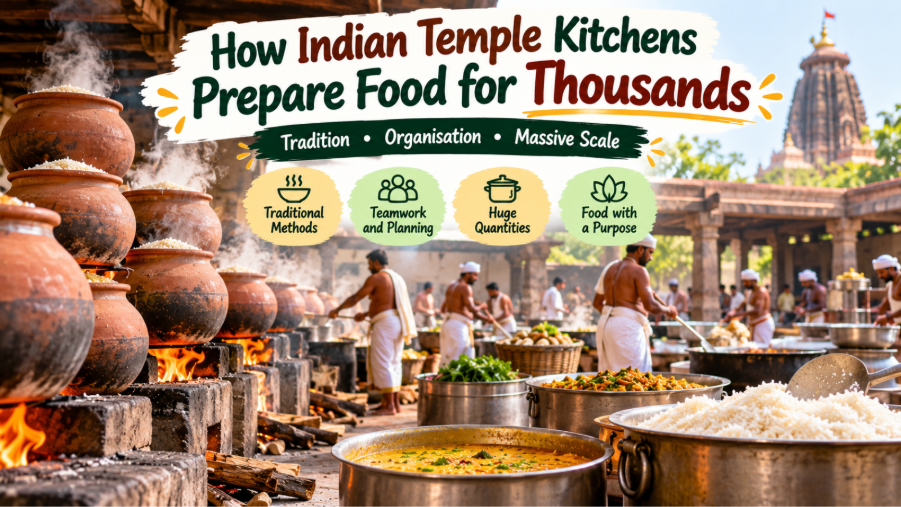
How Indian temple kitchens prepare food for thousands of people is a fascinating story of culinary tradition, organisation, and large-scale food production. From enormous cooking vessels to carefully coordinated preparation, these kitchens demonstrate how communities have developed ways to feed large numbers of people without relying entirely on modern machinery.
Imagine preparing lunch for 10 people. You need ingredients, cooking vessels, enough space, and careful timing. Now imagine preparing food for thousands of people every day, sometimes using traditional cooking methods that have existed for generations.
One remarkable example is the kitchen of the Shree Jagannath Temple, where Mahaprasad is prepared using traditional methods involving wood-fired ovens and stacked earthen pots. Modern meal-production facilities, such as those operated by The Akshaya Patra Foundation, offer another perspective on the challenge of preparing food at scale.
What can these kitchens teach us about cooking, planning, and feeding large communities?
1. The Jagannath Temple Kitchen: A Remarkable Culinary Tradition
In Puri, Odisha, food prepared for Lord Jagannath is known as Mahaprasad. It holds deep religious and cultural significance and is shared among devotees as part of the temple’s traditions.
According to Odisha Tourism, the temple’s traditional kitchen prepares a variety of foods using ingredients such as rice, lentils, vegetables, fruits, cottage cheese, and milk. Cooking takes place in earthen pots over wood-fired ovens, following established ritual practices.
What makes this system particularly interesting is the combination of scale and tradition. Large quantities of food must be prepared while maintaining the practices associated with the offering.
Rather than treating cooking as a single activity, the process involves several coordinated tasks: preparing ingredients, arranging cooking vessels, managing the fire, handling the cooked food, and ensuring that dishes are ready at the appropriate times.
The kitchen is therefore not simply a place where food is cooked. It is a working system built around a shared purpose.
2. Why Are Earthen Pots Stacked on Top of One Another?
One of the most intriguing features associated with the Jagannath Temple kitchen is its use of stacked earthen pots.
Traditional accounts describe food being cooked in pots placed one above another over a wood-fired heat source. Odisha Tourism notes the unusual tradition that the uppermost pot cooks first.
From a food-science perspective, this is an interesting example of heat transfer.
When water-containing food is heated, energy moves through the vessel and the surrounding steam. The precise temperature and cooking rate depend on factors such as the vessel’s position, its contents, the heat source, and the movement of steam.
However, the reported cooking sequence should not be treated as a universal rule of physics. Without measurements of the temperatures inside the individual pots, it is difficult to determine exactly why a particular pot cooks faster in a particular arrangement.
The broader lesson is that traditional cooking systems often rely on accumulated practical knowledge. Generations of cooks refine arrangements of vessels, ingredients, and heat to suit their kitchens and the foods they prepare.
This is an excellent reminder that traditional cooking deserves to be explored with both cultural respect and scientific curiosity.
3. Feeding Thousands Requires More Than Large Cooking Pots
A large pot can hold more food, but equipment alone cannot make a kitchen efficient.
Consider everything that must happen before a large meal is ready:
- Ingredients must be sourced in sufficient quantities.
- Rice, lentils, vegetables, and other ingredients must be prepared.
- Cooking vessels must be arranged and cleaned.
- Food must be cooked in the correct sequence.
- Finished dishes must be handled and distributed appropriately.
Each task depends on the others.
This is why large kitchens depend on coordination, established procedures, and clearly organised responsibilities.
The same principle applies to wedding caterers, community kitchens, school meal programmes, and large restaurants. The challenge is not simply cooking more food; it is making every stage work together.
4. The Modern Comparison: India’s Mega-Kitchens
Traditional temple kitchens are not the only example of large-scale Indian cooking.
The Akshaya Patra Foundation operates centralised kitchens that prepare meals for schoolchildren. According to the organisation, these facilities can typically produce up to 100,000 meals per day, depending on the kitchen. They use specialised equipment, including large cauldrons, rice chutes, and tanks for preparing dal and sambar.
These kitchens demonstrate a different approach to the same basic challenge: preparing large quantities of food reliably.
| Feature | Traditional temple kitchen | Modern centralised kitchen |
| Primary purpose | Religious offerings and associated food traditions | Large-scale meal production and distribution |
| Cooking approach | Traditional methods, including earthen pots in Puri | Mechanised and semi-automated equipment |
| Organisation | Established ritual practices and coordinated preparation | Scheduled production, specialised equipment, and operational controls |
| Distribution | Food offered and subsequently made available to devotees | Meals packed and transported to schools and other recipients |
| Key challenge | Maintaining tradition while preparing food at scale | Producing and delivering large quantities efficiently and safely |
These are broad comparisons, not claims that every temple or modern kitchen operates in exactly the same way.
The most important difference is that each kitchen is designed around its purpose. A temple kitchen follows its religious and cultural requirements, while a centralised school-meal kitchen must coordinate production with transport and delivery schedules.
Both illustrate the importance of planning.
5. What Can Home Cooks Learn From These Kitchens?
You do not need a giant kitchen to benefit from the principles used in large-scale food preparation.
Plan ingredients before cooking
Measure the rice, lentils, spices, and vegetables before you start. This reduces interruptions and makes it easier to follow the recipe.
Prepare ingredients in batches
If you are cooking several dishes, wash and cut the vegetables together where appropriate. Grouping similar tasks can save time and reduce repeated cleaning.
Match the cooking order to the recipe
Some ingredients need longer cooking times than others. Start with the components that require the most time, then prepare the remaining dishes so that everything finishes close to serving time.
Use suitable equipment
Choose a vessel large enough to hold the ingredients comfortably. Overfilling a pot can interfere with stirring and even cooking.
Keep food safety in the plan
Large quantities of cooked food need careful handling. Use clean equipment, avoid leaving perishable foods at room temperature for extended periods, and refrigerate leftovers promptly in suitable containers.
These habits are useful whether you are preparing dinner for a family or organising food for a community gathering.
6. Why These Kitchens Matter Beyond Food
Temple kitchens are more than examples of large-scale cooking. They are part of living cultural traditions.
In Puri, Mahaprasad connects food preparation with religious observance, community participation, and the sharing of a meal. Odisha Tourism describes it as an expression of devotion, equality, and community.
Food also creates a practical connection between people. A meal prepared in large quantities can serve visitors, bring communities together, and preserve culinary knowledge.
At the same time, modern institutional kitchens demonstrate how organised food production can support public nutrition programmes.
These examples have different goals, but both reveal something important: food preparation is not only about recipes. It also involves systems, people, resources, and shared values.
Final Thoughts: Tradition Meets the Science of Cooking
How Indian temple kitchens prepare food for thousands of people reveals an extraordinary intersection of tradition, organisation, and culinary practice.
The Jagannath Temple kitchen demonstrates how established methods, including cooking with stacked earthen pots, remain central to a living religious tradition. Modern centralised kitchens show how specialised equipment and coordinated workflows can produce meals at an enormous scale.
Neither example can be reduced to a single cooking trick. Their success depends on the interaction between ingredients, equipment, preparation, timing, and the people who carry out the work.
The next time you prepare a meal at home, consider borrowing one lesson from these kitchens: good cooking begins before the heat is switched on. Planning the ingredients, organising the work, and understanding the purpose of each step can make even an ordinary meal more manageable.