
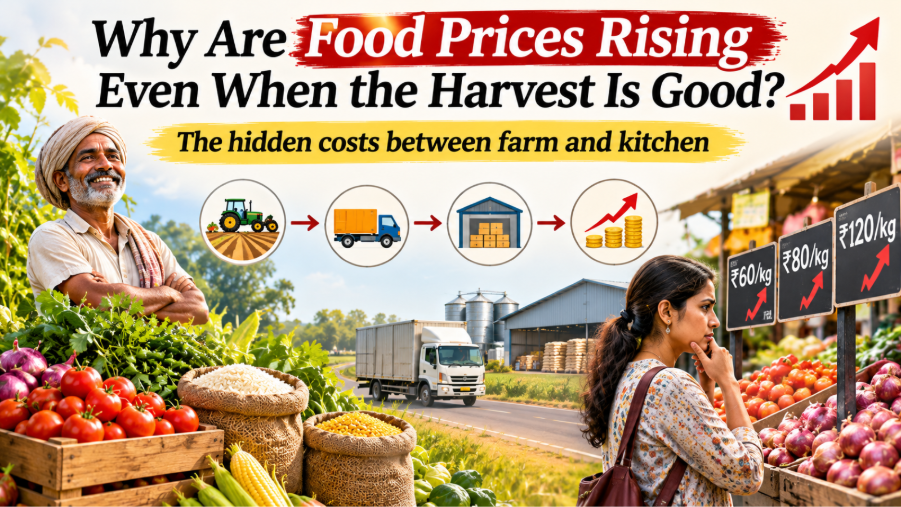
Have you ever wondered why food prices are rising even when farmers report good harvests and markets receive plenty of vegetables and grains? Despite abundant food supplies, consumers often find grocery prices surprisingly high.
It seems contradictory. If more food is available, shouldn’t prices fall?
In theory, increased supply generally puts downward pressure on prices. However, the journey from a farm to a consumer’s kitchen involves much more than harvesting crops. Transportation, storage, processing, labour, packaging, market demand, international trade and distribution all influence the final price.
This means that higher food prices cannot always be explained by agricultural production alone. A country can produce plenty of food while consumers continue to pay more at grocery stores and local markets.
1. A Good Harvest Doesn’t Mean Food Reaches Every Market
Agricultural production is geographically concentrated. A particular state or region may produce a large quantity of a crop, while another region depends heavily on supplies transported from elsewhere.
For example, a bumper tomato harvest in one region does not automatically mean tomatoes become cheap in every city.
Food must travel through multiple stages:
Farm → Collection centre → Wholesale market → Distributor → Retailer → Consumer
If transportation networks are disrupted, trucks become expensive, fuel costs rise, or market arrivals are delayed, prices may remain high in locations far from the production area.
Food availability at the farm level and food availability at the retail level are not necessarily the same thing.
2. Transportation Costs Can Eat Into the Benefits of a Good Harvest
Food transportation requires fuel, vehicles, drivers, loading labour, maintenance, and sometimes refrigeration.
When diesel prices, toll charges, transport wages, or vehicle operating costs rise, transporting food becomes more expensive.
These additional costs can be passed along the supply chain.
Consider a hypothetical example:
| Cost component | Earlier | Now |
| Farm purchase price | ₹20/kg | ₹18/kg |
| Transportation | ₹3/kg | ₹6/kg |
| Handling and wastage | ₹2/kg | ₹3/kg |
| Retail and other costs | ₹5/kg | ₹6/kg |
| Final price | ₹30/kg | ₹33/kg |
Even though the farmer’s selling price declined, the consumer’s price increased.
This demonstrates why a good harvest does not always translate into lower retail prices.
3. Storage Is a Major Hidden Cost
Many agricultural products are highly perishable.
Tomatoes, onions, potatoes, leafy vegetables, fruits, milk, and other fresh foods require careful storage to maintain quality.
Storage facilities may involve:
- Electricity
- Refrigeration
- Warehouse rent
- Labour
- Packaging
- Pest control
- Insurance
- Maintenance
If storage facilities are inadequate, businesses may lose food through spoilage.
These losses increase the cost of supplying the food that successfully reaches consumers.
In some cases, produce may be abundant immediately after harvest but become scarce several months later because it cannot be stored efficiently.
Therefore, a good harvest today doesn’t necessarily guarantee affordable food throughout the year.
4. Food Prices Depend on Timing, Not Just Total Production
Agricultural supply is seasonal.
Even if annual production is high, food may not arrive in markets evenly throughout the year.
For example, a crop might have:
- Large supplies during harvest
- Lower supplies several months later
- Increased demand during festivals
- Temporary supply disruptions during heavy rainfall
Prices can rise during periods when market arrivals are low, even if total annual production remains healthy.
This is particularly important for vegetables, fruits, and other crops that have limited storage life.
The timing of harvesting, transportation, storage, and distribution can sometimes matter as much as the total quantity produced.
5. Wholesale Prices and Retail Prices Are Different
Farmers, wholesalers, distributors, and retailers operate at different stages of the food supply chain.
The price paid to farmers is not the same as the price paid by consumers.
Between these two prices, businesses incur expenses related to:
- Sorting and grading
- Packaging
- Transport
- Market fees
- Storage
- Spoilage
- Labour
- Rent
- Retail operations
A fall in farm-gate prices may not immediately result in a similar reduction in retail prices.
This is because retailers may still be selling products purchased earlier at higher prices, or they may face increased operating costs.
The speed at which price reductions move through the supply chain can vary considerably.
6. International Markets Can Influence Domestic Food Prices
Some food products depend heavily on international markets.
India, for example, imports significant quantities of certain edible oils. When global prices rise, international freight becomes more expensive, currencies fluctuate, or exporting countries change trade policies, domestic prices can be affected.
Even when domestic agricultural production is good, imported ingredients and commodities may remain expensive.
The government has noted that international prices, supply-chain disruptions, and seasonal factors can contribute to food-price volatility.
This is one reason cooking oil prices may not fall simply because domestic crops have performed well.
7. Demand Can Rise Faster Than Supply
A good harvest increases supply, but prices also depend on demand.
If population growth, higher incomes, festive consumption, restaurant demand, or changing dietary habits increase demand, the additional food produced may not be enough to create a significant price reduction.
For example, demand for dairy products, eggs, meat, fruits, and packaged foods may increase as consumers change their consumption patterns.
If supply grows by 5% but demand grows by a similar amount, prices may remain relatively stable rather than falling dramatically.
Markets respond to the balance between supply and demand—not supply alone.
8. Food Waste Can Reduce the Effective Supply
Food produced isn’t necessarily food consumed.
Some produce is damaged during harvesting, transportation, handling, storage, and retail display.
For highly perishable foods, losses can occur at multiple stages.
Suppose farmers produce 100 tonnes of vegetables.
If 10 tonnes are lost before reaching consumers, the effective market supply becomes 90 tonnes.
Even when production is high, these losses reduce the amount of food actually available for purchase.
Improving cold storage, packaging, transportation, processing, and distribution can therefore help make food more affordable without requiring farmers to produce significantly more.
9. Market Intermediaries and Supply-Chain Inefficiencies
Agricultural markets involve several businesses that help connect farmers with consumers.
Intermediaries aren’t necessarily harmful—they often provide essential services such as collecting produce from small farmers, arranging transport, financing transactions, sorting products, and supplying retailers.
However, inefficient supply chains, limited competition, poor market connectivity, or excessive costs at multiple stages can increase the final price.
In certain circumstances, stockpiling or artificial shortages can also contribute to price pressure.
Indian government responses to food-price volatility include monitoring prices, releasing buffer stocks, adjusting import duties, changing export policies, and imposing stock limits where appropriate.
10. Why Food Prices Don’t Always Fall Immediately
Another important factor is the difference between inflation and price levels.
Inflation measures how quickly prices are increasing—not whether prices are returning to earlier levels.
For example:
- Year 1: Rice costs ₹50/kg
- Year 2: Rice rises to ₹60/kg
- Year 3: Rice rises to ₹63/kg
If inflation slows in Year 3, rice has not become cheaper. Its price has simply increased more slowly.
Consumers may hear that food inflation is declining and expect grocery bills to fall. But lower inflation generally means prices are rising at a slower rate, not necessarily decreasing.
This distinction explains why households may continue to feel that food is expensive even when inflation figures improve.
Can a Good Harvest Eventually Lower Food Prices?
Yes, but the impact depends on several conditions.
A good harvest is more likely to reduce prices when:
- Crops reach markets quickly.
- Transportation costs remain stable.
- Storage facilities are adequate.
- Food losses are limited.
- Supply is distributed efficiently.
- Demand doesn’t increase faster than supply.
- International prices don’t create additional pressure.
When these conditions work together, increased agricultural production can benefit both farmers and consumers.
However, if bottlenecks exist between farms and markets, the benefits of a bumper harvest may not fully reach consumers.
Conclusion
Food prices are influenced by much more than the amount of food grown.
A good harvest can increase agricultural supply, but transportation, storage, seasonal availability, international markets, demand, food losses, and supply-chain costs all determine what consumers eventually pay.
The next time someone asks why food prices are rising despite a good harvest, the answer may lie not in the farm—but somewhere between the farm and the kitchen.
More food produced doesn’t automatically mean cheaper food. The entire journey matters.