
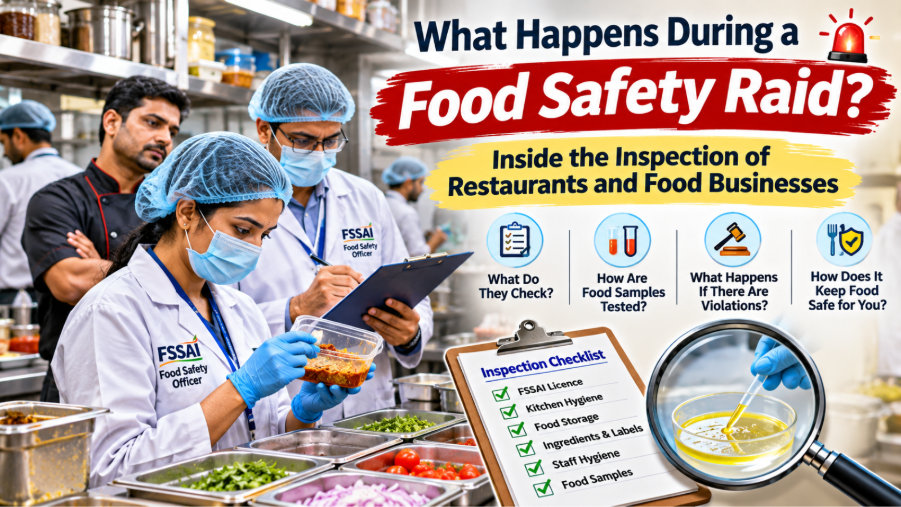
Have you ever watched a news report about food safety raids at a restaurant, where officers inspect the kitchen, collect food samples or confiscate suspicious ingredients? These operations often raise questions: What are officers actually looking for? Can they shut down a restaurant immediately? How do they identify adulterated or unsafe food?
Food safety inspections involve more than checking whether a kitchen looks clean. Officers may examine licences, storage conditions, food preparation practices, ingredients, equipment, records and the safety of food served to customers.
In India, food safety raids and inspections are governed primarily by the Food Safety and Standards Act, 2006, along with related regulations and procedures.
Let’s take a look inside a food safety inspection and understand what happens when officers enter a food business and discover violations.
1. What Triggers a Food Safety Inspection?
Not every food safety inspection is a dramatic raid.
Many inspections are routine and planned. Food businesses may be inspected based on their risk category, regulatory requirements, previous compliance history, or the nature of the food they handle.
Inspections can also be triggered by:
- Consumer complaints about unsafe food.
- Reports of suspected food poisoning.
- Information about food adulteration.
- Suspicion of illegal food storage or manufacturing.
- Complaints about unhygienic kitchens.
- Surveillance campaigns targeting specific food products.
- Special inspections during festivals or periods of increased food demand.
For example, during festival seasons, authorities may conduct special surveillance of sweets, milk products, edible oils, spices, and other commonly consumed foods.
FSSAI’s inspection framework generally aims at systematic compliance improvements. Prior notice may be given for routine inspections, but inspections responding to complaints or suspected violations may be conducted without prior notice. FSSAI
2. What Happens When Food Safety Officers Enter a Restaurant?
The first step is generally identifying the officers and establishing the purpose of the inspection.
Depending on the circumstances, officers may examine the premises, review documents, observe food preparation, inspect storage areas, and check whether the business is complying with applicable food safety requirements.
A restaurant’s inspection can cover several areas:
Licence and registration
Officers may check whether the food business has the required FSSAI registration or licence and whether it is appropriate for the type of business being operated.
Kitchen cleanliness
They may examine:
- Floors, walls, ceilings, and drainage.
- Food preparation surfaces.
- Cleaning and sanitising practices.
- Pest-control measures.
- Waste disposal arrangements.
- Handwashing facilities.
Food storage
Inspectors may check whether food is stored appropriately, protected from contamination, and kept under suitable temperature conditions.
Staff hygiene
They may observe food handlers’ cleanliness, protective clothing, handwashing practices, and whether employees are following appropriate hygiene procedures.
Equipment
Food Safety Officers may check food preparation equipment, refrigerators, freezers, utensils and storage containers for cleanliness, condition and suitability.
In India, food businesses must follow the hygiene and sanitation requirements outlined in Schedule 4 of the Food Safety and Standards regulations. FSSAI
3. How Do Officers Detect Adulterated or Unsafe Food?
One of the most important parts of food safety enforcement is identifying food that may be adulterated, contaminated, mislabelled, or otherwise non-compliant.
Officers don’t always rely on appearance alone. Some violations can be identified through observation, while others require laboratory testing.
Visual inspection
Officers may look for:
- Unusual colour or appearance.
- Signs of spoilage.
- Improper storage.
- Expired or damaged products.
- Suspicious ingredients.
- Unlabelled food products.
- Evidence of contamination.
However, a food product can look perfectly normal and still contain harmful contaminants or adulterants.
Checking labels
Packaged food may be examined for information such as:
- Product name.
- Ingredient list.
- Manufacturing and expiry or best-before information, as applicable.
- Manufacturer details.
- FSSAI licence information.
- Required declarations.
- Packaging integrity.
Incorrect or misleading labelling can itself be a regulatory issue.
Food sampling
When officers suspect a product may be non-compliant, they can collect samples for analysis.
For example, samples may be collected from:
- Milk and milk products.
- Edible oils.
- Spices.
- Sweets.
- Packaged foods.
- Drinking water.
- Prepared food.
- Ingredients used in manufacturing.
The sample is then sent through the prescribed process for laboratory examination.
4. What Happens When Food Samples Are Collected?
Food sampling is a formal legal procedure—not simply taking a food item away for testing.
Under Section 47 of the Food Safety and Standards Act, the sampling procedure includes giving the prescribed notice, handling and sealing samples appropriately, and following the required process for analysis and custody.
In the standard procedure, a sample is generally divided into portions for analysis and safe custody, with provisions allowing the food business operator to request analysis through an accredited laboratory. The precise procedure can vary according to the applicable rules and circumstances. IndiaCode by eCourtsIndia
The result may reveal whether the food meets standards or whether a violation has occurred.
This is why a food product shouldn’t automatically be declared adulterated merely because officers collected it during an inspection. Laboratory results and the applicable legal process may be required.
5. What Do Food Laboratories Actually Test?
Laboratory analysis depends on the food product and the suspected violation.
Tests may examine:
| Food Product | Possible Testing Areas |
| Milk | Fat, solids, adulterants, quality parameters |
| Edible oils | Purity, composition, adulteration |
| Spices | Colour additives, contaminants, adulterants |
| Sweets | Ingredients, permitted additives, contaminants |
| Meat products | Microbial contamination and other safety parameters |
| Water | Microbiological and chemical quality |
| Packaged food | Composition, contaminants, additives, labelling compliance |
For example, if authorities suspect that a spice contains an unauthorised colour, laboratory testing may be needed to establish whether the substance is present and whether it violates the applicable standards.
Similarly, a food that appears fresh may still require microbiological testing if there is suspicion of contamination.
The laboratory is often the difference between suspicion and scientifically supported evidence.
6. Can Food Safety Officers Seize Food or Shut Down a Business?
Yes, authorities may take enforcement action when they identify serious violations. However, the action depends on the nature of the violation and the applicable legal provisions.
Under the Act, Food Safety Officers can inspect premises and, when the law permits, search for and seize food or adulterants suspected of involvement in an offence.
Possible enforcement actions may include:
- Collecting samples for testing.
- Seizing suspected unsafe food.
- Issuing notices requiring corrective action.
- Initiating proceedings for violations.
- Imposing penalties through the appropriate legal process.
- Suspending or cancelling licences in appropriate cases.
- Taking action that restricts operations where legally authorised and warranted.
What happens to seized food?
Food Safety Officers may seize food when they have reason to suspect a connection with a violation.
If the seized food is perishable, deteriorated and unfit for consumption, the Act allows authorities to destroy it following the prescribed procedure.
The exact action depends on the circumstances, the evidence, and the applicable provisions.
A restaurant is not necessarily permanently shut down simply because officers visit or collect samples. Enforcement decisions depend on the seriousness of the findings and the legal process.
7. What Happens After a Laboratory Report Finds a Violation?
The investigation does not necessarily end with the preparation of the laboratory report.
Under the statutory process, the Food Analyst sends the analysis report to the Designated Officer, who reviews the findings and determines the appropriate next steps.
Depending on the nature and seriousness of the violation, the matter may lead to:
- Penalties.
- Adjudication proceedings.
- Further investigation.
- Prosecution.
- Additional enforcement action.
The Food Safety and Standards Act distinguishes between different types and levels of violations. Not every non-compliance results in criminal prosecution.
For example, certain violations may attract monetary penalties, while more serious offences may involve prosecution under the applicable provisions.
The severity of the violation, the evidence, and the relevant legal provisions determine the outcome. IndiaCode by eCourtsIndia
8. Are Food Safety Inspections Really Happening Across India?
Yes. Food safety enforcement involves inspections, surveillance drives, sampling, laboratory testing, and regulatory action across the country.
According to government information reported through the Press Information Bureau, during 2022–23, 2023–24, and 2024–25, authorities conducted risk-based inspections as follows:
| Financial Year | Risk-Based Inspections |
| 2022–23 | 11,904 |
| 2023–24 | 18,098 |
| 2024–25 | 26,267 |
The number of risk-based inspections increased over these three financial years. High-risk food businesses are subject to inspection requirements under the risk-based inspection framework. Press Information Bureau
These figures highlight the scale of food safety monitoring and enforcement in India.
9. How Are Inspections Recorded Today?
Food safety inspections increasingly use digital systems rather than relying entirely on paper records.
FSSAI uses FoSCoRIS, which stands for Food Safety Compliance through Regular Inspection and Sampling.
The platform supports digital inspections, inspection reporting, sample registration, and documentation. It helps standardise inspections and maintain records of regulatory activities. FSSAI
Digital reporting can help improve:
- Documentation.
- Inspection traceability.
- Sample tracking.
- Record management.
- Transparency.
- Consistency in inspection procedures.
This is important because food safety enforcement involves many businesses, officers, samples, laboratories, and regulatory decisions.
10. What Should Consumers Do When They Suspect Unsafe Food?
Food safety isn’t only the responsibility of inspectors. Consumers can also play an important role in identifying potential problems.
If you suspect unsafe food:
Keep evidence
If possible, retain the packaging, bill, photographs, and relevant details about the food.
Avoid consuming the suspected product
Don’t continue eating food that appears spoiled, contaminated, or potentially unsafe.
Report the concern
Consumers can report food safety concerns through the relevant food safety authorities.
Seek medical attention when necessary
If you experience symptoms such as severe vomiting, diarrhoea, dehydration, high fever, or other concerning symptoms after eating, seek appropriate medical care.
A complaint may help authorities investigate a food business or product, especially when multiple consumers report similar problems.
The Bottom Line
A food safety raid may look dramatic from the outside, but the actual process involves much more than entering a restaurant and confiscating food.
Officers may examine licences, kitchen hygiene, storage practices, ingredients, equipment, food preparation procedures, and records. When necessary, they collect samples for laboratory testing. The results can lead to corrective actions, penalties, seizures, licence-related action, or prosecution depending on the nature and seriousness of the violation.
Sources