
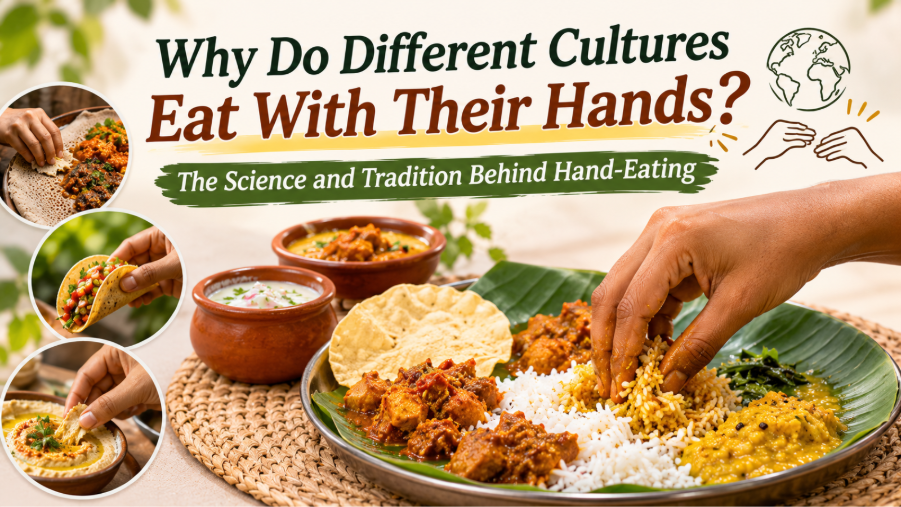
Have you ever wondered why people eat with their hands in many parts of the world? From enjoying rice and curry in India to eating injera in Ethiopia or sharing bread and dips in the Middle East, people have used their hands as an essential part of eating for centuries.
But why do some cultures traditionally eat with their hands while others rely heavily on forks, spoons and chopsticks? Is it simply tradition, convenience, or does touching food actually change the eating experience?
The answer involves culture, sensory perception, food texture, human behaviour and the relationship between our hands and brain. Eating is not just about taste; it is a multisensory experience, and touch plays a bigger role than many people realise.
Let’s explore the traditions, science and practical reasons behind this everyday eating habit.
1. Eating With Hands Is Deeply Connected to Culture and Tradition
In many cultures, eating with hands is not simply a way of consuming food. It is an important part of cultural identity, family traditions, hospitality, and social connection.
In India, for example, eating rice with dal, curry, or other accompaniments using the fingers is common in many households. The technique varies depending on the region, food, and personal preference.
Similarly, in Ethiopia, injera—a soft, fermented flatbread—is traditionally used to scoop up stews and other dishes. In several Middle Eastern cultures, bread is used to pick up dips, meat, and other foods.
These traditions developed over generations, shaped by the types of food people prepared, the ingredients available, social customs, and everyday eating practices.
In many communities, eating with hands also creates a sense of familiarity and connection. Meals may be shared from common dishes, encouraging conversation, hospitality, and togetherness.
The practice isn’t necessarily about avoiding utensils. It reflects how food, culture, and social life have evolved together.
2. Your Hands Are Part of Your Sensory Experience of Food
We often think that taste comes primarily from the tongue, but eating involves several senses working together.
Before food enters your mouth, you may already have experienced it through:
- Sight
- Smell
- Touch
- Temperature
- Texture
When you touch food, your fingers provide information about its consistency, temperature, moisture, and structure.
For example, when eating rice with curry using your fingers, you can feel whether the rice is soft, whether the curry is too hot, how much moisture it contains, and how the ingredients combine.
This information contributes to the overall eating experience.
Your brain constantly combines sensory information from different sources to help you perceive food. Touch is one part of this process, which is why the physical experience of handling food can make eating feel different from using a utensil.
3. Does Touching Food Make It Taste Better?
Could food actually taste better when eaten with your hands?
The answer is not straightforward. Touching food doesn’t automatically improve its flavour, but the sensory experience can influence how we perceive and enjoy it.
Food perception is influenced by expectations, visual appearance, texture, aroma, temperature, and the way food is presented.
For instance, eating a soft roti with curry using your fingers allows you to combine the two foods directly. You can adjust the amount of curry, rice, or other ingredients in each bite.
This creates a level of control over the combination of textures and flavours.
In contrast, eating the same meal with a fork may produce a different eating experience because the way food is picked up, combined, and delivered to the mouth changes.
The flavour itself may not change chemically, but your overall perception and enjoyment can change.
4. Why Certain Foods Are Easier to Eat With Your Hands
Hand-eating is particularly practical for foods that naturally lend themselves to being picked up, shaped, folded, dipped, or combined.
Examples include:
| Food | Why Hands Work Well |
| Roti or chapati | Easily torn into pieces and used to scoop curry |
| Rice and dal | Can be combined into manageable bites |
| Injera | Functions as both food and a scoop |
| Sandwiches | Designed to be held |
| Tacos | Ingredients can be held together in a folded structure |
| Fruits | Many fruits are naturally handheld |
| Fried snacks | Easy to pick up without additional utensils |
Food traditions often develop around the physical characteristics of the foods people eat.
A cuisine containing flatbreads, rice, thick stews, dips, or handheld snacks may naturally encourage particular eating techniques.
The method of eating is often closely connected to the food itself.
5. Your Fingers Help You Judge Food Temperature
One practical advantage of touching food is that your fingers can help you assess temperature before eating.
If you touch a piece of freshly cooked roti or a portion of rice, you can get an immediate indication of how hot it is.
This can help you adjust the size of a bite or wait before eating.
However, fingers aren’t perfect temperature sensors, and touching hot food doesn’t guarantee that it is safe to eat. Food can still be dangerously hot internally even when its surface feels manageable.
Still, temperature awareness is one of the sensory benefits that naturally comes with handling food.
6. Hand-Eating Can Change How You Interact With Your Meal
Eating with hands often involves more active participation.
Instead of simply picking up a prepared bite with a utensil, you may:
- Tear bread.
- Mix rice and curry.
- Combine different ingredients.
- Shape food into a bite.
- Adjust the amount of each component.
This can make eating feel more interactive.
The process may also encourage greater awareness of the food’s texture, moisture, and composition.
However, it doesn’t necessarily mean that people who eat with their hands always eat more slowly or mindfully. Eating speed depends on many factors, including hunger, habits, portion size, social circumstances, and the type of food.
The method of eating is just one part of the overall experience.
7. Why People Eat With Their Hands: The Psychology of Familiarity
Food habits are often learned early in life.
Children observe how their parents, grandparents, and other family members eat. They gradually develop eating habits that feel natural and comfortable.
If someone grows up eating rice with their fingers, that method may feel more intuitive than using a fork. Someone raised in a culture where cutlery is standard may experience the opposite.
These habits can become associated with comfort, family meals, memories, and belonging.
The psychological experience of eating is therefore influenced not only by the food but also by the familiar rituals surrounding it.
A traditional meal eaten in the same way you experienced it during childhood may feel comforting partly because it reminds you of familiar people, places, and experiences.
This is one reason eating practices can be emotionally meaningful even when the food itself is identical.
8. Is Eating With Hands More Hygienic or Less Hygienic?
This is one of the most common questions surrounding hand-eating.
The answer depends on hygiene—not whether someone uses their hands or utensils.
Hands can carry microorganisms that may transfer to food. Utensils can also become contaminated if they are not properly cleaned.
Before eating with your hands, good hygiene practices include:
- Wash your hands with soap and clean water.
- Clean underneath your fingernails.
- Wash your hands after using the bathroom.
- Avoid touching food if your hands have open wounds.
- Keep shared food-serving utensils clean.
- Avoid touching ready-to-eat foods after handling raw meat.
Proper handwashing is particularly important before eating because hands frequently come into contact with surfaces, phones, door handles, and other objects.
Eating with clean hands is a normal and safe practice in many cultures.
9. Does Eating With Hands Make You Eat More Mindfully?
It potentially can, but it depends on the individual.
When eating with hands, you may become more involved in preparing each bite. This could increase awareness of food texture, portion size, temperature, and the combination of ingredients.
For some people, this makes meals feel more engaging.
However, there is no universal rule that hand-eating automatically improves mindfulness, digestion, or health.
Mindful eating is primarily about paying attention to hunger, fullness, flavours, textures, and the eating experience. It can be practised whether you eat with your hands, a spoon, chopsticks, or a fork.
The important factor is your awareness—not the utensil you use.
The Bottom Line
Eating with your hands is much more than a traditional habit. It reflects the relationship between culture, food structure, sensory perception, family traditions, and human behaviour.
Our fingers help us experience food through touch, judge texture, combine ingredients, and interact directly with meals. Cultural traditions also shape which eating methods feel natural, comfortable, and meaningful.
So, why people eat with their hands isn’t explained by one reason alone. It’s a combination of history, practicality, sensory experience, and culture.
The next time you eat rice and curry, tear a piece of roti, or scoop up a delicious dip with bread, remember that your hands are doing more than helping you eat—they’re participating in a multisensory experience that humans have enjoyed for generations.