
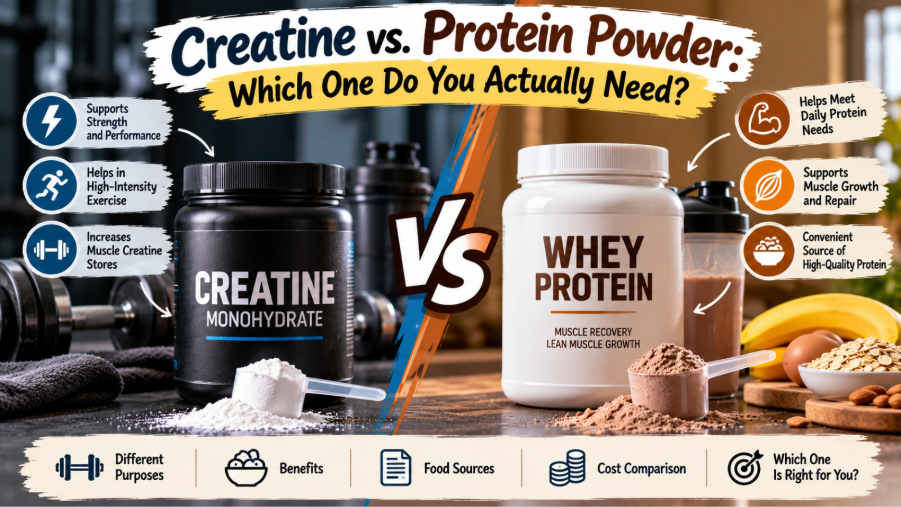
Walking into a supplement store can be confusing, especially when you see shelves filled with protein powders, creatine tubs, pre-workout drinks, and muscle-building formulas. If your goal is to build muscle, improve strength, or recover better after workouts, you may wonder whether you should buy creatine or protein powder first. Understanding creatine vs protein powder can help you choose what actually supports your fitness goals instead of spending money on supplements you may not need.
Although both supplements are popular among gym-goers, they serve different purposes. Protein powder helps you meet your daily protein requirements, while creatine supports the body’s energy system during short, intense activities such as weightlifting and sprinting.
Neither supplement is essential for everyone. Your diet, training routine, budget, and fitness goals should guide your decision.
Creatine vs Protein Powder: What’s the Difference?
The biggest difference is what each supplement does inside your body.
Protein powder provides protein, which supplies amino acids needed to build and repair tissues, including muscle. It is essentially a convenient source of dietary protein, similar in purpose to foods such as eggs, milk, fish, chicken, soy, and lentils.
Creatine helps your muscles rapidly regenerate ATP, a molecule your cells use for energy. Your body produces some creatine naturally, and you also obtain it from foods such as meat and fish. Creatine supplements can increase the amount stored in your muscles, helping support repeated high-intensity exercise.
Here’s a quick comparison:
| Feature | Creatine | Protein powder |
| Main purpose | Supports strength and high-intensity exercise | Helps meet daily protein needs |
| How it works | Increases muscle creatine stores | Supplies amino acids |
| Primary benefit | Can improve performance in repeated intense efforts | Supports muscle growth and repair when protein intake is sufficient |
| Best-known form | Creatine monohydrate | Whey, casein, soy, pea, or blended protein |
| Typical use | Taken consistently, including rest days | Used when convenient to meet daily protein needs |
| Required for muscle growth? | No | Adequate protein is necessary, but powder is not |
| Can food provide it? | The body makes creatine, and some foods contain it | Yes, through protein-rich foods |
Both can support a fitness routine, but they are not interchangeable. Creatine does not replace dietary protein, and protein powder does not provide the same performance benefits as creatine.
Which One Is Better for Building Muscle?
The answer depends on what your body needs most.
Choose protein powder if you struggle to eat enough protein
Protein powder can be useful if your meals do not provide enough protein to support your training and recovery.
For example, if you regularly eat rice, roti, vegetables, and other foods but have few protein-rich ingredients, adding eggs, milk, curd, dal, beans, tofu, paneer, or a protein shake can help improve your overall intake.
Whey protein is made from milk and is a convenient option for people who tolerate dairy. Plant-based alternatives, such as soy or pea protein, may suit people who avoid dairy.
However, protein powder is not automatically better than whole foods. You can build muscle without it if you consistently get sufficient protein from your diet.
Choose creatine if you want to support strength and training performance
Creatine may be useful if you regularly perform resistance training, sprinting, or other high-intensity activities.
Research indicates that creatine supplementation can improve performance during repeated short bursts of intense exercise and support training adaptations. Creatine monohydrate is the most extensively studied form. PubMed Central (PMC)
It is not a steroid, and it does not directly build muscle without training. Its benefits work alongside a suitable workout routine and adequate nutrition.
Can you take both?
Yes. Creatine and protein powder have different roles, so they can be used together when appropriate.
For example, someone who is not getting enough protein from food and wants to improve performance during weight training may find both useful. Someone who already eats enough protein but wants additional support for high-intensity training may choose creatine alone.
Neither supplement is a substitute for consistent training, sufficient sleep, or a balanced diet.
How Much Protein Do You Need to Build Muscle?
Your daily protein requirement depends on your body weight, activity level, age, and training goals.
For people who exercise regularly, sports-nutrition guidance commonly places daily protein needs around 1.4–2.0 grams per kilogram of body weight, although individual requirements vary.
For example, a person weighing 70 kg might aim for approximately 98–140 grams of protein daily during regular training. This is a general sports-nutrition range, not a requirement for every person.
You can get protein from everyday foods, including:
- Eggs and milk
- Chicken and fish
- Paneer and curd
- Dal, chickpeas, and kidney beans
- Soybeans and tofu
- Nuts and seeds, which also provide fats and other nutrients
Protein powder can fill a gap when food alone does not meet your needs. It is not necessary to consume a shake after every workout if your overall diet already provides enough protein.
Creatine vs Protein Powder: Which Is Better on a Budget?
If you have a limited budget, you do not need to purchase every supplement recommended at the gym.
Start by evaluating your current diet and workout routine.
| Your situation | Practical priority |
| You rarely eat protein-rich foods | Improve your protein intake first |
| You already eat enough protein | Protein powder may be unnecessary |
| You want to improve strength during weight training | Creatine may be worth considering |
| You are a beginner at the gym | Focus on training, nutrition, and consistency |
| You cannot afford supplements | Use affordable whole-food protein sources |
| You already meet your protein needs and want performance support | Consider creatine monohydrate |
For an affordable diet, consider eggs, milk, curd, dal, chickpeas, soy chunks, and other locally available protein-rich foods.
A useful rule: Meet your basic nutritional needs before spending money on supplements designed to provide additional benefits.
How Should You Take Creatine and Protein Powder?
If you decide to use either supplement, understand how each is commonly used.
Creatine
Creatine monohydrate is the most widely studied form. A common maintenance dose for healthy adults is 3–5 grams daily. A loading phase is optional, not essential, and you do not need to take creatine only before or immediately after your workout.
Some people experience an increase in body weight because creatine increases water stored in muscles. This is not the same as gaining body fat. Office of Dietary Supplements
Protein powder
Use protein powder when it helps you reach your daily protein target. Follow the product’s serving instructions and check how much actual protein each serving contains.
You can mix it with water or milk, or add it to foods such as oatmeal. The best timing is the timing that fits your routine and helps you meet your nutritional needs consistently.
You do not need to take protein powder and creatine together. If you use both, they can be mixed into the same drink, provided the products are suitable for you.
Safety note: If you have kidney disease, another medical condition, or take medication that may interact with supplements, consult a healthcare professional before starting. Choose products from reputable manufacturers with independent quality testing when available.
Common Mistakes to Avoid
When comparing creatine and protein powder, avoid these common mistakes:
- Expecting supplements to replace training: Neither works as a shortcut to building muscle.
- Buying protein powder without checking your diet: You may already get enough protein from food.
- Expecting creatine to work immediately: Its benefits depend on consistent use and training over time.
- Assuming weight gain from creatine is fat gain: Some initial weight gain can reflect increased water retention.
- Ignoring sleep and recovery: Poor recovery habits can undermine your training progress.
- Buying expensive formulas unnecessarily: A basic protein powder or plain creatine monohydrate may be sufficient for your needs.
Remember that supplements vary in quality, and marketing claims can exceed what scientific evidence supports. The NIH recommends prioritising a nutritionally adequate diet and evaluating supplements carefully. Office of Dietary Supplements
Final Verdict: Which One Do You Actually Need?
The answer to creatine vs protein powder depends on your biggest nutritional or training gap.
If you struggle to consume enough protein, start by improving your diet. Protein powder is a convenient option if food alone does not meet your needs.
If you already eat enough protein and want to support strength and repeated high-intensity exercise, creatine monohydrate may be a useful addition.
If your diet is balanced and you are progressing well in the gym, you may not need either supplement right now.
Build your foundation first: eat well, train consistently, sleep sufficiently, and allow your body to recover. Supplements should support those habits—not replace them.
Sources