
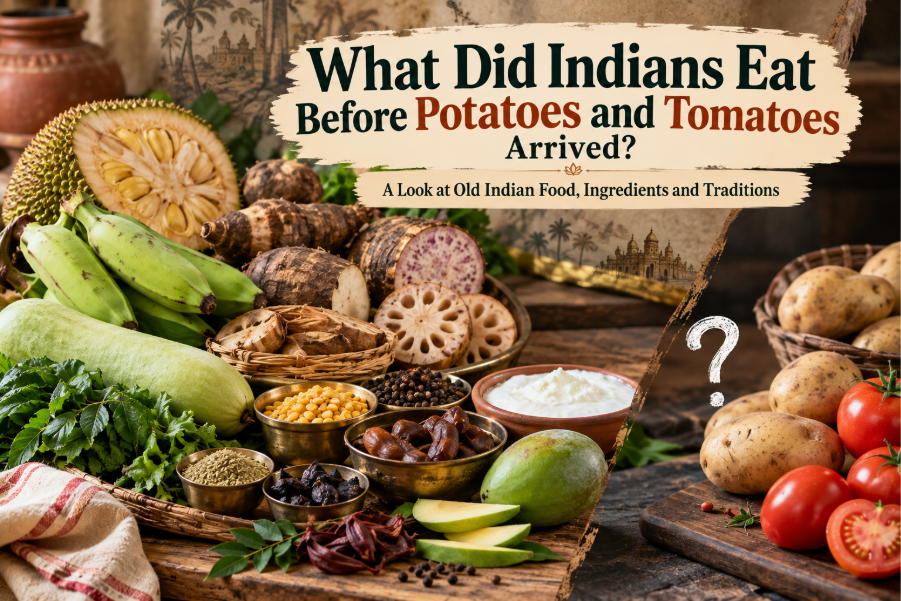
Today, it is difficult to imagine Indian food without potatoes and tomatoes.
Potatoes appear in samosas, aloo parathas, curries and snacks. Tomatoes form the base of countless gravies, chutneys and modern Indian dishes.
But neither ingredient is native to the Indian subcontinent.
So what did Indians eat before potatoes and tomatoes became part of everyday cooking?
The answer is not a single forgotten dish or ingredient. Indian cooks already had an enormous variety of grains, pulses, vegetables, fruits, roots, souring agents, spices and cooking techniques.
Potatoes and tomatoes eventually became important additions to this existing food culture rather than creating Indian cuisine from scratch. Historical research shows that New World crops changed Indian cooking considerably, but their arrival and adoption happened at different times.
Let’s take a look at what Indian kitchens could have looked like before the familiar combination of aloo, tomato and chilli became so common.
When Did Potatoes and Tomatoes Come to India?
The history is more complicated than the popular story suggests.
Potatoes, tomatoes and chilli peppers originated in the Americas and reached the Old World after the Columbian Exchange.
Potatoes were being cultivated in parts of India by the 17th century. A historical study cites observations from the 1670s describing potatoes in western India.
Tomatoes followed a different path. Although tomatoes reached India earlier through global trade, evidence suggests that they took much longer to become an everyday ingredient in Indian cooking. Some food historians place their widespread culinary adoption much later, particularly during the 19th century.
That means there wasn’t one particular day when Indian cuisine suddenly changed.
Instead, these ingredients gradually moved through trade networks, farms, markets and kitchens.
What Did Indians Eat Before Potatoes?
The absence of potatoes didn’t mean Indian meals lacked filling or starchy foods.
India already had a huge variety of indigenous crops and vegetables.
1. Yams
Yams were an important source of starch in several regional cuisines.
Different varieties could be boiled, roasted, fried or cooked with spices.
Their substantial texture made them useful in preparations where modern cooks might automatically reach for a potato.
2. Colocasia or Arbi
Colocasia, commonly known as arbi in several parts of India, has a long culinary tradition.
It can be boiled, fried, roasted or cooked in gravies.
Even today, arbi remains an important ingredient in many regional dishes.
3. Raw Banana
Raw banana is another versatile ingredient that can provide a firm, starchy texture.
Across different Indian cuisines, it is used in curries, fries, koftas and traditional preparations.
4. Sweet Potato
Sweet potatoes are also part of India’s long history of tuber-based foods and are particularly familiar in regional and fasting cuisine.
5. Jackfruit
Young jackfruit has a naturally meaty texture and absorbs spices well.
In several parts of India, raw jackfruit has traditionally been prepared as a vegetable or curry.
6. Lotus Root
Lotus is not only a plant associated with Indian culture and religion.
Its edible roots have also been used in regional cooking, particularly in parts of North and East India.
These ingredients show that Indian cooking already had many ways of creating hearty, substantial dishes before the potato became popular.
What Did Indians Use Instead of Tomatoes?
This is perhaps the more surprising part of the story.
Modern Indian cooking frequently uses tomatoes to provide:
- Sourness
- Moisture
- Body
- Colour
- Mild sweetness
- Acidity
But Indian cuisine had developed many other ways to achieve those characteristics.
Tamarind
Tamarind is one of the most important traditional souring ingredients in Indian cuisine.
It is especially prominent in many South Indian and coastal preparations.
Its deep, rounded acidity can completely transform a dish.
Raw Mango
Raw mango provides a bright, sharp sourness.
It can be used fresh or dried and powdered into amchur, which is particularly important in North Indian cooking.
Kokum
Kokum is strongly associated with western and coastal Indian cuisines.
It contributes a distinctive fruity acidity to curries, dals, drinks and other preparations.
Yogurt
Yogurt provides both acidity and richness.
It can form the base of gravies, marinades and cooling accompaniments.
Pomegranate
Dried pomegranate seeds, known as anardana, provide a fruity sourness and are used in various North Indian preparations.
So Indian cooking did not need tomatoes to create tangy food.
It already had a remarkably diverse collection of souring ingredients.
A historical review of Indian cuisine specifically notes the importance of ingredients such as tamarind, kokum and other traditional souring agents before the tomato became widespread.
What About Indian Food Before Red Chilli?
There is another major ingredient that arrived from the Americas: chilli pepper.
Today, chilli is so closely associated with Indian food that it seems ancient.
But chilli peppers are not native to India.
Before chilli became widespread, Indian cooks already used sources of pungency and heat such as:
Black Pepper
Black pepper is native to the Indian subcontinent and has been an important spice in Indian cooking for centuries.
Long Pepper
Pippali, or long pepper, was another traditional source of pungency.
It has a distinct flavour and a long history in South Asian food and traditional medicine.
Ginger
Fresh and dried ginger contributed warmth and pungency to many dishes.
Mustard
Mustard seeds and mustard oil provided another characteristic form of heat.
The arrival of chilli therefore didn’t introduce the idea of spicy food to India.
It introduced a new type of heat that Indian cooks eventually incorporated into countless regional cuisines.
Research on the evolution of Indian cuisine identifies chilli, potato and tomato among the major New World crops that transformed Indian cooking.
What Did Indian Curries Look Like Without Tomatoes?
The modern onion-tomato curry base is so familiar that it can feel ancient.
But Indian cooking has never had one universal curry formula.
Before tomatoes became common, cooks could create rich gravies using ingredients such as:
- Coconut
- Yogurt
- Ground lentils
- Sesame
- Poppy seeds
- Almonds
- Cashews
- Onions
- Spices
- Tamarind
- Kokum
- Reduced cooking liquids
Different regions developed different combinations.
A coconut-based curry from the western coast could be completely different from a yogurt-based preparation in the north or a tamarind-based dish in the south.
This regional diversity existed long before the tomato became a common ingredient.
What Did People Eat Instead of Aloo Samosas?
The samosa itself has a much older history than the potato filling most Indians know today.
Early versions of stuffed fried pastries travelled through Central and West Asian food traditions before becoming established in South Asia.
Their fillings could vary depending on the region and period.
Meat, onions, peas, nuts and other ingredients could be used.
The potato eventually became one of the most popular fillings because it was inexpensive, filling and highly adaptable.
So the familiar aloo samosa is a later evolution of a much older food tradition.
What About Aloo Paratha?
The same principle applies to aloo paratha.
The potato made an exceptionally useful filling because it could be boiled, mashed, seasoned and stuffed into dough.
But the paratha itself did not depend on potatoes.
Indian flatbread traditions are far older and include numerous varieties made from wheat, millet, rice and other grains.
The potato simply created another extremely popular version.
Indian Food Was Never Static
One of the biggest mistakes we can make when discussing traditional food is imagining that there was once a fixed version of “authentic Indian cuisine.”
Indian food has always changed.
Ingredients moved through:
Trade → migration → agriculture → markets → households → adaptation
New ingredients were accepted, modified and combined with existing techniques.
That is how a foreign crop could eventually become something that feels completely Indian.
From Foreign Crops to Indian Staples
Today, it is easy to forget that many familiar ingredients have travelled across continents.
| Ingredient | Origin | Role in modern Indian food |
| Potato | Andes, South America | Curries, snacks, breads and fillings |
| Tomato | Americas | Gravies, chutneys and sauces |
| Chilli pepper | Americas | Heat and seasoning |
| Peanut | South America | Snacks, chutneys and cooking |
| Maize | Americas | Regional breads and snacks |
| Cashew | Brazil | Sweets, gravies and snacks |
The Columbian Exchange brought numerous New World crops into the Old World, and several eventually became deeply integrated into Indian cuisine.
Why Does This History Matter?
The story isn’t simply about discovering which ingredients are “foreign.”
It tells us something much more interesting about food.
Cuisine evolves.
Ingredients travel.
Cooks experiment.
Families adapt recipes.
Regions develop their own versions.
And eventually, something that was once unfamiliar can become part of a culture’s everyday food identity.
The potato may have originated thousands of kilometres away, but today aloo paratha is unquestionably part of Indian food culture.
The tomato may have arrived much later than many of India’s traditional ingredients, yet tomato-based curries are now central to countless modern kitchens.
That’s the fascinating thing about food history.
What feels ancient isn’t always ancient.
And what was once foreign can eventually become completely at home.
Final Thoughts
So, what did Indians eat before potatoes and tomatoes?
They ate an enormous variety of foods.
They cooked with yams, arbi, raw banana, jackfruit, gourds, leafy vegetables, grains and pulses.
For sourness, they relied on tamarind, raw mango, kokum, yogurt and other traditional ingredients.
For heat, they had black pepper, long pepper, ginger and mustard long before chilli became a staple.
Indian cuisine didn’t need potatoes and tomatoes to be diverse.
Instead, these ingredients eventually joined an already sophisticated food tradition and were transformed by Indian cooks into dishes that are now considered classics.
And perhaps that’s the most interesting lesson of all:
Indian cuisine isn’t defined by where every ingredient came from. It’s defined by what generations of cooks did with those ingredients.