
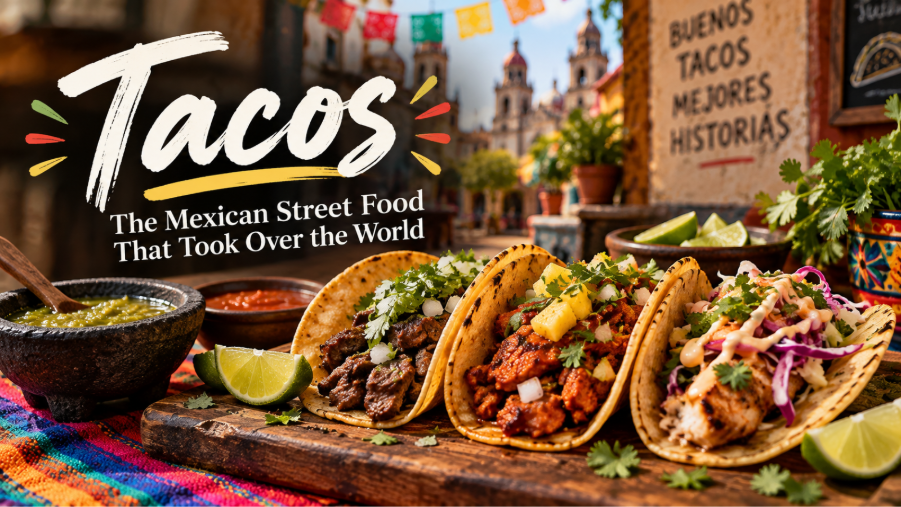
Few foods are as easy to recognize as a taco. A warm tortilla folded around a flavorful filling may look simple, but inside that fold is an entire food culture built around contrast, freshness, texture, and bold seasoning.
Tacos began as a deeply rooted part of Mexican food culture and gradually became one of the world’s most recognizable street foods. Today, they appear everywhere from neighborhood taquerías and food trucks to upscale restaurants and home kitchens.
Yet the taco’s global success isn’t really about one recipe. It is about an incredibly adaptable format: something warm, something savory, something fresh, and a little heat, all held together in one tortilla.
A Tortilla at the Center
The tortilla is more than a wrapper.
In Mexican cooking, tortillas have been a foundational food for centuries, particularly tortillas made from corn. Their flavor and texture provide the base on which the rest of the taco is built.
Corn tortillas bring a distinctive earthy character, while flour tortillas are softer and more flexible and are particularly associated with northern Mexican traditions.
The choice of tortilla can completely change the experience.
A delicate corn tortilla lets the filling take center stage. A soft flour tortilla creates a different kind of richness and chew.
Either way, the taco begins with something remarkably humble.
The Art of the Filling
There is no single taco filling.
That is one of the reasons the food has traveled so successfully.
A taco can contain slow-cooked meat, grilled beef, seafood, vegetables, beans, mushrooms, cheese, or combinations of several ingredients.
Some of the most recognizable styles include carne asada, featuring grilled beef; carnitas, traditionally made with slow-cooked pork; barbacoa, associated with tender, slow-cooked meat; and tacos al pastor, known for marinated pork cooked on a vertical spit.
Each filling brings a different texture and flavor.
The tortilla provides the foundation, but the filling gives the taco its personality.
Tacos Al Pastor and the Power of the Spit
Few tacos are as visually distinctive as al pastor.
Thin slices of marinated pork are traditionally stacked on a vertical spit and cooked slowly as the exterior develops caramelized edges. The meat is sliced directly from the spit and commonly paired with ingredients such as onion, cilantro, salsa, and pineapple.
The technique has an interesting history, reflecting cultural exchange and adaptation within Mexican cuisine.
It is also a perfect example of what makes tacos so compelling: smoky meat, acidity, sweetness, herbs, heat, and tortilla all meet in a single bite.
The Salsa Is Not an Afterthought
Ask someone what makes a taco memorable, and they might mention the meat.
Ask someone who loves tacos, and they may talk about the salsa.
Salsas can completely change the character of a taco.
A bright green salsa can bring acidity and freshness. A roasted red salsa can add smokiness. A fiery chile-based salsa can transform an otherwise mild filling.
There are also salsas built around dried chiles, fresh herbs, tomatoes, tomatillos, onions, and other ingredients.
The important idea is balance.
A good salsa shouldn’t simply make a taco hotter. It should make the taco taste more complete.
Onion, Cilantro, Lime-and Contrast
The toppings on a taco often look modest.
A handful of chopped onion. Fresh cilantro. A squeeze of lime.
But these small additions perform important jobs.
Rich meat benefits from acidity. Fatty fillings benefit from freshness. Soft ingredients become more interesting when paired with crisp or crunchy elements.
This is why tacos rarely depend on one dominant flavor.
Instead, they are built around contrast.
Rich and bright. Soft and crisp. Savory and acidic. Mild and spicy.
That balance is one of the taco’s greatest strengths.
Soft or Crispy?
The soft-versus-crispy taco debate is almost a category of its own.
Traditional Mexican tacos are commonly built with soft tortillas, allowing the tortilla and filling to work together.
Crispy-shell tacos developed their own identity, particularly as Mexican-inspired food spread internationally.
Both versions have their appeal.
Soft tacos are flexible, tender, and closely connected to the tortilla itself. Crispy tacos introduce a completely different texture and a satisfying crunch.
The important thing is not deciding that one is universally better.
It is understanding that the shell changes the entire eating experience.
Fish Tacos Changed the Conversation
Tacos don’t need to be heavy.
Fish tacos demonstrate how light and fresh the format can become.
Grilled or battered fish can be paired with cabbage, lime, salsa, creamy sauces, herbs, and other fresh ingredients.
The combination is particularly effective because seafood provides a relatively delicate base for stronger acidic and spicy elements.
Fish tacos also helped introduce the taco format to audiences who might not immediately associate tacos with grilled or fried seafood.
Tacos Go Vegetarian
The taco is remarkably friendly to vegetables.
Roasted mushrooms can bring a meaty texture. Charred corn introduces sweetness. Beans provide richness. Grilled peppers bring smokiness. Avocado contributes creaminess.
Even simple vegetables become more exciting when combined with salsa, lime, herbs, and a warm tortilla.
This flexibility has helped tacos move beyond their traditional meat-centered image without losing the character of the format.
Why Street Food Made Tacos Global
There is something inherently social about tacos.
They are quick to assemble, easy to customize, and designed to be eaten without complicated tableware.
That makes them ideal street food.
A taco can be prepared to order, passed directly to the customer, finished with salsa and herbs, and eaten within minutes.
This immediacy helped the format travel.
As Mexican food became more widely known internationally, tacos became one of its most accessible ambassadors.
People didn’t need to understand every element of Mexican cuisine to understand a taco.
They only needed to take a bite.
The Global Taco
Once tacos traveled beyond Mexico, they began changing.
Restaurants adapted fillings to local ingredients. Chefs experimented with seafood, vegetables, different meats, fusion sauces, and unconventional toppings.
Some interpretations stay closely connected to Mexican traditions. Others are unmistakably inspired by local food cultures.
That creates an interesting question:
At what point does a taco stop being Mexican and become something new?
There is no simple answer.
Food has always traveled, changed, and adapted. The taco’s global journey is simply a particularly visible example of that process.
Tacos in India
India is an especially interesting place for tacos because the format already feels familiar.
Indian food has a long tradition of flatbreads, spiced fillings, chutneys, pickles, fresh herbs, and contrasting textures.
That makes the taco surprisingly easy to understand.
Indian restaurants and home cooks can create tacos using paneer, tandoori vegetables, spiced chicken, beans, corn, or other ingredients while adding Indian-style chutneys and masalas.
The result may not be a traditional Mexican taco-and it doesn’t have to be.
The format provides a bridge between two food cultures that both value bold seasoning and layered flavors.
The Taco’s Secret Is Its Size
A taco is small enough to encourage experimentation.
Instead of committing to one large dish, diners can try several fillings.
One taco can be smoky.
The next can be spicy.
Another can be fresh and citrusy.
Another can be completely vegetarian.
That makes tacos particularly well suited to modern dining, where variety and customization are part of the experience.
What Makes a Great Taco?
Despite all the variations, the best tacos usually share a few characteristics.
The tortilla should complement the filling rather than disappear beneath it.
The main ingredient should be properly seasoned.
There should be enough moisture and richness to make the taco satisfying, but not so much that it becomes difficult to eat.
Fresh ingredients should bring contrast.
And the salsa should enhance the filling rather than simply overpower it with heat.
A great taco is not necessarily complicated.
It is balanced.
More Than a Trend
Tacos may look like another global food trend, but their story is much deeper.
Their popularity comes from a food tradition with generations of history, regional diversity, cooking techniques, and cultural identity.
The global taco boom did not create the food.
It introduced more people to something that was already deeply established.
That distinction matters.
Behind every trendy taco menu is a much older culinary tradition.
The Fold That Keeps Evolving
Perhaps the taco’s greatest achievement is its ability to remain recognizable while constantly changing.
The tortilla stays.
The basic idea stays.
But the filling, salsa, toppings, cooking method, and flavor combinations can move in almost any direction.
That is why tacos can belong to a roadside stand in Mexico, a food truck in Los Angeles, a restaurant in London, or a contemporary kitchen in India without feeling completely out of place.
They are simple enough to understand and flexible enough to reinvent.
And that may be the real reason tacos took over the world.
Not because there is one perfect taco, but because there is a taco for almost everyone.