
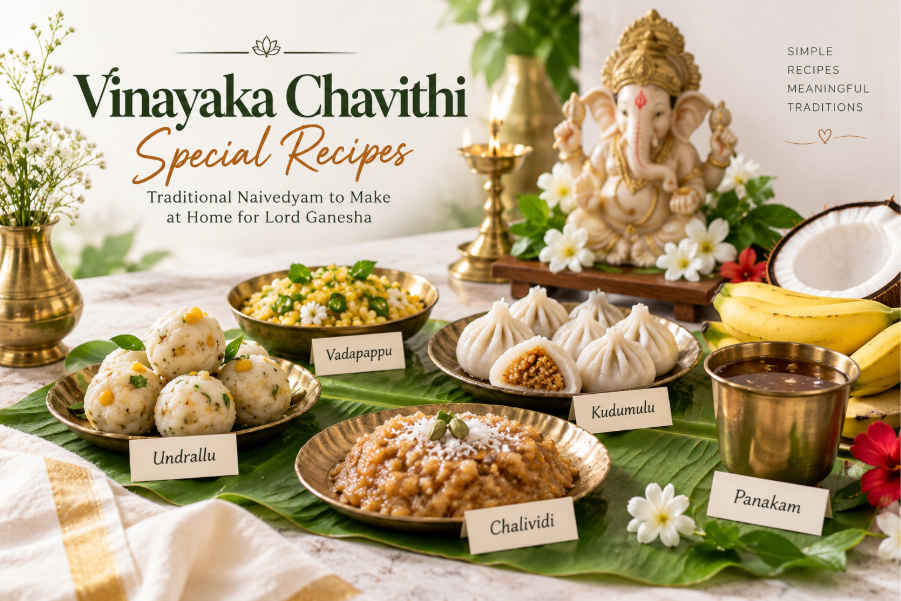
Vinayaka Chavithi is a festival filled with devotion, family traditions, flowers, prayers, and, of course, food prepared with love.
In many Telugu households, the food offered to Lord Vinayaka is simple, homemade, and deeply connected to tradition. Rice flour, jaggery, coconut, lentils, fruits, and seasonal ingredients come together to create a special naivedyam that is prepared specifically for the occasion.
Among the most familiar offerings are Undrallu, Kudumulu, Chalividi, Vadapappu, and Panakam. Each preparation has its own taste and texture, making the final naivedyam plate both festive and comforting.
If you are celebrating Vinayaka Chavithi at home, here is a traditional-style menu you can prepare in your own kitchen.
1. Undrallu
Undrallu are one of the most traditional Telugu offerings associated with Vinayaka Chavithi.
These soft steamed rice balls are made with rice rava and dal and are particularly satisfying because they are naturally simple and lightly seasoned.
Ingredients
- 1 cup rice rava
- ¼ cup chana dal
- 2 cups water
- 1 teaspoon ghee
- A pinch of salt
- 1 teaspoon cumin seeds
- 1-2 green chilies, finely chopped, optional
How to Make Undrallu
- Wash the chana dal and soak it for around 20-30 minutes.
- Heat a little ghee in a thick-bottomed pan.
- Add cumin seeds and, if using, finely chopped green chili.
- Add water and bring it to a boil.
- Add the soaked chana dal and a small pinch of salt.
- Slowly add the rice rava while continuously stirring to prevent lumps.
- Cook until the mixture becomes thick and leaves the sides of the pan.
- Allow it to cool enough to handle.
- Grease your hands lightly with ghee or water and shape the mixture into small round balls.
- Steam the balls for approximately 10-15 minutes until firm and cooked through.
Serve the Undrallu warm as part of the naivedyam.
2. Sweet Kudumulu
Kudumulu are another beloved Vinayaka Chavithi preparation. The sweet version is made from rice flour and filled with a mixture of coconut and jaggery.
They are closely related to the modak family of Ganesha offerings, but their preparation and name vary across regions and households.
Ingredients
For the outer covering:
- 1 cup rice flour
- 1¼ cups water
- A pinch of salt
- 1 teaspoon ghee
For the filling:
- ¾ cup grated fresh coconut
- ½ cup grated jaggery
- ¼ teaspoon cardamom powder
How to Make Sweet Kudumulu
- Add jaggery and grated coconut to a pan.
- Cook over low heat until the jaggery melts and the mixture thickens.
- Add cardamom powder and mix well.
- Turn off the heat and allow the filling to cool.
- Bring water to a boil with a little ghee and a pinch of salt.
- Reduce the heat and gradually add rice flour.
- Stir continuously until the mixture comes together.
- Cover and let it rest for a few minutes.
- When it is cool enough to handle, knead the dough until smooth.
- Take a small portion and flatten it into a disc.
- Place some coconut-jaggery filling in the center.
- Fold and seal the edges, creating a small dumpling.
- Steam the kudumulu for around 10-12 minutes.
The finished dumplings should have a soft, slightly glossy exterior with a warm coconut-jaggery center.
3. Chalividi
Chalividi is a simple traditional preparation made primarily with rice flour and jaggery.
It is particularly appealing for a festival menu because it uses ingredients that are already familiar in many Indian kitchens while still feeling special enough for naivedyam.
Ingredients
- 1 cup rice flour
- ¾ cup jaggery
- ½ cup water, approximately
- 2 tablespoons grated coconut
- ¼ teaspoon cardamom powder
- 1 teaspoon ghee
How to Make Chalividi
- Add jaggery and water to a pan.
- Heat until the jaggery dissolves.
- Strain the mixture if it contains impurities.
- Return the jaggery syrup to the pan.
- Add grated coconut and cardamom powder.
- Gradually add the rice flour while stirring continuously.
- Cook over low heat until the mixture becomes thick and starts leaving the sides.
- Add a little ghee and mix well.
- Transfer it to a greased plate.
- Flatten gently and allow it to cool.
- Cut into small portions or serve as small mounds.
The texture should be soft and slightly chewy rather than dry.
4. Vadapappu
Not every festival offering needs to be sweet.
Vadapappu is a simple preparation of soaked moong dal and is traditionally served fresh rather than heavily cooked.
Its freshness makes it a pleasant contrast to the richer sweet offerings.
Ingredients
- 1 cup yellow moong dal
- 1 small cucumber, finely chopped
- 1-2 green chilies, finely chopped, optional
- 1 tablespoon grated coconut
- A small handful of coriander leaves
- 1 teaspoon lemon juice
- A pinch of salt
How to Make Vadapappu
- Wash the moong dal thoroughly.
- Soak it in enough water for around 1-2 hours.
- Drain the water completely.
- Add the soaked dal to a bowl.
- Mix in chopped cucumber, grated coconut, coriander, and green chili if using.
- Add a small amount of salt.
- Finish with fresh lemon juice.
- Mix gently and serve fresh.
Because this preparation is not meant to be heavily cooked, use fresh ingredients and prepare it close to the time of serving.
5. Panakam
Panakam is a refreshing jaggery-based drink traditionally flavored with spices.
It is especially welcome alongside a festival spread because it is light, cooling, and easy to prepare.
Ingredients
- ½ cup jaggery
- 3 cups water
- ¼ teaspoon cardamom powder
- A small pinch of black pepper powder
- A little dry ginger powder, optional
- A few drops of lemon juice, optional
How to Make Panakam
- Dissolve the jaggery in water.
- Strain the mixture to remove any impurities.
- Add cardamom powder and black pepper.
- Add a small pinch of dry ginger powder if desired.
- Mix thoroughly.
- Add a little lemon juice for freshness if your family tradition includes it.
- Chill or serve at room temperature.
The ideal Panakam should taste sweet, lightly spiced, and refreshing rather than overwhelmingly sugary.
A Simple Vinayaka Chavithi Naivedyam Plate
You don’t have to prepare an enormous feast.
A beautiful homemade offering can be built around a few traditional preparations:
Main Offerings
- Undrallu
- Sweet Kudumulu
- Chalividi
Fresh Offering
- Vadapappu
Traditional Drink
- Panakam
Alongside
- Fresh seasonal fruits
- Coconut
- Bananas
- Betel leaves and other customary offerings according to your family tradition
This creates a balanced plate with steamed foods, sweets, fresh ingredients, fruit, and a traditional drink.
How to Prepare Everything Without Stress
The easiest approach is to prepare the dishes in stages.
The previous evening:
Grate the coconut, prepare the jaggery, measure the rice flour and rice rava, and soak the dal if convenient.
On the festival morning:
Begin with the preparations that take the longest. Make the sweet filling first, followed by the dough and steamed offerings.
Closer to puja:
Prepare Vadapappu and Panakam so they remain fresh.
Before offering:
Arrange the food neatly on a clean plate or banana leaf according to your family’s tradition.
The goal is not to prepare the largest possible spread.
It is to prepare the food carefully and offer it with devotion.
A Few Homemade Tips
Keep the rice-flour dough soft
If the dough becomes too dry, the Kudumulu can crack while shaping. Add water gradually and keep the dough covered while working.
Don’t overcook the jaggery filling
The coconut-jaggery mixture should become thick enough to hold together but should not turn hard.
Steam gently
Over-steaming can make rice-flour dumplings tougher. Cook them until the outer layer is properly set.
Prepare fresh offerings close to puja
Vadapappu is best when freshly mixed, while Panakam can be prepared slightly earlier.
Follow your family’s tradition
Vinayaka Chavithi food traditions vary from household to household and region to region. Some families prepare additional sweets, savories, fruits, or other naivedyam.
There is no need to force every traditional dish onto one plate.
The Meaning Behind the Meal
The most beautiful part of Vinayaka Chavithi cooking is that these foods are not simply recipes.
They are part of a ritual.
Rice flour is shaped by hand. Jaggery and coconut become a sweet filling. Lentils are soaked and prepared fresh. A simple spiced drink comes together in minutes.
The ingredients may be humble, but the occasion gives them significance.
For many families, the preparation itself becomes part of the celebration, with different members helping in the kitchen before gathering for the puja.
A Festival Served From the Home Kitchen
Vinayaka Chavithi doesn’t require complicated restaurant-style food.
Some of the most meaningful offerings are made from ingredients that have been used in Indian kitchens for generations.
Undrallu, Kudumulu, Chalividi, Vadapappu, and Panakam create a beautiful combination of sweet, savory, soft, fresh, and refreshing flavors.
More importantly, they turn cooking into part of the celebration.
So this Vinayaka Chavithi, if you are preparing naivedyam at home, keep it simple, make it fresh, and let every dish carry a little of the care that went into preparing it.
After all, festival food tastes best when it comes from the heart.