
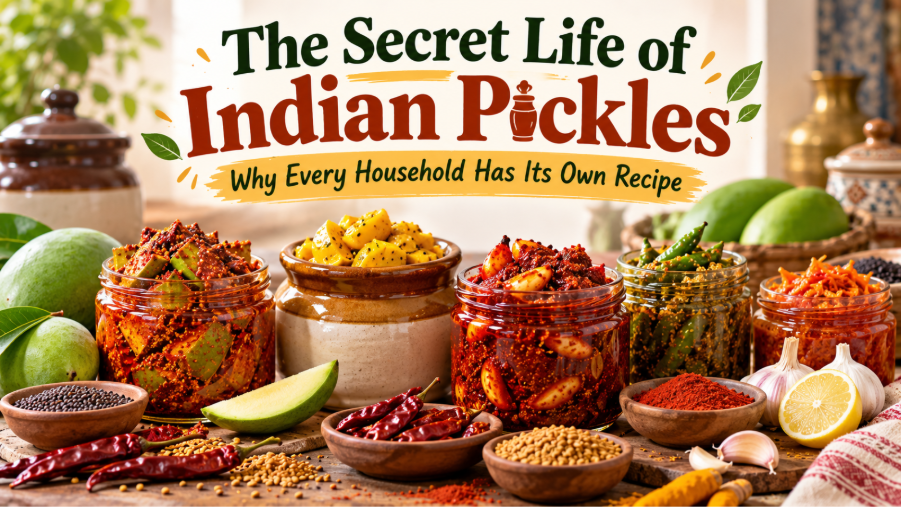
In India, a meal can feel incomplete without that little spoonful of pickle on the side. A simple plate of rice and dal becomes more exciting with spicy mango achar, while a humble curd rice meal can transform with a touch of tangy lemon pickle. But here is something fascinating: give ten Indian households the same mangoes, oil, salt, and spices, and you may end up with ten completely different pickles. The magic of traditional Indian pickle recipes lies not just in the ingredients, but in regional traditions, family habits, seasonal produce, and the tiny adjustments passed from one generation to another.
Indian pickles are more than accompaniments. They are a way of preserving seasonal ingredients, expressing regional identity, and keeping family food traditions alive. And behind every jar is a story that deserves to be explored.
Why Traditional Indian Pickle Recipes Are So Different
At first glance, making pickle sounds simple: prepare the ingredients, add salt and spices, and allow the flavours to develop. Yet small differences can create dramatically different results.
Consider the ingredients that influence a pickle’s final flavour:
- The main ingredient: Raw mangoes, lemons, gooseberries, chillies, garlic, and tamarind each have their own flavour and texture.
- The spices: Mustard, fenugreek, turmeric, chilli powder, and other seasonings create different combinations of heat, bitterness, aroma, and earthiness.
- The oil: The choice and quantity of oil can influence the pickle’s aroma, texture, and overall character.
- The preparation method: Cutting, grinding, salting, drying, and resting ingredients all affect the final result.
- The family recipe: Some households add garlic, others avoid it. Some prefer a sharper sourness, while others aim for a more balanced flavour.
Even the variety and ripeness of the mango can make a difference. A firm, sour mango behaves differently from one that is softer or less acidic.
This is why a pickle recipe is rarely just a list of measurements. It is also a collection of choices made by the person preparing it.
India’s Pickle Map: One Country, Hundreds of Flavours
India’s pickle traditions vary enormously from region to region. Although mango pickle is widely loved, the country offers a remarkable range of ingredients and preparation styles.
1. Andhra Pradesh: The Bold World of Avakaya
Avakaya is one of Andhra Pradesh’s best-known culinary specialities. It typically combines raw mango pieces with mustard powder, red chilli powder, salt, and oil.
The flavour is powerful: spicy, sour, and rich with mustard. Families may adjust the spice blend, the amount of oil, or the inclusion of garlic to suit their preferences.
In many households, preparing avakaya is a seasonal activity. Raw mangoes are selected, prepared, and mixed with spices in batches intended to last beyond mango season. The process can become a family event, with different people helping to clean, cut, measure, mix, and store the ingredients.
The result is not simply a condiment. It is a taste associated with a particular season and the people who prepare it.
2. Gujarat: The Sweet-and-Sour Side of Mango Pickle
Gujarati cuisine offers a different experience through preparations such as chhundo, a grated raw mango preserve that combines sweetness with tanginess and, in some versions, warming spices.
Unlike the bold, oil-rich character associated with many Andhra mango pickles, chhundo can have a jam-like consistency and a distinctly sweet-sour profile.
This contrast shows how the same fruit can become two very different foods depending on the culinary tradition. One household may look for fiery heat; another may prefer a balance between sweetness and acidity.
3. Tamil Nadu: Tiny Mangoes, Big Flavour
Tamil Nadu is known for preparations such as maavadu, made using small, tender mangoes.
Instead of cutting large mangoes into chunks, this style takes advantage of tiny, immature fruits. Their texture and intense sourness help create a pickle that is quite different from conventional mango achar.
Seasonal availability is important here. The size and stage of the mango influence how it can be prepared, which helps explain why some traditional pickles are closely tied to a particular time of year.
4. Karnataka: The Character of Tender Mangoes
Karnataka has its own tender-mango pickle traditions, including preparations made with locally valued mango varieties.
The fruit itself can be central to the result. Certain varieties are prized for their aroma, texture, or suitability for preservation.
This is an important part of regional food culture: a pickle’s identity does not always come from a secret spice mixture. Sometimes it begins with finding the right ingredient.
5. Beyond Mango: India’s Wider Pickle Universe
Mango may dominate many pickle shelves, but Indian households preserve much more than mangoes.
Common examples include:
- Lemon pickle: Tangy, salty, and sometimes bitter, with flavours that deepen as it matures.
- Amla pickle: Made from Indian gooseberries, with a distinctive sour taste.
- Green chilli pickle: For people who enjoy a sharp chilli kick alongside their meals.
- Garlic pickle: A pungent, savoury option that can develop a rich, mellow flavour.
- Gongura pickle: Associated with Andhra cuisine, made using the sour leaves of the gongura plant.
- Mixed vegetable pickle: A combination that may include carrots, cauliflower, green chillies, and other vegetables.
These examples are not an exhaustive list. Across India, local ingredients, community traditions, and individual preferences have produced an enormous variety of pickled foods. Research on Himalayan and neighbouring regional traditions also documents pickles made from a wide range of locally available plants and other ingredients.
The Family Secret: Why Grandma’s Pickle Tastes Different
Have you ever eaten a pickle at a relative’s house and wondered why it tastes different from the one at home, even though both are supposedly made using the same recipe?
The answer may lie in details that never make it into a written recipe.
A handful of extra mustard seeds. A slightly different chilli powder. Mangoes cut into larger pieces. A longer resting period.
These small variations can change the balance of flavours and the texture of the finished pickle.
Family recipes also evolve over time. Someone might reduce the chilli because children prefer a milder taste. Another family member might introduce a spice combination learned from a relative. Eventually, the modified version becomes the household’s standard recipe.
There is also the influence of memory. A particular pickle may remind someone of summer holidays, meals at their grandparents’ house, or eating hot rice with a generous spoonful of homemade achar.
That emotional connection helps explain why a commercially produced pickle, even one with a similar ingredient list, may not feel quite the same.
The difference is not necessarily that one recipe is objectively better. Each version carries its own combination of flavour, experience, and personal meaning.
The Science Behind the Flavour
Traditional pickle-making is also a form of food preservation.
Salt can draw moisture from ingredients and help create conditions that discourage some unwanted microorganisms. Oil can limit contact with air when used appropriately in oil-based preparations. Acidity, whether supplied by ingredients or developed through a suitable fermentation process, can also play an important role in preservation.
However, not all Indian pickles are fermented. Some are primarily preserved through salting, oil, acidity, drying, or a combination of techniques. The process depends on the particular recipe.
Flavour develops through several factors:
Salt: Adds its own taste while influencing moisture movement and, in some preservation methods, microbial activity.
Acidity: Contributes the sharp, tangy character associated with ingredients such as raw mango and lemon.
Spices: Mustard, fenugreek, chilli, and other spices contribute aroma and varying levels of heat and bitterness.
Time: Depending on the preparation, resting allows ingredients to exchange flavours and the overall taste to develop.
This helps explain why freshly prepared pickle and a properly matured batch can taste noticeably different.
It is important, however, not to assume that every pickle becomes safer simply by being left to age. Safe preservation depends on the recipe, ingredient proportions, preparation hygiene, and storage conditions. Traditional experience is valuable, but it should not replace appropriate food-safety practices.
Why Pickle-Making Is a Seasonal Ritual
For many families, pickle-making begins when a particular ingredient becomes available in abundance.
Mango season is an obvious example. Rather than treating raw mangoes as an ingredient available all year, households traditionally take advantage of the seasonal supply to prepare batches of pickle.
This approach connects cooking with the agricultural calendar. The ingredient is selected when it is suitable for the recipe, and the preparation becomes part of the rhythm of the year.
It can also turn an ordinary kitchen task into a shared activity. One person washes the produce, another cuts it, someone else measures the spices, and an experienced family member supervises the mixture.
The knowledge is passed on through observation as much as instruction.
A younger family member might not know the exact spice proportions, but they may remember how the mangoes should feel, what the mixture should smell like, or how a parent or grandparent checked whether the ingredients were ready.
That practical knowledge is one reason traditional food preparation remains culturally important.
Can You Recreate a Family Pickle Recipe?
Yes, but the best starting point is to record the details that experienced cooks may otherwise leave unexplained.
If you want to preserve a family recipe, consider documenting:
- The ingredient variety: Record the type of mango, lemon, chilli, or other produce used.
- The measurements: Note the amounts of salt, spices, oil, and other ingredients rather than relying only on phrases such as “a little.”
- The preparation: Record how ingredients are washed, cut, dried, ground, or mixed.
- The timing: Note any resting, curing, or fermentation periods required by the recipe.
- The storage method: Record how the finished pickle is stored and whether refrigeration is required.
Most importantly, use a reliable recipe with appropriate preservation instructions. Do not casually reduce the salt or acid in a recipe that relies on those ingredients for safety. Keep utensils and containers clean, and discard pickle that shows signs of spoilage rather than tasting it to check whether it is safe.
You can still preserve a family’s characteristic flavour while documenting the method carefully.
The Real Secret Behind Indian Pickles
The secret behind traditional Indian pickle recipes is not one extraordinary spice or a mysterious ingredient that only grandmothers know about.
It is the combination of local produce, regional preferences, preparation methods, seasonal traditions, and individual family choices.
An Andhra avakaya, a Gujarati chhundo, a Tamil Nadu maavadu, and a homemade lemon pickle may share the same broad purpose, but their flavours and stories are distinct.
That is what makes Indian pickles so fascinating. They demonstrate how a familiar ingredient can become something entirely different in another kitchen.
So the next time you open a jar of homemade achar, remember that you are tasting more than salt, spices, and preserved fruit. You may also be tasting a family’s history, a region’s culinary identity, and a tradition that has travelled from one generation to the next.
And perhaps the most interesting question is this: if you tasted two homemade pickles side by side, could you guess which household made each one?