
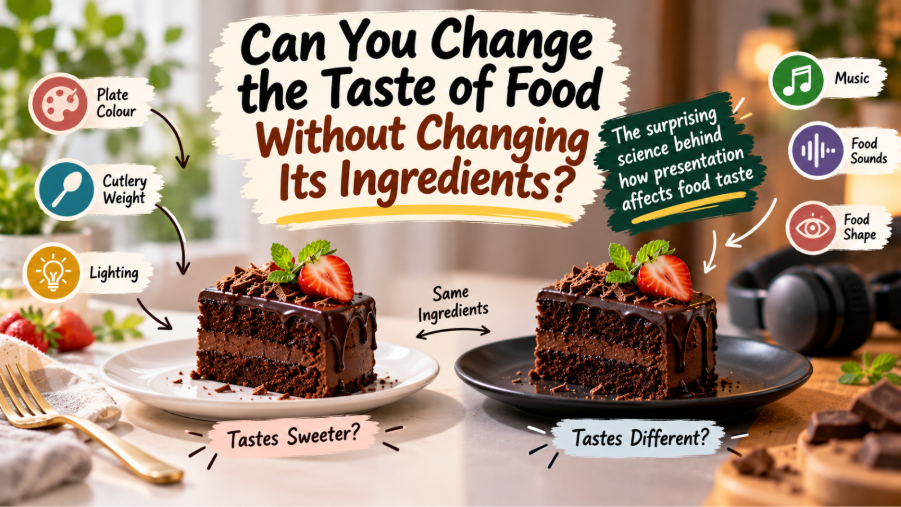
Imagine eating the same chocolate from two different plates and finding that one seems sweeter than the other. Or drinking coffee in a quiet room and then tasting it while listening to loud music. Surprisingly, your experience of flavour might change even though the ingredients remain exactly the same. The science behind how presentation affects food taste reveals that eating is not just about your tongue—it’s also about your brain, eyes, ears, nose, and expectations.
Food companies, restaurants, and chefs have long explored how our surroundings influence the way we experience food. The colour of a plate, the weight of a spoon, the sound of a crunch, and even the lighting in a room can influence how we perceive a meal.
But can these factors genuinely change taste, or do they simply change our expectations? Let’s explore the fascinating science behind this everyday mystery.
How Presentation Affects Food Taste: Your Brain Does More Than You Think
When you eat, your brain combines information from several senses to create what you experience as flavour.
Your tongue detects basic taste qualities such as sweetness, sourness, bitterness, saltiness, and umami. Your nose detects aromas, while your eyes provide clues about a food’s colour, freshness, and texture. Touch and temperature also contribute to the experience.
Your brain brings these signals together to form a perception of flavour.
For example, a strawberry dessert with a vivid red colour may seem more strawberry-like than a pale version, even if both contain similar ingredients. The colour does not necessarily change the food’s chemical composition, but it can influence what your brain expects to taste.
Researchers call this kind of interaction multisensory perception: the brain combines information from different senses rather than treating each sense as an isolated experience.
That is why food can sometimes taste different without any change to its recipe.
1. Can a Plate’s Colour Make Food Taste Sweeter?
Believe it or not, the plate beneath your food can influence how you perceive its flavour.
In a study published in Food Quality and Preference, researchers served identical strawberry mousse on plates of different colours. Participants rated the mousse served on white plates as sweeter and more flavourful than the mousse served on black plates. However, the results of this type of experiment do not mean white plates always make every food taste better. ScienceDirect
Why might this happen?
Your brain uses visual contrast and past experiences to form expectations about food. A bright dessert against a contrasting background might appear more vivid, while a different presentation may change what you anticipate before taking a bite.
Try this at home: serve the same dessert on a white plate and a dark plate. Ask someone to taste both without telling them they contain the same food. Their ratings might differ—or they might not notice a difference at all.
The interesting part is that the recipe stays the same, but the eating experience may change.
2. Does a Heavy Spoon Make Food Taste Better?
Imagine eating yoghurt with a lightweight plastic spoon and then eating the same yoghurt with a heavier spoon. Would the food seem different?
Research suggests that the properties of cutlery can influence people’s judgements of food. In experiments involving yoghurt, researchers found that spoon weight and colour affected some ratings, including perceived density, sweetness, or how expensive the food seemed. The effects depended on the conditions, rather than appearing consistently in every comparison. Springer
One possible explanation is expectation.
A heavier spoon may feel more substantial or premium, which can influence how you judge the food you are eating. The spoon does not change the yoghurt’s ingredients, but the sensation of using it becomes part of the overall experience.
Restaurants sometimes pay close attention to tableware for this reason. The right plate, glass, or utensil can contribute to a sense of quality, although expensive cutlery cannot turn a poorly prepared meal into a delicious one.
3. Can Music Change the Way Food Tastes?
Your ears participate in the eating experience more than you might expect.
Background music can influence mood, attention, and expectations, all of which may affect how you experience a meal. Research into multisensory flavour perception has explored how sounds and other environmental cues interact with food perception. However, the effects vary with the food, sound, setting, and individual listener. Springer
Consider the difference between eating in a peaceful café and eating in a noisy, crowded room. Even when the meal is identical, your overall enjoyment may change.
Sounds produced by food itself can also matter. Think about biting into a crisp apple or a crunchy potato chip. The crackling sound helps signal freshness and texture, making the experience different from eating a softened version of the same food.
This does not mean music can reliably make every food sweeter or saltier. Instead, sound is one part of the larger sensory experience that shapes how we enjoy eating.
4. Why Food Colour Changes Your Expectations
Before you even taste a food, its appearance gives your brain clues about what it might taste like.
A bright red strawberry usually suggests sweetness and ripeness. A vivid green lime suggests sourness. A golden-brown crust may suggest that bread has been baked or toasted.
These associations develop through experience and learned expectations. When a food’s appearance matches what you expect, the flavour experience may feel familiar. When the appearance conflicts with your expectations, the food may seem surprising or confusing.
Researchers have reviewed dozens of studies on visual cues and flavour perception, finding that colour and shape can influence taste judgements in some situations. The evidence is mixed, though: some experiments find clear effects, while others report small or no differences. DOI
That distinction matters. Food presentation can influence perception, but it does not guarantee a particular taste response in every person.
5. Can the Shape of Food Change How You Experience It?
Food shapes can affect expectations, recognition, and sometimes the way we judge flavour.
For example, a round biscuit and a sharply shaped cracker may create different expectations before you taste them. A carefully arranged plate may also make a meal appear more refined than the same food served casually.
But shape is not a magic ingredient. Research examining food and plate shapes has found that their effects depend on the particular food and the surrounding visual cues. In some studies, plate colour affected ratings while plate shape had little or no measurable effect. ScienceDirect
This is why chefs use presentation thoughtfully rather than relying on one universal rule. A shape that works beautifully for a dessert might not have the same effect on a savoury dish.
The broader lesson is simple: presentation influences what we expect, but flavour still depends on the food itself.
6. Five Experiments to Try in Your Own Kitchen
You don’t need a professional kitchen or expensive equipment to explore food perception. These simple experiments can help you discover how your senses influence your eating experience.
Experiment 1: The Same Food, Two Plates
Take the same snack and divide it into two equal portions. Serve one on a white plate and the other on a dark plate.
Taste both and rate their sweetness, flavour intensity, and overall enjoyment from 1 to 10. Try the experiment without looking at the plates first, then repeat it while looking at them.
Experiment 2: The Blind Taste Test
Ask someone to prepare two identical samples of a food you enjoy. Taste them without knowing which is which.
Before revealing the samples, write down what you notice about their flavour and texture. This helps you explore how much your expectations influence your judgements.
Experiment 3: Change the Cutlery
Eat the same dessert using two different spoons, such as a lightweight spoon and a heavier metal spoon.
Notice whether the experience changes. Does the dessert seem creamier, more luxurious, or exactly the same?
Experiment 4: Listen to Your Food
Eat a crunchy snack in a quiet room. Then try the same snack while listening to background noise at a comfortable volume.
Pay attention to how clearly you notice the crunch and whether the overall experience feels different.
Experiment 5: Change the Presentation
Arrange the same fruit in two ways: place one portion casually in a bowl and arrange the other neatly on a plate.
Compare how appealing each portion looks before tasting them.
Remember: These are informal demonstrations, not controlled scientific studies. Your results may differ from someone else’s, and noticing a difference does not necessarily mean the food’s actual chemical taste has changed.
What This Means for Restaurants, Home Cooks, and Food Lovers
Understanding how presentation affects food taste can be useful beyond restaurant kitchens.
For home cooks: A little attention to colour, arrangement, and serving dishes can make an ordinary meal feel more inviting without changing the recipe.
For restaurants: Thoughtful presentation can help establish expectations about quality and create a memorable dining experience.
For food photographers and bloggers: Lighting, background colours, plates, and food arrangement can make images more appealing and influence what viewers expect a dish to taste like.
For anyone trying new foods: Understanding the influence of expectations can help you approach unfamiliar dishes with a more open mind.
Presentation is not a replacement for good ingredients or cooking techniques. It is another way to shape the overall experience of a meal.
Final Verdict: Can You Change the Taste Without Changing the Ingredients?
Yes, you can sometimes change how food tastes to you without changing its ingredients. The important distinction is between changing the food’s actual composition and changing your perception of it.
Your brain combines information from taste, smell, sight, sound, and touch to create the experience of flavour. Plate colour, cutlery, food appearance, and the surrounding environment can influence that experience, although the effects are not universal.
The next time you prepare a meal, experiment with how you serve it. Try a different plate, adjust the presentation, or pay closer attention to the sounds and aromas.
You might discover something surprising: enjoying food isn’t just about what is on your plate. It’s also about how your senses experience it.
Sources
- Motoki, K., Spence, C., and Velasco, C. (2023). When visual cues influence taste/flavour perception: A systematic review. ScienceDirect — Food Quality and Preference
- Harrar, V. and Spence, C. (2013). The taste of cutlery: how the taste of food is affected by the weight, size, shape, and colour of the cutlery used to eat it. Flavour Journal
- Piqueras-Fiszman, B. et al. (2012). Is it the plate or is it the food? Food Quality and Preference
- Stewart, P. C. and Goss, E. (2013). Plate shape and colour interact to influence taste and quality judgments. Flavour Journal
- Spence, C. (2012). Assessing the impact of the tableware and other contextual variables on multisensory flavour perception. Flavour Journal