
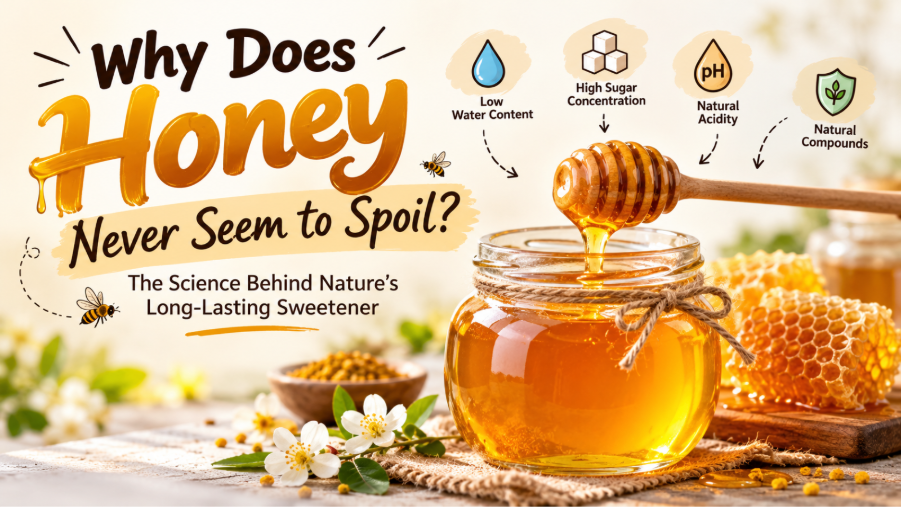
The secret lies in honey’s unusual chemistry. Its low water content, natural acidity, and sugar concentration make it difficult for many microorganisms to grow. Understanding why honey does not spoil reveals how bees transform flower nectar into a remarkably durable food.
Honey is one of the few foods that can remain stable for years when stored properly. A jar discovered at the back of a kitchen cupboard may look just as golden as the day it was purchased, although its colour, texture, and aroma can change over time.
But does that mean honey lasts forever? Not exactly. Storage conditions, moisture, and contamination all matter. Let’s explore the science behind honey’s impressive shelf life and learn how to keep it fresh at home.
Why Honey Does Not Spoil Easily
Honey’s long shelf life comes from several natural properties working together. No single factor explains its durability; instead, its composition creates an environment that most spoilage microorganisms struggle to tolerate.
1. Honey Contains Very Little Water
Water is essential for the growth of most bacteria, yeasts, and moulds. Although honey contains some water, ripe honey generally has a low moisture content.
Its concentrated sugars bind much of the available water, leaving less accessible for microorganisms to use.
Scientists describe this property using the term water activity. It measures how much water is available for microbial growth, rather than simply measuring the total amount of water in a food.
Honey’s low water activity is one of the main reasons it resists spoilage.
However, honey is not completely immune to microbial growth. Certain yeasts can survive in honey and may ferment it if enough moisture enters the jar.
2. Its High Sugar Concentration Makes Life Difficult for Microbes
Honey consists primarily of sugars, particularly fructose and glucose, along with smaller quantities of other sugars and compounds.
This concentrated sugar environment creates an osmotic effect. Water tends to move out of microbial cells exposed to the surrounding high sugar concentration, making growth difficult.
That is why honey can remain stable much longer than many foods with higher water content.
The same principle helps explain why sugar is used in some traditional food-preservation methods, including jams and fruit preserves.
However, sugar concentration alone does not guarantee preservation. The amount of available water and the food’s other properties also matter.
3. Honey Is Naturally Acidic
Honey is mildly acidic, with a typical pH around 3.2–4.5, although the exact value varies by floral source and other factors.
Many bacteria grow best in environments that are less acidic. Honey’s acidity therefore provides another barrier against the growth of many microorganisms.
This protection works alongside its low water activity and high sugar concentration. Together, these characteristics help explain why properly stored honey can remain usable for a long time.
4. Bees Help Transform Nectar Into Honey
Honey’s durability begins inside the beehive.
Honeybees collect nectar from flowers and process it using enzymes and other natural mechanisms. They also fan their wings to help remove moisture from the nectar as it matures.
One important enzyme, glucose oxidase, can contribute to the formation of small amounts of gluconic acid and hydrogen peroxide when the right conditions are present.
Hydrogen peroxide has antimicrobial properties, although its concentration and activity vary. It is only one part of honey’s natural defence system.
The result is a concentrated food with properties very different from those of the original flower nectar.
5. Honey’s Natural Composition Provides Additional Protection
Honey contains small amounts of compounds such as organic acids, minerals, and plant-derived substances. Their concentrations vary depending on the flowers visited by bees and the conditions in which the honey is produced.
Some of these compounds contribute to honey’s antioxidant activity and other biological properties.
However, honey’s resistance to spoilage should not be attributed to antioxidants alone. Its low water activity, acidity, and high sugar concentration are more central to its stability.
This combination makes honey an excellent example of how the composition of a food can influence its shelf life.
Can Honey Really Last for Thousands of Years?
Honey is often described as a food that never expires. Stories about ancient honey discovered in Egyptian tombs have helped reinforce this reputation.
However, claims that archaeologists found perfectly preserved, edible honey thousands of years old are not consistently supported by reliable evidence.
What we can say with confidence is that honey can remain stable for extended periods when it is properly processed and protected from moisture and contamination.
Commercial honey may carry a best-before date. This date generally concerns expected quality rather than indicating that the honey suddenly becomes unsafe afterward.
Over time, honey can darken, develop a different aroma, or change texture. These changes do not necessarily mean it has spoiled.
The important distinction is that honey is highly resistant to spoilage, not completely immune to it.
Why Does Honey Turn Solid or Crystallise?
Have you ever opened a jar of honey and discovered that it has become thick, grainy, or almost solid?
This is usually crystallisation, a natural process in which glucose separates from the liquid and forms crystals.
Crystallisation depends on several factors, including the glucose-to-fructose ratio, temperature, and the presence of tiny particles that help crystals form.
Honey with a higher glucose concentration often crystallises more quickly. Some varieties remain liquid for longer because their composition differs.
Is Crystallised Honey Spoiled?
Usually, no. Crystallisation is a normal physical change and does not, by itself, indicate spoilage.
If you prefer liquid honey, place the closed jar in warm water and allow the crystals to dissolve gradually. Avoid overheating it, as excessive heat can affect its flavour, aroma, and quality.
Never assume that every change in appearance is harmless, however. Unexpected foaming, an alcoholic or sour smell, or other signs of fermentation may indicate that moisture has entered the honey.
How to Store Honey So It Lasts Longer
Although honey is naturally stable, the way you store it can make a difference.
Keep the lid tightly closed. Honey can absorb moisture from the surrounding air. Extra moisture may increase the risk of fermentation.
Use a clean, dry spoon. Avoid introducing water, food particles, or other contaminants into the jar.
Store it in a cool, dry cupboard. Room-temperature storage away from direct sunlight is generally suitable. Refrigeration is usually unnecessary and can encourage crystallisation.
Avoid adding water directly to the jar. If you want honey in tea, add it to the drink rather than diluting the entire container.
Check for unusual changes. A different texture alone is not proof of spoilage, but unexpected fermentation signs deserve attention.
These simple habits help preserve honey’s flavour and quality for longer.
Does Honey Ever Go Bad?
Yes, honey can spoil under certain conditions, particularly when moisture enters the container.
Honey that absorbs enough water may begin to ferment as naturally occurring yeasts become active. This can produce bubbles, foaming, and an alcoholic or sour smell.
Contamination can also affect its quality. If honey shows clear signs of fermentation or unusual contamination, it is best to discard it rather than taste it to check whether it is safe.
One important safety point: never give honey to babies younger than 12 months, because it can contain Clostridium botulinum spores that may cause infant botulism. This risk exists even when the honey looks and smells normal.
The Sweet Science Behind Honey’s Long Shelf Life
Honey’s impressive durability is not magic. It is the result of several natural properties working together: concentrated sugars, low water activity, acidity, and compounds that can inhibit microbial growth.
Understanding why honey does not spoil easily also highlights an important lesson about food preservation. A food’s shelf life depends not only on its ingredients but also on moisture, processing, handling, and storage.
So, the next time you find a jar of honey in your cupboard, remember that its remarkable stability comes from its chemistry. Store it properly, keep moisture out, and enjoy this naturally sweet ingredient in drinks, desserts, marinades, and everyday meals.