
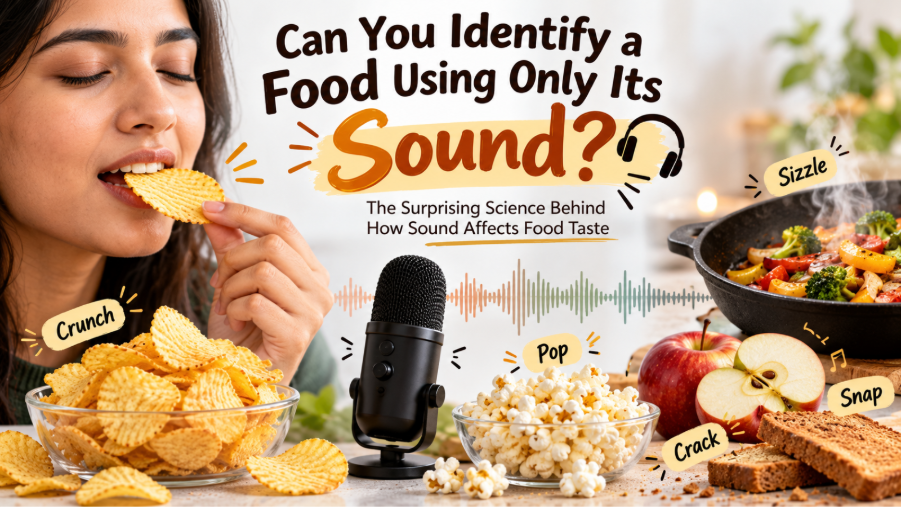
Close your eyes and imagine hearing a potato chip crunch, butter sizzling in a hot pan, or popcorn popping inside a microwave. Before you even see the food, your brain begins making predictions about its texture, freshness, and flavour. This is where how sound affects food taste becomes fascinating. Eating is not just about what your tongue detects; it is a multisensory experience involving hearing, sight, smell, touch, and taste. But can you actually identify a food using sound alone? And can the sound of a bite change how delicious something seems? Let’s explore the science behind the sounds of food and try a simple experiment to discover how much your ears influence what you eat.
The Crunch Test: Can Your Ears Recognise Food?
Imagine three sounds:
- A sharp, brittle crunch.
- A soft, squishy bite.
- A loud, hollow crack.
Even without seeing the food, you might associate the first sound with a crisp snack, the second with something soft or juicy, and the third with a hard shell or brittle coating.
Your brain uses these acoustic clues to make quick predictions about what is happening in your mouth. However, identifying the exact food is much harder than identifying its general texture.
A crisp sound could come from a potato chip, a cracker, a piece of toast, or a fresh vegetable. The sound gives you a clue, not necessarily the answer.
Try this experiment: Ask someone to play recordings of different foods while you keep your eyes closed. Start with familiar sounds such as biting an apple, crunching a chip, pouring cereal, and snapping a carrot. Write down your guesses before revealing the answers.
You may recognise some foods immediately but confuse others. That difference highlights an important point: hearing can help you interpret food, but it rarely tells the whole story.
Why Does Crispy Food Sound So Satisfying?
Think about biting into a fresh potato chip. The first bite produces a sharp crackle, followed by several smaller crunches. Now imagine biting into a chip that has absorbed moisture and become soft.
The flavour might remain similar, but the experience changes dramatically.
This happens because crispness is closely connected to the physical structure of food. Dry, brittle foods tend to fracture suddenly when bitten, producing rapid vibrations that travel through the food and surrounding air.
Microphones can capture these vibrations as sound. Researchers can then study properties such as loudness, frequency, and the timing of individual cracks to investigate food texture.
Moisture often changes how these foods fracture. A cracker exposed to humid air may lose its characteristic snap because water alters the structure of the material.
Your ears can therefore provide useful information about texture, even before you consciously think about what you are eating. how sound affects food taste
Your Brain Eats With Your Ears
Food perception involves more than taste receptors on the tongue. Your brain combines signals from multiple senses to create the experience you recognise as flavour.
Smell plays a major role because aromas reach the nose both before and during eating. Sight influences expectations, while touch helps you assess qualities such as temperature, thickness, and texture.
Sound adds another layer.
When you bite into a crisp food, the noise you hear can reinforce the expectation that it is fresh and crunchy. If the same food produces an unexpectedly quiet or soft sound, your perception may change.
Researchers have investigated this effect through experiments involving foods such as potato chips. In a well-known series of studies, psychologist Charles Spence and colleagues found that changing the sounds associated with biting chips could influence how participants rated their crispness and freshness.
The important detail is that the chips themselves did not need to change. Altering the sound was enough to affect people’s judgments.
This is one reason how sound affects food taste is such an interesting subject: the experience of eating depends partly on how the brain interprets sensory information, not just on the food’s physical ingredients.
Four Food Sounds That Reveal More Than You Think
Different cooking and eating sounds can tell you something about the food producing them. They are useful clues, although none is a perfect test of quality or safety.
1. The Sharp Crunch of a Potato Chip
A fresh, brittle chip usually breaks into small pieces with a distinct crunch.
If a chip becomes soft after absorbing moisture, its sound may become less pronounced. That difference can help you recognise a change in texture.
However, crunchiness alone does not guarantee freshness. Seasoning, thickness, ingredients, and cooking methods can also affect the sound.
2. The Sizzle of Food in a Hot Pan
The sound of onions or vegetables sizzling can make a kitchen feel alive.
That familiar sound often comes from moisture heating and escaping from the food, alongside the movement of oil and other ingredients. As cooking continues, the sound may change depending on the amount of moisture, the temperature, and the ingredients in the pan.
A vigorous sizzle can indicate active cooking, but it does not prove that a pan is at the ideal temperature or that the food is fully cooked.
3. The Pop of Corn Kernels
Popcorn produces a distinctive popping sound when heat causes moisture inside a kernel to turn into steam. Pressure builds until the kernel’s outer shell ruptures, allowing the starchy interior to expand.
The familiar popping sequence is therefore linked to a physical change inside each kernel.
The rate of popping can slow as fewer kernels remain ready to burst. However, sound alone cannot tell you whether every kernel has popped or whether the popcorn is perfectly cooked.
4. The Snap of Fresh Vegetables
Biting into a fresh carrot or snapping a celery stalk can produce a firm, crisp sound.
That sound is related to the structure of the plant tissue, including its cell walls and internal water pressure. As vegetables lose moisture during storage, their texture can change, sometimes making them less crisp.
Still, a loud snap does not tell you everything about nutritional quality or freshness. Appearance, smell, storage history, and other factors matter too.
Can You Identify Food Without Seeing It?
Let’s turn the science into a small challenge.
You will need a few familiar foods, a phone to record sounds, and another person to help conduct the test.
Step 1: Choose five foods. Select items with different textures, such as a cracker, an apple, a carrot, a potato chip, and a piece of toast.
Step 2: Record the sounds. Ask someone to record each food being bitten, snapped, or broken. Keep the recording distance and background noise as consistent as possible.
Step 3: Listen without seeing the food. Play the recordings in a random order and write down your guesses.
Step 4: Repeat the challenge. Try listening with headphones, then listen through a phone speaker. The recording equipment can change the sound you hear, so the results may differ.
Step 5: Compare your answers. Count how many foods you identified correctly and which textures were easiest to recognise.
For a fairer test, use several recordings of each food and avoid giving clues through the order or background sounds.
You might find that identifying a general texture is easier than identifying the exact ingredient. That is a useful distinction: sound often tells us how a food behaves more reliably than what the food is.
When Food Sounds Change the Way We Eat
The connection between sound and eating has attracted interest beyond scientific laboratories. Restaurants, food manufacturers, and product designers can all benefit from understanding how people respond to sensory experiences.
The Restaurant Experience
Imagine entering a restaurant where you hear vegetables sizzling on a hot plate or the crackle of a freshly baked crust being cut.
These sounds can build anticipation before you take your first bite. They help create an atmosphere and communicate something about the cooking process.
The sound is part of the overall dining experience, even though it cannot replace flavour, aroma, or food quality.
The Food Packaging Industry
Packaging can also influence the way people perceive food. Opening a crisp packet, breaking a chocolate bar, or biting into a crunchy snack produces familiar sounds that may contribute to expectations about texture and quality.
Food companies pay attention to these sensory details when developing products and packaging.
However, a satisfying sound is not proof that a product is healthier, fresher, or safer. It is one part of how people experience food.
The Science of Sound and Flavour
Researchers studying multisensory perception investigate how the brain combines information from different senses.
The sound of a bite can influence perceived crispness, while background music and environmental noise may affect the overall eating experience. The effects depend on the situation, the food, and the individual.
Understanding these interactions helps explain why eating is more complex than simply tasting something on your tongue.
The Final Bite: Your Ears Are Part of the Experience
The next time you bite into a crispy snack, listen carefully. Notice the initial crack, the smaller crunches, and how the sound changes as you chew.
These everyday noises provide clues about the food’s structure and texture. They can also influence your expectations and contribute to the pleasure of eating.
So, can you identify a food using only its sound? Sometimes. Familiar foods may be surprisingly easy to recognise, but similar textures can make accurate identification difficult.
Ultimately, the science of how sound affects food taste reminds us that flavour is a multisensory experience. Our ears do more than hear the kitchen; they help our brains interpret the food we eat.