
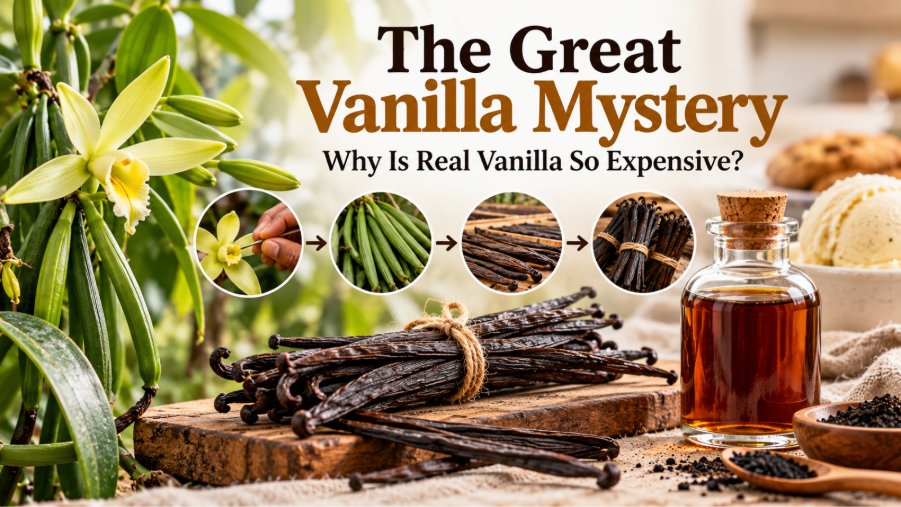
Vanilla is one of the world’s most loved flavours, appearing in ice cream, cakes, cookies, chocolates, and countless desserts. Yet a small bottle of pure vanilla extract can cost significantly more than many other flavourings. The reason goes far beyond its delicious aroma. The story of why real vanilla is so expensive involves delicate orchids, labour-intensive pollination, months of processing, unpredictable harvests, and a surprisingly complex journey from tropical farms to your kitchen.
Unlike many flavour ingredients that can be produced relatively quickly, natural vanilla requires patience at almost every stage. Its distinctive fragrance develops through a careful curing process, and producing high-quality vanilla demands considerable skill. So, what makes this humble-looking ingredient so valuable? Let’s follow the journey of a vanilla bean and uncover the secrets behind its price.
The Vanilla Orchid: A Flower With a Complicated Life
Vanilla begins as an orchid, not as a ready-made flavouring in a bottle.
The vanilla orchid, particularly Vanilla planifolia, is a climbing tropical plant native to the Americas. Today, it is cultivated commercially in several tropical regions, including Madagascar, Indonesia, Uganda, and Mexico.
Unlike many crops, vanilla presents farmers with a particular challenge: its flowers are receptive to pollination for a very short period.
A flower may open in the morning and close by the end of the day. If pollination does not happen during that window, the flower usually fails to produce a vanilla pod.
In parts of its native range, natural pollination can occur through specific insects. In many commercial growing regions, however, farmers rely on people to pollinate flowers individually by hand.
This is one of the first reasons natural vanilla costs so much.
Why Hand Pollination Matters
Vanilla flowers are not easily pollinated in most commercial growing environments. Farmers often use a small tool or their fingers to transfer pollen from one part of the flower to another.
The work requires precision because the flower is delicate and the opportunity is brief.
On a farm with thousands of flowering plants, pollinating each flower can require substantial labour. The number of pods produced also depends on successful pollination and the health of the plants.
This means vanilla production cannot simply be expanded by planting more vines. Farmers must also have the time, workers, and suitable conditions needed to manage the flowers.
Every vanilla pod begins with a narrow window of opportunity.
From Green Pod to Fragrant Vanilla: Months of Waiting
After pollination, the vanilla orchid produces a long, green fruit commonly called a vanilla bean or pod. But the pod does not immediately smell or taste like the vanilla used in desserts.
Freshly harvested vanilla pods have relatively little of the familiar aroma. Much of that characteristic fragrance develops during curing, a process that transforms the pod’s chemistry.
The process typically involves several stages:
- Killing: Heat treatment or another method stops the pod’s growth and begins the changes needed for curing.
- Sweating: The pods are kept warm to encourage biochemical reactions that help develop colour and flavour.
- Drying: Moisture is gradually reduced to help preserve the pods.
- Conditioning: The pods rest for an extended period so their aroma and flavour can develop further.
The exact methods vary by producer and region. The full process can take several months, and careful handling is essential throughout.
Why Curing Changes Everything
One of vanilla’s best-known flavour compounds is vanillin. It contributes the familiar sweet, creamy aroma associated with vanilla, although natural vanilla contains many other aromatic compounds that create its complexity.
During curing, enzymes and other chemical processes help transform compounds in the green pod into flavour-producing substances.
Drying also needs to be carefully controlled. If the pods dry too quickly, their quality may suffer. If they retain too much moisture or are stored improperly, mould and other quality problems can develop.
This combination of time, skill, and careful quality control adds to the cost of the finished product.
Madagascar and the Global Vanilla Market
Madagascar is one of the world’s most important producers of natural vanilla. Its climate and established growing traditions make it especially significant in the international vanilla trade.
However, vanilla prices can change dramatically from year to year.
Weather events, crop disease, changes in demand, labour costs, and the size of harvests all affect the market. Because vanilla production requires considerable time and labour, farmers cannot always respond quickly when demand increases.
The supply chain adds further complexity. Vanilla passes through growers, collectors, processors, exporters, and manufacturers before reaching consumers.
Why Vanilla Prices Can Rise So Quickly
Imagine a season in which bad weather damages a significant portion of the crop. The number of high-quality pods available for sale may fall, even though producers and food manufacturers still need vanilla.
Because new vines take time to establish and produce useful harvests, increasing supply is not an immediate solution.
At the same time, market prices can influence farmers’ decisions about when to harvest, how to cure their pods, and whether to invest in future production.
This helps explain why vanilla prices can be volatile rather than remaining consistently high or low.
It also means the price of a bottle of vanilla extract does not depend only on the amount of vanilla inside it. Processing, transportation, manufacturing, packaging, and retail costs all contribute.
Why Real Vanilla Is Different From Artificial Vanilla
Not every product labelled vanilla flavouring is made in the same way.
Pure vanilla extract is generally produced by extracting flavour compounds from cured vanilla beans using a suitable liquid, commonly alcohol and water. Its aroma comes from a mixture of naturally occurring compounds.
Vanilla bean paste typically combines vanilla seeds or other vanilla-derived ingredients with a thickening base. Products vary, so the ingredient label matters.
Artificial vanilla flavouring uses flavour compounds produced through other methods. Many products rely heavily on vanillin, the compound responsible for much of vanilla’s familiar aroma.
Artificial vanilla can be a practical and affordable choice for everyday baking. It is not automatically poor quality; the best option depends on the recipe and the result you want.
Natural vanilla, however, offers a broader mixture of aromatic compounds that can create a more layered flavour.
When Is Pure Vanilla Worth the Extra Cost?
For a delicate dessert in which vanilla is a main flavour, the difference may be noticeable. Think of vanilla custard, panna cotta, simple ice cream, or a lightly flavoured cream.
In a strongly flavoured chocolate cake or heavily spiced dessert, the difference may be less obvious because other ingredients dominate.
A useful rule is to reserve expensive pure vanilla for recipes where its flavour can shine, while using a more affordable flavouring when appropriate for everyday cooking.
How to Choose Good-Quality Vanilla
With several vanilla products available, choosing the right one can be confusing. A high price does not automatically guarantee the best flavour for every recipe.
Here are a few things to consider when shopping.
Read the label carefully. Look for products clearly labelled as pure vanilla extract if that is what you want. Vanilla flavouring, vanilla essence, and pure extract may have different ingredients and production methods.
Consider the recipe. Vanilla beans and paste can be useful when you want visible seeds in custards, creams, and ice cream. Extract is convenient for cakes, cookies, and everyday baking.
Check the aroma. Good-quality vanilla generally has a rich, warm fragrance. A pleasant aroma is useful, although smell alone cannot verify authenticity or quality.
Buy from a reputable seller. Because natural vanilla can be expensive, misleading labelling and adulteration are concerns in the market. Reliable suppliers and transparent ingredient lists help you make a more informed choice.
Store it properly. Keep vanilla extract tightly closed in a cool place away from direct sunlight. Follow the manufacturer’s storage instructions to preserve its aroma.
Is Growing Vanilla an Easy Way to Produce Your Own?
Growing vanilla at home may sound like an appealing way to avoid expensive store-bought products. However, producing usable vanilla beans requires more effort than simply planting an orchid.
Vanilla is a tropical climbing plant that needs suitable warmth, humidity, support, and care. It can take several years for a plant to mature enough to flower.
If the plant flowers, pollination may need to be performed by hand, depending on the environment. The pods must then mature on the vine before being harvested and cured.
Even after all that work, the final flavour depends on the quality of the pods and the curing process.
For gardening enthusiasts, growing vanilla can be an interesting long-term project. For someone who simply wants vanilla for baking, buying a small bottle of good-quality extract is usually much more practical.
The Real Reason Vanilla Is So Expensive
So, why real vanilla is so expensive comes down to a combination of biological limitations, intensive labour, lengthy processing, and unpredictable supply.
Each pod begins as a delicate flower that may require hand pollination. The harvested fruit then undergoes a curing process that takes months to develop its characteristic aroma. Weather, crop conditions, and global demand add further uncertainty to the price.
Artificial vanilla offers a useful alternative for many recipes, but natural vanilla remains valued for its complex aroma and distinctive flavour.
The next time you add a few drops of vanilla extract to a cake or dessert, remember that the flavour represents a long journey from a tropical orchid to your kitchen.
Sometimes, the smallest ingredient has one of the biggest stories behind it.