
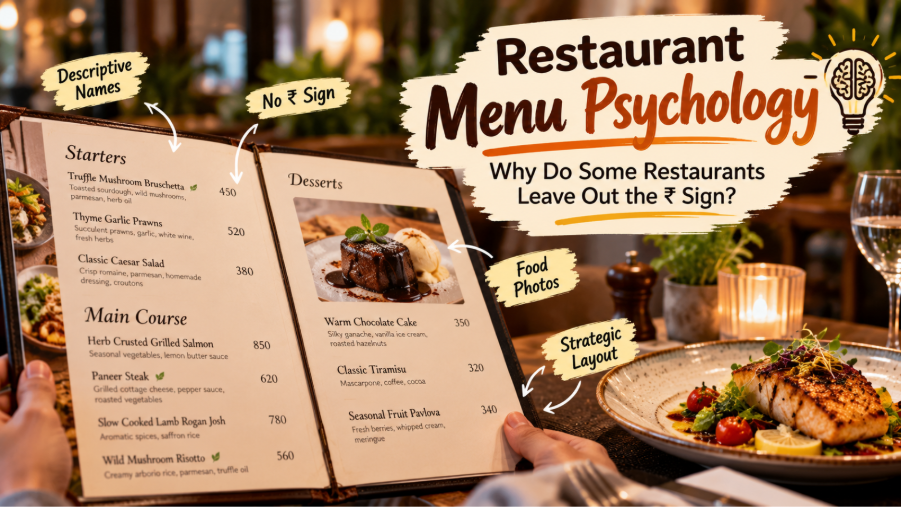
Have you ever opened a restaurant menu, spotted a dish priced at 450, and ordered it without thinking much about the cost? Now imagine seeing the same dish listed as ₹450. Although the price is identical, the way it is presented can change how you perceive it. This is one fascinating aspect of restaurant menu psychology: the way restaurants display prices, describe dishes, and organise menus can influence how customers make dining decisions. Some restaurants omit currency symbols, use descriptive food names, or highlight selected dishes to shape the ordering experience. But do these techniques actually work, and why do restaurants use them? Let’s explore the psychology behind menu design, separating research-backed findings from popular restaurant-industry beliefs.
Why Do Some Restaurants Leave Out the ₹ Sign?
Walk into different restaurants in India, and you may notice that prices appear in several formats:
- ₹450
- Rs. 450
- INR 450
- 450
The last format removes the currency symbol entirely. Some restaurants use this style to create a cleaner, less cluttered menu.
One explanation comes from research into how people respond to prices. A study by Cornell University researchers reported that diners in an experimental restaurant setting spent more when prices were displayed as numerals without a dollar sign than when the prices included a dollar sign or were written out in words. The findings suggest that the way prices are presented can affect spending in some circumstances.
However, there is an important distinction: this research does not prove that removing the Indian rupee symbol will make every Indian customer spend more. Customer behaviour varies, and the study’s findings should not be treated as a universal rule.
For restaurants, the practical consideration is whether a price format makes the menu easier to scan while fitting the establishment’s style.
A minimalist café might display 450, while a family restaurant may prefer ₹450 for clarity. Both approaches can work when customers can understand the prices easily.
5 Ways Restaurant Menus Influence What You Order
Price formatting is only one part of menu design. Restaurants also make decisions about wording, layout, visual hierarchy, and the information presented alongside each dish.
Research reviews suggest that these design choices can influence customers’ perceptions and intentions, although their effects on actual purchases vary across settings. ScienceDirect
1. Descriptive Dish Names Make Food More Appealing
Compare these two menu descriptions:
Option A: Chocolate Cake
Option B: Warm Chocolate Cake with Silky Ganache and Roasted Hazelnuts
The second description gives you more information about the texture, ingredients, and experience you might expect.
Descriptive wording can make a dish sound more appealing by helping customers imagine its flavour. Research on descriptive menu labels has found positive effects on customers’ attitudes toward certain dishes and restaurants, although results depend on the context. WUR Research Portal
However, descriptions should accurately reflect the dish. Elaborate wording cannot compensate for poor food quality.
2. Menu Layout Directs Attention
When you open a menu, you probably don’t examine every item with equal attention.
Headings, spacing, photographs, borders, and typography help organise information and make certain dishes easier to notice.
Restaurants may give signature dishes a dedicated section or use a photograph to show what a meal looks like. These choices can help customers navigate a long menu.
But the idea that a particular position on a menu always generates more sales is too simplistic. Studies have produced mixed results, and customers’ preferences, prices, and the number of available options also matter. Taylor & Francis Online
3. Price Endings Can Communicate Different Impressions
Have you noticed prices such as ₹199, ₹250, and ₹499?
Prices ending in 9 are often associated with value-oriented pricing, while rounded prices can communicate simplicity or quality in some contexts.
These associations are not universal. A ₹499 meal may feel expensive to one customer and affordable to another, depending on the restaurant, portion size, location, and expectations.
Restaurants choose price endings for several reasons, including their pricing strategy, brand identity, and operational preferences.
Rather than assuming every price is a psychological trick, consider the complete offer: ingredients, portion size, service, and the overall dining experience.
4. Food Photography Creates Expectations
A well-composed photograph of a burger, dessert, or traditional Indian meal can help customers visualise what they might order.
Images may be especially useful when a dish has an unfamiliar name or contains ingredients that customers do not immediately recognise.
However, photographs can also create unrealistic expectations if they show exaggerated portions, excessive garnishes, or food that looks significantly different from what is served.
Accurate images help customers make informed decisions and build trust.
5. Dish Names Can Suggest Authenticity and Quality
Consider the difference between a menu item labelled “Vegetable Curry” and one described as “Traditional Andhra-Style Vegetable Curry.”
The second name provides information about the dish’s regional identity and flavour profile.
Terms such as traditional, homemade, and artisan can also influence expectations. Experimental research has examined how naming styles affect perceptions of authenticity, liking, and willingness to pay. Wiley Online Library
These words are most useful when they genuinely describe the food. A restaurant should not imply a regional tradition or preparation method that the dish does not represent.
Do These Menu Tricks Actually Work?
The short answer is that some techniques can influence customer perceptions, but no single design choice guarantees higher sales.
A 2023 meta-analysis examined 53 studies involving 16,522 participants and found that the effects of menu design varied by the type of design element and the outcome being measured. The overall effects were not equally strong across customer attitudes, intentions, and purchasing behaviour. ScienceDirect
Consider the missing rupee symbol again. A Cornell study involving 201 diners found that participants given menus displaying prices as numerals without dollar signs spent an average of $5.55 more than those given menus with dollar signs or written-out prices. However, this was a specific restaurant experiment, and its results do not establish that the same effect will occur in every restaurant or in India. Cornell Chronicle
For restaurant owners, the sensible approach is to treat menu design as something to test rather than a collection of guaranteed tricks.
For customers, understanding these techniques can make it easier to recognise how presentation influences expectations.
How Restaurants Can Design Better Menus
Good menu design should help customers choose confidently while allowing the restaurant to communicate its identity.
Here are five practical principles:
- Keep prices clear. Whether you use ₹450 or simply 450, customers should understand exactly what they will pay.
- Write useful descriptions. Mention meaningful ingredients, preparation methods, and regional styles without exaggeration.
- Organise dishes logically. Separate starters, main courses, desserts, and beverages so customers can navigate the menu easily.
- Use photographs selectively. Include accurate images where they help customers understand unfamiliar dishes.
- Test changes before making assumptions. Compare customer responses, sales patterns, and feedback before deciding that a particular layout works better.
For Indian restaurants, menus should also account for dietary preferences, vegetarian and non-vegetarian choices, spice levels, and clear allergen information where applicable.
A well-designed menu is not simply a sales tool. It is part of the communication between a restaurant and its customers.
The Final Bill: What Your Menu Is Really Telling You
The next time you sit down at a restaurant, look beyond the dishes themselves. Notice how the prices are displayed, which descriptions catch your attention, and how the menu guides you through the available choices.
You may discover that the dining experience begins before the food reaches your table.
Ultimately, restaurant menu psychology is about understanding how presentation, language, and expectations interact with human decision-making. These techniques can influence what customers notice and how they perceive a dish, but their effectiveness depends on the restaurant, the customer, and the context.
The best menus combine thoughtful design with transparent pricing and accurate descriptions. After all, a clever menu might attract attention, but good food and a satisfying experience are what encourage customers to return.