
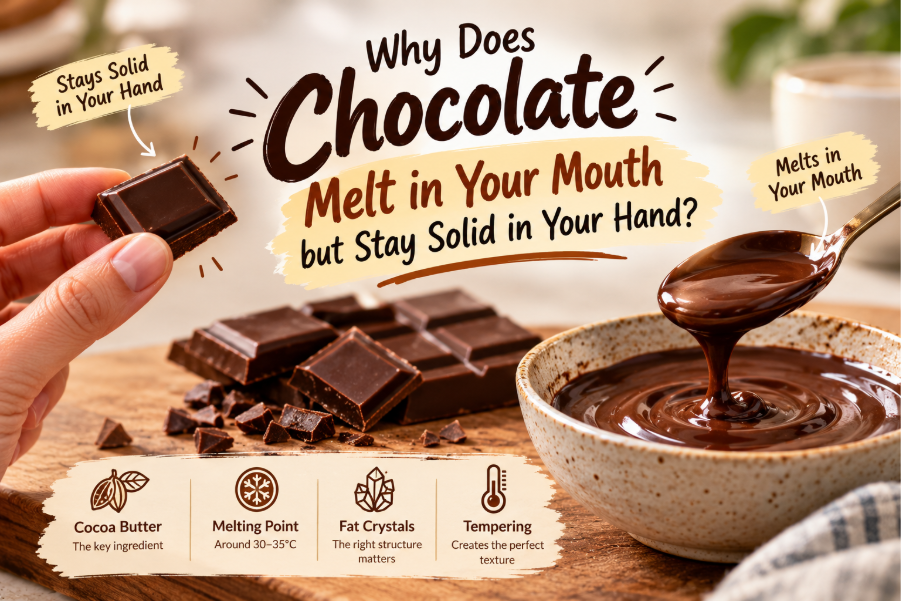
Chocolate seems to perform a little magic: it stays firm on a table, holds its shape in your fingers, and then melts into a smooth, creamy treat as soon as you place it on your tongue. The science behind why chocolate melts in your mouth but stays solid in your hand comes down to one special ingredient: cocoa butter.
Cocoa butter is the natural fat found in cacao beans. Its unique melting behaviour allows well-made chocolate to remain solid at ordinary room temperatures while melting at temperatures close to that inside your mouth. But temperature is only part of the story. The arrangement of fat crystals, the chocolate-making process, and the size of the piece all help determine how chocolate feels when you eat it. The Library of Congress
The Secret Ingredient: Cocoa Butter
Cocoa butter is the key to chocolate’s distinctive texture. Extracted from cacao beans, this natural fat forms the structure that helps chocolate stay firm until it warms up.
Unlike a simple substance with one precise melting point, chocolate melts over a temperature range because it contains several ingredients and different fat structures. Cocoa butter typically melts around 30–35°C, depending on its composition and crystal structure. That range is close to the temperature inside your mouth, which is generally around 37°C. ScienceDirect
At room temperature, much of the cocoa butter remains solid, keeping the chocolate firm. Once the chocolate warms in your mouth, the fat begins to melt, allowing the piece to soften and develop its familiar creamy texture.
This balance is crucial. If cocoa butter melted at a much lower temperature, chocolate could become soft and messy before you even ate it. If it melted at a much higher temperature, it would remain firm for longer in your mouth and could feel waxy.
Why Chocolate Melts in Your Mouth but Stays Solid in Your Hand
The biggest difference is the temperature and how heat reaches the chocolate.
Your hands are usually cooler than the inside of your mouth. When you hold a chocolate bar, your fingers transfer heat to its surface, but the chocolate may not warm enough to melt quickly throughout the piece. In your mouth, warmer tissue comes into direct contact with the chocolate, transferring heat and helping the cocoa butter melt.
The tongue and roof of your mouth also provide contact surfaces that help warm the chocolate. As the fat melts, the solid structure weakens, and the chocolate becomes softer. Your tongue and teeth then break it into smaller pieces, exposing more of it to warmth and saliva.
That is the simple explanation for why chocolate melts in your mouth but stays solid in your hand: the cocoa butter is designed by nature—and carefully managed by chocolate makers—to melt close to body temperature. The effect is not absolute, however. Chocolate can melt in your hand on a hot day, and a large, cold piece may take longer to soften in your mouth. The Library of Congress
The Tiny Fat Crystals That Make Chocolate Special
Here is where chocolate science gets even more interesting.
When cocoa butter cools and becomes solid, its fat molecules can arrange themselves into several different crystal structures. This phenomenon is called polymorphism. Each structure has different properties, including a different melting temperature.
Scientists commonly describe six forms of cocoa butter crystals. For chocolate makers, Form V is especially desirable because it helps produce chocolate that is firm, glossy, snaps cleanly, and melts smoothly in the mouth. edu.rsc.org
Other crystal forms can produce chocolate that is softer, crumbly, dull, or less pleasant to eat. The ingredients alone do not determine the final texture; the way the cocoa butter solidifies matters, too.
This microscopic arrangement is one reason two chocolate bars can feel different even when they look similar. Their fat composition and manufacturing processes may lead to different melting behaviour.
What Is Chocolate Tempering, and Why Does It Matter?
Have you ever noticed how good-quality chocolate has a shiny surface and breaks with a satisfying snap? Those qualities are closely linked to a process called tempering.
Tempering involves carefully heating, cooling, and mixing chocolate to encourage the formation of the desired cocoa butter crystals. It helps manufacturers create a stable structure that gives chocolate its familiar firmness and smooth melting behaviour. The Library of Congress
Proper tempering helps chocolate:
- Develop a glossy finish.
- Break with a clean snap.
- Maintain its shape at suitable room temperatures.
- Melt smoothly in the mouth.
- Resist some of the unwanted texture and appearance changes that can occur during storage.
When chocolate is poorly tempered or exposed to temperature fluctuations, fat crystals can change. This may contribute to fat bloom, a pale or whitish coating that sometimes appears on the surface. Bloom can affect appearance and texture, although it does not automatically mean the chocolate is unsafe to eat.
Tempering is therefore more than a technique for making chocolate look attractive. It helps control the structure responsible for the chocolate-eating experience.
Why Chocolate Feels Creamy Instead of Oily
If chocolate contains fat, why does it feel creamy rather than like a spoonful of oil?
The answer lies in its mixture of ingredients. Chocolate is not made from cocoa butter alone. Depending on the type, it also contains cocoa solids, sugar, milk ingredients, and sometimes emulsifiers such as lecithin.
These ingredients are distributed throughout the fat. When cocoa butter melts, the chocolate softens, but the other particles do not all turn into liquid. Instead, they become part of a thick mixture that gradually disperses in your mouth.
Manufacturers also grind the solid ingredients into very small particles. This reduces grittiness and contributes to the smooth texture associated with chocolate.
As the chocolate warms, it releases flavour compounds, too. The combination of melting fat, fine particles, and aromas helps create the rich sensory experience that makes chocolate so appealing. PubMed Central (PMC)
Does Dark, Milk, and White Chocolate Melt Differently?
Yes. Different types of chocolate can melt and feel different because their ingredients and fat compositions vary.
Dark chocolate usually contains cocoa solids, cocoa butter, and sugar. Its texture and melting behaviour depend on the proportions of these ingredients and how the cocoa butter was tempered.
Milk chocolate contains milk ingredients in addition to cocoa components and sugar. Milk fat can influence its texture, softness, and melting characteristics.
White chocolate contains cocoa butter, sugar, and milk ingredients but no cocoa solids. Because cocoa butter is still its main characteristic fat, white chocolate can also melt readily in the mouth.
The exact melting behaviour varies by recipe and manufacturing process. Chocolate made with alternative fats may behave differently from chocolate made primarily with cocoa butter. The Library of Congress
Why Chocolate Sometimes Melts in Your Hand Anyway
Chocolate does not always stay solid when you hold it. If the surrounding temperature rises, heat gradually transfers from your fingers into the chocolate.
A few factors affect how quickly it melts:
- Room temperature: A warm room makes chocolate soften more quickly.
- Contact time: Holding a piece for longer gives your fingers more time to transfer heat.
- Piece size: Thin pieces generally warm through faster than thick bars.
- Chocolate composition: Different fat mixtures can change how easily chocolate softens.
- Tempering: The cocoa butter crystal structure influences firmness and melting behaviour.
For the best texture, store chocolate in a cool, dry place away from direct sunlight and sudden temperature changes. Avoid leaving it in a hot car or beside a sunny window.
A Simple Chocolate Experiment You Can Try at Home
Want to see the science in action? Try this easy experiment.
You will need:
- Two small pieces of the same chocolate bar
- A plate
- A timer
What to do:
- Place one piece on a plate at room temperature.
- Hold the second piece gently between your fingers.
- Observe both pieces for a few minutes.
- Compare how their surfaces and textures change.
The piece in your hand may begin to soften where your fingers touch it, while the piece on the plate may remain firm if the room is cool enough.
Now place a small piece of chocolate on your tongue and allow it to soften without chewing immediately. Notice how its texture changes as it warms.
What does this demonstrate? Heat transfer and cocoa butter’s melting behaviour work together to create chocolate’s characteristic texture. This is a simple illustration rather than a controlled scientific experiment, because the results depend on room temperature, the chocolate’s starting temperature, and the size of each piece.
The Sweet Science Behind Every Bite
The next time you enjoy a piece of chocolate, remember that its smooth texture is the result of fascinating food science. Cocoa butter melts close to body temperature, microscopic fat crystals help control firmness, and careful tempering gives chocolate its shine, snap, and melt-in-the-mouth quality.
That is why chocolate melts in your mouth but stays solid in your hand—at least when the room is cool enough. A small difference in temperature, combined with the unique properties of cocoa butter, transforms a firm chocolate bar into a creamy treat.
Sometimes, the best food experiences come from the smallest scientific details.
Sources