
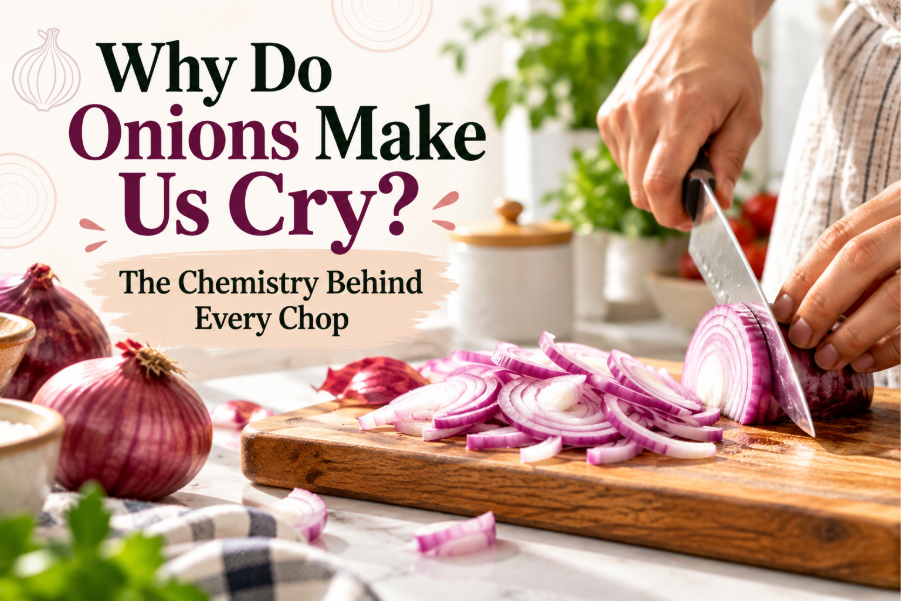
One minute, you’re preparing dinner. The next, your eyes are watering, and chopping a single onion feels like an emotional experience. But why onions make us cry has a fascinating scientific explanation. It isn’t simply their strong smell; it’s a chemical reaction that begins when we cut into them.
The Chemistry Begins When You Cut an Onion
An onion contains sulfur-containing compounds and enzymes stored within its cells. When you slice it, you damage those cells, allowing the substances to interact and trigger chemical reactions.
One result is the formation of a volatile compound called syn-propanethial-S-oxide, commonly known as the onion lachrymatory factor.
This compound travels through the air and reaches the moist surface of your eyes. There, it stimulates sensory nerves, triggering a protective response that causes your tear glands to produce more tears.
In simple terms, your eyes aren’t crying because they’re sad. They’re trying to wash away an irritant.
Why Do Some Onions Make You Cry More Than Others?
Have you noticed that some onions barely affect your eyes while others leave you reaching for a tissue?
Several factors can influence the experience:
- Onion variety: Different varieties contain different levels and combinations of sulfur compounds.
- Growing conditions: Soil and cultivation conditions can influence an onion’s chemical composition.
- Cutting technique: Crushing more cells can increase the release of irritating compounds.
- Ventilation: Poor airflow allows irritating vapours to linger around your face.
Consequently, the same chopping technique may produce different results depending on the onion and your kitchen environment.
Four Ways to Reduce Onion Tears
You don’t need to avoid onions to make cooking more comfortable. Try these simple methods.
1. Use a sharp knife. A sharp blade makes cleaner cuts and can reduce unnecessary crushing of onion tissue.
2. Chill the onion briefly. Refrigerating an onion before cutting may slow some chemical reactions and reduce irritation. However, results vary.
3. Improve ventilation. Use an extractor fan or suitable airflow to help carry irritating vapours away from your face.
4. Avoid leaning over the cutting board. Keeping your face farther away may reduce exposure to the vapours.
For additional protection, properly fitted kitchen goggles can help prevent irritating compounds from reaching your eyes.
Does Cutting Onions Underwater Help?
Water can capture some irritating compounds, but cutting onions underwater isn’t a particularly practical solution. Handling a sharp knife in water can also be dangerous.
Instead, combine a sharp knife with good ventilation. If you still experience irritation, try chilling the onion before cutting.
Why Does Onion Chemistry Matter in Cooking?
The same chemical reactions responsible for onion tears also contribute to the onion’s distinctive character.
When onions are heated, their flavour changes considerably. Raw onions can taste sharp and pungent, whereas slowly cooked onions become softer, sweeter, and more mellow.
Heat transforms their chemical composition and encourages browning reactions when suitable conditions are present.
Therefore, the onion that makes your eyes water on the chopping board can become a completely different ingredient in a curry, soup, or caramelised onion dish.
The Science Behind Every Chop
Onions demonstrate how much chemistry happens during an ordinary kitchen task. A simple cut damages cells, enzymes trigger reactions, and a volatile compound sets off your body’s protective response.
The next time your eyes start watering, remember that your onion isn’t deliberately making you cry. It’s chemistry doing its job—and your eyes responding as they should.