
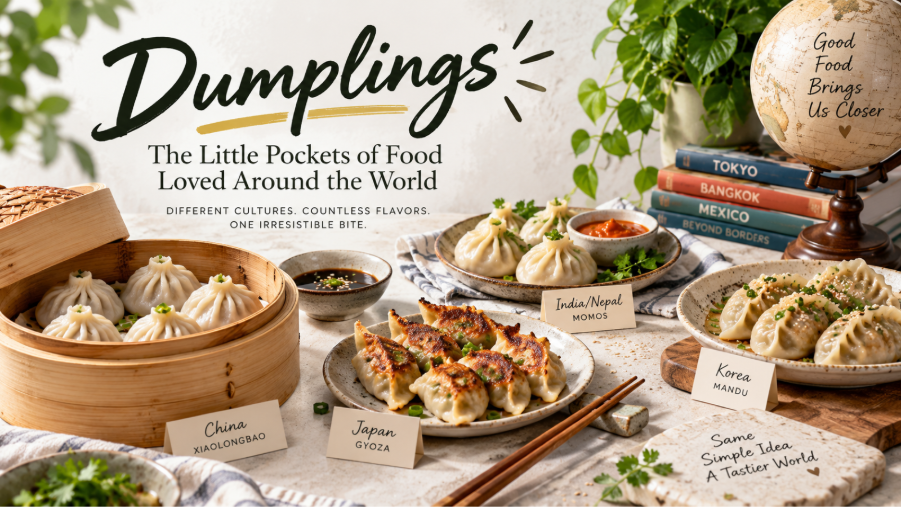
Folded, steamed, boiled, fried, stuffed, or sometimes completely unfilled, dumplings appear in an astonishing number of food cultures.
In one country, they might arrive as delicate parcels filled with pork and vegetables. Somewhere else, they may be stuffed with spiced potatoes, meat, cheese, or seafood. Some are served in soup, some alongside dipping sauces, and others become the centerpiece of a meal.
That is what makes dumplings so fascinating.
There is no single dumpling recipe. Instead, there is a simple culinary idea that countless cultures have interpreted in their own way: wrap something delicious, cook it, and turn a handful of ingredients into a satisfying little parcel.
One Idea, Many Names
The word “dumpling” covers an enormous family of foods.
Chinese jiaozi can be boiled, steamed, or pan-fried. Japanese gyoza are known for their thin wrappers and crisped bottoms. Korean mandu come in numerous shapes and fillings.
In India and the Himalayan region, momos have become enormously popular, appearing with vegetable, chicken, pork, paneer, and other fillings.
Then there are delicate xiaolongbao, filled with hot broth, and the wide world of dim sum, where steamed and fried dumplings can appear alongside many other small dishes.
They may look different, but the basic pleasure remains remarkably similar.
The Wrapper Changes Everything
A dumpling wrapper may seem like a minor detail, but it has a huge influence on the final dish.
A thin wrapper produces a delicate bite and lets the filling dominate.
A thicker wrapper creates something more substantial and chewy.
Some wrappers are made primarily from wheat flour. Others use rice flour, starches, or different grains.
The wrapper also determines how the dumpling handles cooking.
A steamed dumpling needs a wrapper that can remain tender without breaking. A pan-fried dumpling needs enough strength to survive the heat while developing a crisp base.
In other words, the outside is doing far more work than it appears.
The Art of the Fold
Dumpling-making can be surprisingly artistic.
A simple half-moon fold can be pinched closed by hand. More elaborate versions may have pleats running around the edge, creating intricate patterns.
The shape isn’t always just decoration.
Folding controls how much filling fits inside, how the dumpling cooks, and how easily it can be picked up with chopsticks or eaten by hand.
Experienced dumpling makers can produce dozens of nearly identical parcels in a remarkably short time.
That combination of repetition and precision is part of the craft.
Jiaozi: A Chinese Classic
Chinese jiaozi are among the world’s best-known dumplings.
They can be filled with combinations of meat, vegetables, aromatics, and seasonings and prepared in several ways.
Boiled jiaozi are tender and juicy. Steamed versions have a softer exterior, while pan-fried dumplings develop a golden, crispy base.
They are especially associated with family gatherings and celebrations, including Lunar New Year traditions.
Making dumplings together can turn cooking into a social activity rather than simply a task.
Gyoza Brings the Crisp
Japanese gyoza share historical connections with Chinese dumplings but have developed their own distinctive identity.
They typically feature a relatively thin wrapper and a savory filling, often built around pork, cabbage, garlic, ginger, and other aromatics.
One of their defining features is the cooking method.
Gyoza can be browned in a pan before being finished with steam, creating a contrast between a crisp underside and a tender upper portion.
That texture difference is a major part of their appeal.
Xiaolongbao: The Dumpling With a Surprise
Some dumplings are interesting because of their filling.
Xiaolongbao are interesting because of what happens when you bite into them.
These delicate soup dumplings contain flavorful broth inside the wrapper along with the filling. When properly prepared, the result is a small parcel holding an unexpectedly large amount of liquid.
Eating them requires care.
The dumpling is often lifted gently, placed into a spoon, opened carefully, and enjoyed without losing the precious broth.
It is one of those foods that turns dinner into a small culinary experience.
Momos and India’s Love for Dumplings
In India, the word “dumpling” is often closely associated with momos.
From street stalls to food courts and restaurants, momos have become one of the country’s most recognizable Asian-inspired foods.
Steamed momos are perhaps the most familiar, but fried and tandoori-style versions have also developed strong followings.
Fillings vary widely, and Indian versions often feature bold sauces and spicy chutneys that give them a character of their own.
This is a great example of how a food can travel across borders and develop a new identity.
The result doesn’t have to be identical to the original to become culturally meaningful.
Dim Sum Is Bigger Than One Dumpling
Dumplings are often associated with dim sum, but dim sum itself is a much broader dining tradition.
A dim sum meal can include steamed dumplings, buns, rolls, pastries, savory bites, and sweets served in small portions.
That small-plate format makes the meal feel exploratory.
Instead of ordering one large dish, diners can sample several different textures and flavors.
For people discovering Chinese cuisine, this variety is part of the attraction.
Steamed, Fried, or Boiled?
The cooking method can completely transform a dumpling.
Steaming keeps the wrapper tender and highlights the filling.
Boiling creates a soft, comforting texture and allows the dumpling to absorb some of the surrounding liquid.
Pan-frying adds caramelization and crunch, creating a contrast between the crisp base and juicy interior.
Deep-frying takes the idea even further, producing a crisp exterior and a richer overall bite.
The ingredients may remain similar, but the cooking method can make the dumpling feel like an entirely different food.
What Goes Inside?
Almost anything.
Pork remains a classic filling in many East Asian dumpling traditions, but beef, chicken, shrimp, fish, mushrooms, cabbage, chives, tofu, and other vegetables are widely used.
Vegetarian dumplings can be every bit as satisfying as meat-filled versions because mushrooms, fermented ingredients, aromatics, and sauces can provide plenty of depth.
There are also sweet dumplings in various culinary traditions, filled with ingredients such as red bean paste, sesame, fruit, or other sweet fillings.
The dumpling is less a fixed recipe than a format waiting to be filled.
The Dipping Sauce Changes the Experience
A dumpling can taste completely different depending on what accompanies it.
Soy sauce brings salt and umami.
Black vinegar adds acidity and depth.
Chili oil contributes heat and fragrance.
Sesame-based sauces create richness.
Fresh herbs, garlic, ginger, scallions, and other aromatics can add another layer.
This is why dumplings often arrive with several condiments.
The diner isn’t simply eating a finished dish.
They are adjusting it bite by bite.
Why Dumplings Feel So Comforting
There is something inherently comforting about food wrapped in dough.
The exterior keeps the filling warm and protected while cooking. The result is soft, chewy, juicy, or crisp depending on the method.
There is also an element of surprise.
You can see the shape, but you don’t completely know what is inside until you bite into it.
That makes dumplings both familiar and playful.
Dumplings Are Built for Sharing
Few foods encourage sharing quite as naturally as dumplings.
A plate can contain several varieties, allowing everyone at the table to try different fillings and cooking styles.
That makes them especially well suited to restaurants and gatherings.
One person might reach for a vegetable dumpling. Another chooses pork. Someone else goes straight for the chili oil.
The meal becomes interactive.
Why They Became Global
Dumplings have several qualities that make them exceptionally adaptable.
They can be inexpensive.
They can use relatively simple ingredients.
They can be prepared in large batches.
They can accommodate different fillings.
They can be steamed, boiled, fried, or baked.
And they are easy to serve in portions.
Those qualities make dumplings practical food as well as delicious food.
When culinary traditions travel, foods with this kind of flexibility have an advantage.
The Dumpling’s Global Family
Once you start looking for dumplings, you begin finding them everywhere.
From pierogi in Poland and ravioli in Italy to empanadas in parts of Latin America and manti across Central Asian and Middle Eastern cuisines, many cultures have developed their own approaches to enclosing fillings in dough.
They are not all technically the same food, and their histories are different.
But the recurring idea is fascinating.
Across distant cuisines, people repeatedly arrived at the combination of dough + filling + cooking.
It is a remarkably effective formula.
Why India Took to Them So Quickly
The popularity of dumplings in India makes sense when you look at existing food habits.
Indian cuisine already has a rich tradition of stuffed breads, filled snacks, savory pastries, and foods designed to be eaten with sauces and chutneys.
Momos fit naturally into that environment.
They are portable, customizable, easy to share, and capable of carrying strong flavors.
As a result, momos have moved well beyond their original regional associations and become a familiar part of India’s modern street-food landscape.
The Modern Dumpling
Today’s dumpling world is more experimental than ever.
Restaurants are playing with unusual fillings, colorful wrappers, vegetarian ingredients, fusion sauces, and different cooking techniques.
Social media has also helped dumplings become highly visual food.
Pleats, glossy wrappers, dramatic steam, crispy bottoms, colorful fillings, and the moment a soup dumpling releases its broth all create naturally shareable food moments.
Yet the best modern versions still depend on the same fundamentals.
Good dough.
Balanced filling.
Proper seasoning.
And careful cooking.
The Small Food With a Huge Reach
Perhaps the most remarkable thing about dumplings is how little they need to become satisfying.
A small amount of dough.
A modest filling.
A little seasoning.
Then heat.
The result can become an entire meal, a snack, a celebration food, or a restaurant specialty.
That simplicity is part of the reason dumplings have survived and evolved across generations and cultures.
A World Wrapped in Dough
Dumplings are often described as comfort food, but they are also a lesson in how food travels.
Jiaozi, gyoza, mandu, momos, xiaolongbao, and countless other varieties demonstrate how one broad culinary idea can develop different personalities in different places.
Some are delicate.
Some are fiery.
Some are crispy.
Some are impossibly juicy.
Some are designed for celebrations, while others are everyday street food.
Yet they all share the same irresistible concept: something delicious hidden inside a little pocket of dough.
And perhaps that is why dumplings have become so universally loved.
Different countries may fold them differently, but the joy of opening one is almost everywhere the same.