
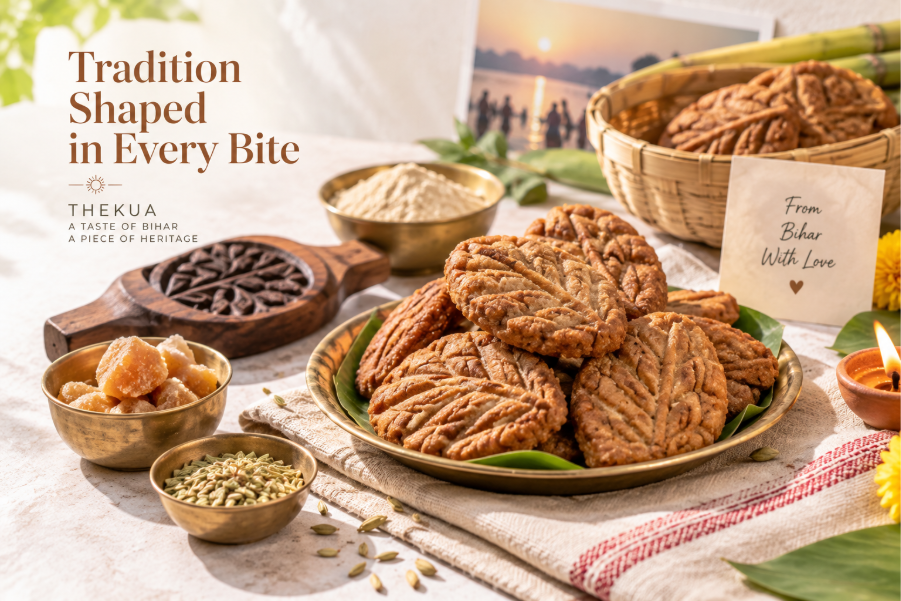
Some Indian sweets are made for celebrations. Others become celebrations themselves.Thekua belongs to the second kind.
Golden, crisp, deeply aromatic, and made with simple ingredients such as whole wheat flour, jaggery, and ghee, this traditional Bihari sweet carries far more than sweetness. For generations, Thekua has been closely associated with Chhath Puja, where it is prepared as prasad and offered with devotion. Yet beyond the festival, it has also remained a beloved homemade snack, remembered for its distinctive texture, rustic flavour, and unmistakable pressed patterns.
It is a sweet that tastes simple—but carries a story with every bite.
More Than a Sweet
At first glance, Thekua may look like a thick, rustic cookie.
There is no elaborate frosting, glossy syrup coating, or complicated decoration. Instead, its beauty comes from the ingredients themselves and the traditional way they are brought together.
Whole wheat flour forms the base. Jaggery gives it a warm caramel-like sweetness, while ghee contributes richness and helps create its characteristic texture. Fennel seeds, cardamom, and coconut are often added for fragrance and flavour.
The dough is kept firm rather than soft. Small portions are shaped and traditionally pressed against a carved wooden mould called a saancha. This creates the detailed patterns that make each Thekua instantly recognizable.
It is then deep-fried until golden brown.
The result is crisp on the outside, firm and dense inside, with the earthy sweetness of jaggery and the aroma of spices.
Thekua and the Spirit of Chhath
The strongest connection Thekua has is with Chhath Puja, one of the most important festivals celebrated in Bihar and neighbouring regions.
During Chhath, food is not simply prepared for enjoyment. It becomes part of a larger ritual of gratitude, devotion, family, and community.
Thekua is traditionally prepared as an offering and forms an important part of the prasad. Its preparation is therefore approached with care, from selecting the ingredients to shaping and frying each piece.
Thekua’s association with Chhath has helped preserve the sweet across generations. A recipe that could easily have remained a household specialty became part of a much larger cultural tradition.
And that is one reason its flavour can feel so nostalgic even to someone encountering it for the first time.
The Ingredients Are Simple—The Technique Is Not
One of the most fascinating things about Thekua is how much its final texture depends on small details.
The ingredients may be familiar, but the method matters.
Jaggery is commonly dissolved in water before being added to the flour. Ghee is rubbed into the flour to create what is traditionally known as moyan. The mixture should hold together without becoming soft or sticky.
The dough needs to remain firm.
Too much water can make the Thekua lose its characteristic density. Too little can make shaping difficult. The dough is therefore brought together gradually until it reaches the right consistency.
This is one of those traditional preparations where experience often matters as much as measurements.
A grandmother who has made Thekua for decades may not need a recipe card. She knows the dough by touch.
The Wooden Mould Makes It Special
The most recognizable feature of traditional Thekua is often its patterned surface.
A piece of dough is pressed onto a wooden mould, traditionally carved with decorative designs. The dough takes the imprint before being carefully removed and fried.
These patterns are not merely decorative.
They are part of the identity of the sweet.
The moulds themselves can become objects associated with family kitchens and festival preparation. A particular design may immediately remind someone of the Thekua made at home during childhood.
That makes every piece slightly different while still belonging to the same tradition.
Why Jaggery Gives Thekua Its Character
Sugar could make a sweet taste sweet.
Jaggery does something different.
Its deeper, caramel-like flavour gives Thekua an earthy richness that works particularly well with whole wheat flour and ghee. When fried, the jaggery contributes to the golden-brown colour and adds to the roasted character of the sweet.
Fennel provides a gentle anise-like aroma, while cardamom brings warmth. Coconut, where used, adds another layer of texture.
Nothing dominates.
Instead, the flavours build gradually.
That balance is part of what makes Thekua so different from syrup-heavy Indian sweets.
Crisp, Dense and Made to Last
The texture of Thekua is another reason it has remained popular beyond the festival kitchen.
Unlike soft sweets that need to be eaten quickly, properly prepared Thekua has a firm, crisp structure and can keep for considerably longer when stored correctly.
Historically, that made it practical as well as delicious.
It could be prepared in batches, shared with relatives, carried while travelling, or enjoyed later with tea.
The sweet therefore occupies an interesting space between festive food and everyday snack.
It is traditional enough for a sacred offering, yet comforting enough to disappear from a family snack box.
A Taste That Travels
Although Thekua is strongly associated with Bihar, its cultural footprint extends beyond one state.
It is also prepared and enjoyed in neighbouring regions, including Jharkhand and parts of eastern Uttar Pradesh, and has connections with food traditions across the border in Nepal.
Like many regional Indian foods, its identity is not defined by a single modern boundary.
Families have carried recipes with them as they moved for work, education, marriage, or other reasons. In the process, traditional foods travelled too.
That is how a food rooted in one region can gradually become familiar far beyond its original home.
From Festival Kitchen to Modern Food Culture
Thekua is also finding new ways to enter contemporary food conversations.
Traditional Indian foods are increasingly being presented not simply as nostalgic recipes, but as regional products with their own stories, techniques, and cultural value.
Thekua fits naturally into that movement.
Its ingredients are recognizable. Preparation has a strong visual identity. Its connection with Chhath gives it cultural depth. And its long-standing place in Bihari households gives it a story that cannot be recreated by simply developing a new dessert.
In 2026, that story has even reached international diplomatic circles, with Thekua being presented as a traditional Indian gift during Prime Minister Narendra Modi’s visit to Slovakia.
At the same time, entrepreneurs are turning family Thekua recipes into businesses, showing how a homemade festival food can find a new audience without completely losing its traditional character.
How Thekua Is Traditionally Made at Home
Making Thekua does not require a long list of ingredients.
A traditional version generally begins with:
- Whole wheat flour
- Jaggery
- Ghee
- Fennel seeds
- Cardamom
- Grated or dried coconut
- Water
- Oil or ghee for frying
The jaggery is dissolved in a small amount of water and allowed to cool slightly. Meanwhile, ghee is rubbed thoroughly into the flour until the mixture develops the right crumbly texture.
The aromatic ingredients are mixed in, followed by the jaggery water.
The mixture is brought together into a firm dough.
Small portions are then shaped and pressed onto a greased wooden saancha. Finally, the pieces are deep-fried over moderate heat until they develop a deep golden colour and crisp exterior.
The most important step is patience.
If the oil is too hot, the outside can brown before the centre cooks properly. A moderate temperature allows the Thekua to develop its characteristic colour and texture.
Once fried, the pieces are cooled completely before storing.
The Sweetness of Memory
Ask someone about Thekua and the answer may not begin with ingredients.
It may begin with a festival.
A courtyard filled with preparations. A family kitchen working together. The smell of jaggery and ghee. Wooden moulds being brought out. Plates being arranged before the puja. Children waiting for their share after the offering.
That is what makes traditional food so powerful.
A recipe can tell you what goes into a dish.
Memory tells you why it matters.
Thekua has survived not because it is complicated, but because it is meaningful. Its ingredients are humble, its method is traditional, and its appearance is unmistakable. Yet together they create something deeply connected to home, faith, family, and place.
Why Thekua Deserves a Wider Audience
Indian cuisine is often introduced to the world through famous dishes—biryani, butter chicken, samosas, dosas, naan, and countless others.
But regional sweets such as Thekua show another side of India’s food culture.
They reveal how food can preserve geography, ritual, craftsmanship, and family history all at once.
Thekua does not need elaborate presentation to stand out.
Its golden colour, carved patterns, jaggery-rich flavour, and unmistakable crunch tell their own story.
And perhaps that is the real charm of Thekua.
It is not simply a Bihari sweet.
It is a small piece of tradition, pressed by hand, fried in a family kitchen, offered with devotion, and passed from one generation to the next.
Every bite carries a little of where it came from.
Celebrate the festival with delicious traditional offerings! 🪔 Explore our Vinayaka Chavithi Special Food guide for authentic Naivedyam recipes to make at home.