
Walk into a restaurant in Hyderabad, Bengaluru, Chennai, Kochi, or many other Indian cities, and you may find Mandi on the menu alongside biryani and kebabs. Today, Mandi is a familiar choice for many Indian diners. However, it did not originate in India.
Mandi traces its roots to Yemen, particularly the Hadhramaut region. The dish developed around slow-cooked meat, fragrant rice, and a distinctive cooking method. This technique gives Mandi its signature tenderness and smoky flavor.
This article explores Mandi’s journey from Yemen to India, its traditional cooking method, and why it became a popular restaurant dish across the country.
What makes Mandi’s journey particularly interesting is what happened after it travelled beyond the Arabian Peninsula. It found a long-standing home in Hyderabad through the city’s Arab and Yemeni communities, especially in Barkas, and eventually moved beyond those communities into the wider restaurant scene. Today, Mandi is no longer something most Indian diners encounter only as an unfamiliar Arabian dish. It has become part of India’s modern restaurant culture, while still carrying traces of the culinary traditions from which it came.
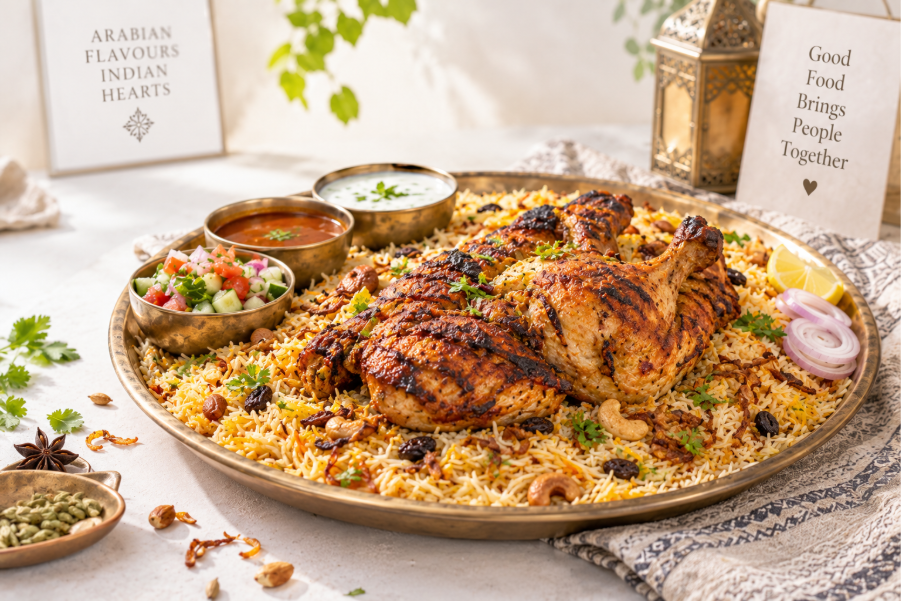
Mandi Is Not Simply Arabian Biryani
At first glance, it is understandable why people compare Mandi with biryani. Both can feature fragrant rice, tender meat and a combination of spices, and both are often served in generous portions that are perfect for sharing. However, the two dishes are built around noticeably different cooking philosophies. Biryani generally places considerable emphasis on layered spices, aromatics and masala, while traditional Mandi tends to allow the natural flavour of the meat, the aroma of the rice and the character of the cooking process to take a more prominent role.
The difference becomes especially noticeable when you taste them side by side. A good biryani can be intensely aromatic and richly spiced, with every layer contributing another burst of flavour. Mandi can feel more restrained, but that does not mean it is bland. Its flavour comes from slow cooking, meat juices, aromatic rice and smoke, creating a style of richness that does not depend on a heavy masala. This distinction is one of the reasons Mandi has found its own audience in India instead of simply becoming another variation of biryani.
The Yemeni Roots of Mandi
Mandi is traditionally associated with Hadhramaut in Yemen. It developed as a rice and meat dish prepared through slow cooking.
The traditional technique helps explain the tender meat and aromatic rice. The meat is cooked in an enclosed space, traditionally a deep pit. The rice is prepared beneath it.
As the meat cooks, its juices and fat add flavor to the rice. The cooking environment also gives the dish its smoky character.
The name Mandi is often linked to the Arabic word nada, associated with moisture. This reflects the desired tenderness of the meat.
Modern restaurants use different equipment and techniques. However, the goal remains similar: tender meat and aromatic, flavorful rice with a subtle smoky taste.
The cooking method is therefore just as important as the ingredients when understanding what makes Mandi unique.
The Smoke Is Part of the Flavour
One of the most memorable qualities of traditional Mandi is the smoky character that develops during cooking. In traditional preparations, meat is suspended inside a pit or enclosed cooking chamber above the rice, allowing the meat to cook slowly while its juices contribute to the dish below. The combination of controlled heat, rendered fat and smoke creates a flavour that is difficult to reproduce through ordinary stovetop cooking.
Restaurants in India do not always use the traditional pit method. Many rely on specialized ovens or adapted cooking equipment designed to achieve similar results at a larger commercial scale. This means that the Mandi served in an Indian restaurant may not be prepared exactly as it would be in Yemen, but the emphasis on tender meat, aromatic rice and smoky depth remains central to the experience.
How Mandi Found a Home in Hyderabad
The Indian story of Mandi becomes particularly fascinating when it reaches Hyderabad. The city has long had cultural and historical connections with the Arab world, and the Barkas neighbourhood in the Old City became associated with Yemeni and Arab communities connected with the Nizam’s military establishment. These communities brought their own traditions, languages and food culture with them, and Mandi became part of that culinary heritage.
For many years, Mandi remained closely connected with Barkas and the communities that had preserved the tradition. Gradually, however, diners from outside those communities began discovering the dish. Restaurants serving Mandi appeared in other parts of Hyderabad, making it easier for people who had never experienced the traditional dish to try it. As its popularity grew, Mandi moved from being a food associated with a particular community to becoming a restaurant favourite for a much wider audience.
That transition is an important part of the story because it shows how food often travels in unexpected ways. A dish does not always become popular because someone deliberately decides to introduce it as a trend. Sometimes it begins within a small community, becomes part of a neighbourhood’s identity and eventually attracts the curiosity of people from outside that community.
Why Hyderabad Was Ready for Mandi
Hyderabad was perhaps an especially natural place for Mandi to find an audience because the city already had a strong appetite for rice-and-meat dishes. Biryani had become deeply embedded in Hyderabad’s food identity, while kebabs and other meat-based dishes were already popular. Mandi therefore did not have to convince diners to appreciate the basic combination of rice, meat and spices. Instead, it offered a different interpretation of something people were already comfortable eating.
The contrast was appealing. Someone who enjoyed biryani could try Mandi and immediately understand its basic appeal while also noticing that it was not simply another biryani. The rice was often lighter in seasoning, the meat was exceptionally tender, and the smoky character gave the entire dish a different personality. The large portions and communal presentation made it even more suitable for the city’s dining culture.
Barkas and the Indian Mandi Story
Barkas remains an important part of understanding how Mandi developed its Indian identity. The neighbourhood’s connection with Yemen and the Arab world helped preserve culinary traditions that might otherwise have remained unfamiliar to the wider population. As restaurants began serving these foods to a broader audience, dishes that were once closely associated with the community gradually became accessible to anyone interested in trying something different.
The movement of Mandi beyond Barkas also reflects a larger pattern in Indian food culture. Regional and community-specific foods often begin in particular neighbourhoods before spreading through restaurants, social networks and changing consumer tastes. Once diners become familiar with a dish, restaurants adapt it further, making adjustments based on local preferences while retaining enough of its original character for people to recognize it.
Chicken or Mutton?
For most Indian restaurant diners, the choice often comes down to chicken Mandi or mutton Mandi. Chicken is usually the easier introduction because it is familiar, relatively light and capable of absorbing the smoky flavours of the cooking process beautifully. Mutton provides a richer experience, particularly when it has been cooked slowly enough to become exceptionally tender and deeply flavoured.
Indian restaurants have also created many variations around these basic choices. Some serve grilled chicken, while others combine Mandi rice with fried or roasted preparations. These adaptations demonstrate how quickly a travelling dish can begin responding to the expectations of its new audience. The Mandi served in India therefore exists somewhere between traditional Arabian preparation and modern Indian restaurant culture.
The Rice Matters More Than You Might Think
Rice is one of the reasons Mandi can taste dramatically different from one restaurant to another. The traditional dish is not defined simply by the use of long-grain basmati rice, although basmati has become common in many Indian versions. The type of rice, the amount of water used, the cooking time and the way the meat juices interact with it can all influence the final result.
Good Mandi rice should remain separate rather than turning into a heavy, oily mass. Each grain should carry the aroma of the cooking process without being overwhelmed by spices. When the rice is paired with tender meat and a sharp, spicy or acidic accompaniment, the result is balanced rather than monotonous.
This is another reason Mandi should not be judged simply by comparing it with biryani. The two dishes are trying to achieve different things. Biryani often celebrates layers of masala and aromatic intensity, while Mandi can make subtlety, smoke and meat tenderness the centre of the meal.
The Large Platter Is Part of the Experience
Mandi is rarely a dish that feels designed for a quiet meal eaten alone. In many restaurants, it arrives on a large communal platter covered with rice and topped with generous pieces of meat. The size of the serving immediately changes the atmosphere of the table. Instead of everyone receiving an individual plate, the food becomes something to gather around and share.
That communal style fits naturally into Indian dining culture, where large family meals and group celebrations are already important. A Mandi platter can become the centre of a table filled with friends, cousins or colleagues, with everyone reaching for the rice, meat and accompanying sauces. The food is therefore doing more than satisfying hunger; it is creating a shared experience.
The presentation also plays a role in Mandi’s modern popularity. A huge platter of fragrant rice topped with roasted meat is naturally photogenic, which has helped the dish become highly visible on social media. What may once have been an unfamiliar Arabian meal can now appear repeatedly in restaurant videos, food reviews and photographs, encouraging more people to try it.
What Usually Comes With Mandi?
Although the exact accompaniments vary between restaurants, Mandi is commonly served with fresh salads and spicy sauces that provide contrast to the fragrant rice and rich meat. Tomato-based chilli sauces are particularly common, bringing acidity and heat to a dish that is otherwise relatively gentle in its seasoning.
These accompaniments are not just decorative additions. They help balance the meal. The rice provides warmth and aroma, the meat contributes richness, and the fresh or spicy sides introduce acidity, heat and freshness. Together, they create a meal that feels much more varied than the rice-and-meat combination might suggest at first.
Why Mandi and Biryani Became Rivals
Once Mandi became popular in Indian cities, comparing it with biryani was almost unavoidable. Both occupy a similar space in restaurant culture, both are associated with generous servings and both can be ordered for groups. Yet the comparison becomes less useful when we stop asking which one is better and start asking what makes each one different.
Biryani usually has a stronger spice and masala flavor, while Mandi highlights the meat, aromatic rice, and smoky cooking process. Biryani is rich and layered, whereas Mandi is lighter and more restrained.
For many people, there is room for both. Biryani may be the dish they crave when they want something intensely spiced and indulgent, while Mandi becomes the choice when they want tender meat, fragrant rice and a more smoky experience.
From Hyderabad to Other Indian Cities
Mandi’s popularity is no longer limited to Hyderabad. Restaurants serving Arabian and Yemeni-inspired food have appeared in several Indian cities. They give diners a chance to discover Mandi in a restaurant setting. Swiggy’s 2026 Restaurant Awards also listed Mandi among its trend-led dish families, alongside pasta, Arabic cuisine, cheesecake, grills, and shawaya.
That recognition is significant because it shows how the dish has moved into mainstream restaurant culture. Mandi is no longer simply something people seek out because they already know about its Yemeni origins. For many diners, especially younger customers exploring restaurant menus, it is simply one of the familiar options available when they want a large rice-and-meat meal.
India Has a Habit of Making Food Its Own
The evolution of Mandi in India follows a pattern that can be seen across the country’s food culture. Indian diners have a long history of adopting foods from other parts of the world and adapting them to local tastes. Chinese food developed Indian restaurant interpretations, pizza acquired toppings that would be unusual in Italy, and pasta became part of everyday home cooking in many Indian households.
Mandi is now moving through the same process. Some restaurants remain closely connected to traditional Arabian methods, while others adapt the dish according to what local customers expect. The spice level may change, the rice may change, and the meat preparation may evolve, but the core idea of fragrant rice served with tender meat remains recognizable.
That doesn’t make the Indian version less interesting. In fact, adaptation is often how food traditions survive when they cross borders. A dish that never changes may remain limited to its original community, while one that can adjust to a new environment has the possibility of becoming part of another culture’s food landscape.
The Bigger Story Behind Mandi
Mandi’s journey from Yemen to India is ultimately a story about people as much as food. Recipes travel because people travel. Communities carry their cooking traditions with them, preserve them in new places. And eventually introduce them to neighbours and wider audiences.
Hyderabad’s Barkas community provides a particularly clear example of this process. What began as part of a Yemeni and Arab culinary tradition became increasingly visible outside the community and eventually entered the city’s mainstream restaurant culture. From there, Mandi continued travelling, finding new audiences and adapting to new dining habits.
Today, a diner ordering Mandi in an Indian restaurant may simply be looking for a satisfying meal with fragrant rice and tender meat. But behind that platter is a much longer journey involving migration, community, adaptation and cultural exchange.
A Dish With Two Homes
Mandi’s story in India is not really about replacing one food tradition with another. It is about what happens when a dish finds a second home.
Its Yemeni identity remains important, particularly in understanding the cooking techniques and traditions that define the original dish. At the same time, its Indian journey has created new interpretations and introduced Mandi to millions of diners who may have never encountered it otherwise.
That is what makes its rise so fascinating. Mandi did not need to become biryani to succeed in India. It found its own space by offering something different: fragrant rice, exceptionally tender meat, smoky depth, generous portions. And the pleasure of sharing a giant platter with other people.
From Hadhramaut to Barkas, and from Barkas to restaurant tables across India, Mandi has travelled a remarkable distance. The next time a steaming platter arrives at your table, it is worth looking beyond the rice and meat for a moment. What you’re eating is not just a restaurant trend.