
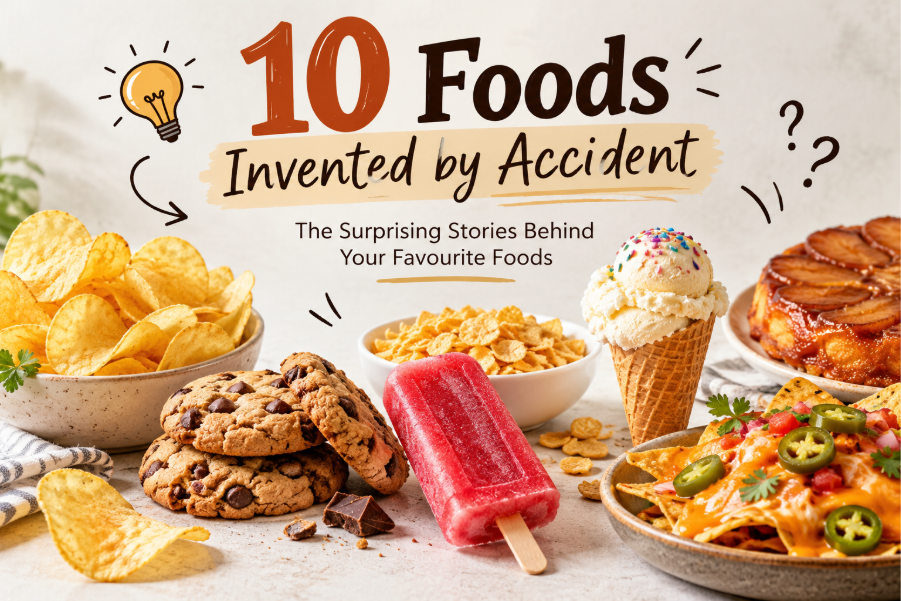
Some of the world’s most famous foods began with unexpected discoveries and kitchen experiments. These foods invented by accident include crispy potato chips, chocolate chip cookies, and other treats with surprising origin stories. Explore how these culinary accidents became beloved favorites and discover which stories are backed by history and which remain popular legends.
10 Foods Invented by Accident and the Stories Behind Them
1. The Potato Chip: A Crunchy Snack With a Legendary Origin
Origin: Saratoga Springs, New York, United States
Potato chips are often associated with an 1853 story involving chef George Crum at Moon’s Lake House in Saratoga Springs.
According to the popular account, a customer complained that the fried potatoes were too thick. Crum supposedly sliced another batch extremely thin and fried it until crisp. The customer enjoyed the result, and the potato chip was born.
It makes a great story, but the historical details are disputed. Recipes for thin fried potatoes existed before 1853, so Crum’s role in inventing the snack is not conclusively established.
What made them successful?
Their thin shape, crunchy texture, and salty flavour made them different from ordinary fried potatoes. As manufacturing and packaging improved, potato chips became a popular packaged snack worldwide.
The takeaway: A famous food story can be entertaining even when its precise origins remain uncertain.
2. Chocolate Chip Cookies: When Chocolate Changed a Classic
Origin: Massachusetts, United States
The chocolate chip cookie is closely associated with Ruth Wakefield, who ran the Toll House Inn with her husband in the 1930s.
Wakefield developed a cookie recipe featuring pieces of chocolate. The familiar story claims that she expected the chocolate to melt into the dough, only to discover that the pieces retained their shape.
Although popular accounts differ on the exact circumstances, Wakefield’s recipe played a major role in popularising chocolate chip cookies.
Why it worked
The combination of buttery dough, sweetness, and chocolate created a delicious contrast. Depending on the recipe, the cookies could be crisp around the edges and soft in the centre.
The recipe became widely known, and a commercial agreement with Nestlé helped spread it to home kitchens.
Today, chocolate chip cookies remain a classic example of how a simple recipe can become a global favourite.
3. Popsicles: A Frozen Discovery on a Cold Night
Origin: United States
The Popsicle is associated with Frank Epperson, who reportedly left a drink made with powdered soda mix and a stirring stick outside overnight in 1905.
The cold weather froze the drink around the stick, creating something resembling the frozen treats sold today.
Epperson later developed the idea commercially and received a patent for his frozen confection in 1923.
Why it became popular
Popsicles were colourful, refreshing, portable, and easy to eat. They also offered an inexpensive way to enjoy flavoured ice during warm weather.
The original story is a reminder that everyday objects can become part of an invention when someone recognises their potential.
4. Corn Flakes: How Grain Experiments Changed Breakfast
Origin: Battle Creek, Michigan, United States
Corn flakes emerged from experiments conducted by John Harvey Kellogg and his brother Will Keith Kellogg in the late 19th century.
The brothers experimented with grains while developing foods for patients at the Battle Creek Sanitarium. One frequently repeated account describes cooked grain being left to stand before being rolled, producing flakes rather than a smooth sheet of dough.
Their work eventually contributed to the development of flaked breakfast cereals. However, the history involved several experiments, so it is misleading to attribute the entire invention to one simple accident.
Will Keith Kellogg later established a cereal business in 1906, helping popularise corn flakes as a convenient breakfast food.
Why it changed breakfast
Corn flakes were easy to prepare, stored well when packaged properly, and could be served with milk. They helped make ready-to-eat cereal a familiar part of modern breakfast culture.
5. The Ice Cream Cone: An Edible Solution
Origin: United States
One popular story connects the modern ice cream cone to the 1904 World’s Fair in St. Louis, Missouri.
According to the account, an ice cream vendor ran out of serving dishes. A nearby waffle vendor supposedly rolled a thin waffle into a cone so that the ice cream could be served without a bowl.
The story is widely repeated, but the history is more complicated. Evidence of edible cones and similar serving methods existed before the fair.
Why it became popular
The cone made ice cream portable and convenient. People could enjoy their dessert while walking without carrying a separate dish.
Modern cones come in different varieties, including wafer, sugar, and waffle cones. Each offers a slightly different flavour and texture.
The ice cream cone shows how a practical serving solution can become an essential part of the food experience.
6. Tarte Tatin: A French Dessert With a Twist
Origin: Lamotte-Beuvron, France
Tarte Tatin is a traditional French upside-down apple tart associated with sisters Stéphanie and Caroline Tatin.
According to culinary legend, Stéphanie accidentally overcooked apples while preparing a tart. Rather than discard them, she reportedly covered the apples with pastry and finished baking the dessert before turning it upside down to serve.
The exact circumstances are uncertain, but the sisters helped popularise the dessert.
What makes it special?
The apples cook in butter and sugar, developing a rich caramel flavour. The pastry provides a crisp contrast to the soft fruit.
Unlike an ordinary apple tart, the apples are cooked beneath the pastry and become the centrepiece when the dessert is inverted.
Today, tarte Tatin is served in restaurants around the world, often with cream or ice cream.
7. Worcestershire Sauce: From Experimental Mixture to Kitchen Essential
Origin: Worcester, England
Worcestershire sauce was developed in the 19th century by chemists John Wheeley Lea and William Henry Perrins.
The familiar origin story says they prepared a sauce based on a recipe associated with a former colonial administrator. The initial mixture reportedly tasted unpleasant, so it was stored away. After ageing and fermentation, it developed a more appealing flavour.
Although this story is widely repeated, the sauce’s development involved experimentation, and some details of its origin remain uncertain.
Why cooks still use it
The sauce combines savoury, tangy, sweet, and fermented flavours. A small amount can add complexity to marinades, gravies, dressings, and soups.
Its development also illustrates an important principle in food science: fermentation and ageing can transform the flavour of ingredients over time.
A useful kitchen tip: Add Worcestershire sauce gradually when cooking. Its flavour is concentrated, so a small quantity can make a noticeable difference.
8. Nachos: A Quick Snack That Became a Global Favourite
Origin: Piedras Negras, Mexico
Nachos have one of the better-documented stories on this list.
In 1943, Ignacio Anaya reportedly prepared a quick snack for a group of visitors at a restaurant in Piedras Negras, near the United States border. The usual cook was unavailable, so Anaya improvised with ingredients he had on hand.
He combined tortilla chips with melted cheese and sliced jalapeños. The visitors enjoyed the dish, which became associated with his nickname, Nacho.
How nachos evolved
The original preparation was relatively simple. Modern versions can include beans, salsa, vegetables, meat, guacamole, and different cheeses.
Nachos spread internationally because they are easy to share and can be adapted to different tastes.
The story also shows that improvisation does not always involve a mistake. Sometimes, making the best of a situation is enough to create something memorable.
9. Champagne: When Bubbles Became a Luxury
Origin: Champagne, France
Champagne’s history is often simplified into a story about wine that accidentally developed bubbles during fermentation.
In reality, sparkling wine production developed over time. Secondary fermentation created carbonation, but early winemakers struggled to control the process. Pressure inside bottles could cause them to break, making the bubbles a technical challenge rather than an immediate triumph.
Winemakers gradually improved their methods, helping sparkling wines become more reliable and desirable.
How it became famous
Champagne eventually became associated with celebrations, luxury, and special occasions. Its reputation grew through improvements in production, trade, and marketing.
One important distinction is that Champagne is not simply any sparkling wine. The name is protected for qualifying wines produced in the Champagne region of France.
This example demonstrates how an unexpected chemical process can become the foundation of a carefully developed culinary tradition.
10. The Oreo: A Deliberate Invention With an Interesting History
Origin: United States
Oreo cookies were introduced by the National Biscuit Company, now known as Nabisco, in 1912.
Unlike some entries on this list, the Oreo is not known to have originated through an accidental discovery. It was a commercial product developed during a period when biscuit makers were experimenting with sandwich cookies.
Oreo’s design paired two chocolate-flavoured biscuits with a sweet cream filling. The combination was simple, recognisable, and easy to adapt into other desserts.
Why it became iconic
The contrast between the biscuits and the filling made Oreo a distinctive product. Its versatility also helped it find a place in milkshakes, cheesecakes, ice cream, and homemade desserts.
Its inclusion here offers an important lesson: food histories often become simplified over time. A fascinating origin story does not always mean a genuine accident took place.
What These Food Stories Teach Us About Culinary Creativity
The history of food is rarely as simple as a single mistake leading to instant success. Some discoveries happened unexpectedly, while others emerged through experimentation, practical problem-solving, and years of refinement.
These stories reveal three important patterns.
First, experimentation matters. The development of corn flakes and other foods demonstrates how testing different ingredients and techniques can lead to new products.
Second, practical problems can inspire creativity. The story of nachos illustrates how working with available ingredients can produce something memorable.
Finally, popular food stories deserve scrutiny. The potato chip and ice cream cone legends show why it is important to distinguish traditional accounts from documented history.
The most interesting food discoveries often combine creativity with persistence. An unusual result might spark an idea, but turning it into a lasting favourite usually requires further development.
Beyond Accidents: How Food Innovations Really Happen
Not every culinary breakthrough begins with a mistake. Some come from chefs experimenting with flavours, communities adapting recipes to local ingredients, or manufacturers developing new preparation methods.
Consider how many familiar foods have evolved. Pizza has developed countless regional variations. Chocolate has become the basis for an enormous range of desserts. Traditional preservation methods have helped communities store food for generations.
Food is constantly changing because people experiment with ingredients, learn from one another, and adapt their cooking to new circumstances.
That is what makes culinary history so fascinating: behind every popular dish is a story about the people, techniques, and cultures that helped bring it to life.
Conclusion
From potato chips and chocolate chip cookies to nachos and corn flakes, the stories behind famous foods reveal the creativity that shapes our eating habits.
Some originated through unexpected discoveries, others through deliberate experimentation, and several have acquired legends that are difficult to verify.
The next time you enjoy a favourite snack, consider how it became popular. Its history might be just as interesting as its flavour.